Best Of
Re: Why is triangle used instead of Quad?
To add to what's already been said and hopefully clarify a few things: there's a number of different reasons why an artist would choose to use a triangle instead of a quad when creating an arch. The relevance of any specific answer really depends on the model's intended use and the desired outcome for the project. Looking at those two images, it's not entirely clear whether this model is just a block out or a final low poly.
If it's a block out then it's possible that the triangles provide some additional edges that are required for subsequent modeling operations. Quad corners work well for most linear edge transitions and some types of curved intersections but they can also disrupt the curvature of adjacent edge loops. N-gon corners produce a similar effect.
While it can be beneficial to model with quads and n-gons, triangles can also be useful for pulling support loops inwards along a curve. Below is an example of how quad and n-gon corners can create subtle smoothing artifacts near curved surfaces. Converting these corner faces to triangles produces edge tension that can help reduce the visibility of smoothing artifacts near surfaces that transition from flat to curved.

If it's a low poly model then the mesh may need to be triangulated in certain areas to make seam placement and UV unwrapping easier. While most applications can display quads and n-gons, there are a variety of different triangulation methods and there's no guarantee that the order of the underlying edges and faces will be the same in every application. Which is why it's generally considered best practice to triangulate the final low poly model before exporting for baking and texturing. This will ensure that the model's geometry and smoothing behavior is consistent as it moves through the production pipeline.
Here's an example of just how varied the triangulation methods can be when moving the same mesh between two different applications. This sort of geometry miss match isn't a deal breaker for most simple modeling operations or basic material authoring but it can cause significant issues when working with tangent space normal textures.

Severe gradation in the normal map is often caused by the differences between the shading behavior of the high poly and low poly surfaces. This additional color information is specific to the state of the meshes during the bake. Alterations to the order of the low poly mesh will tend to produce normal artifacts, unless the difference between the shading behavior and baked normal information is resolved.
Which is why normal bakes from meshes without any smoothing splits tend to be sensitive to triangulation changes. The example below shows how the direction and intensity of the normal values changes, based on the low poly's shading splits and edge order.

While it possible to find workarounds for actively controlling mesh triangulation and using smoothing groups, these types of "Never fail, quick and easy!" solutions tend to ignore the fundamentals of established, current generation workflows. Granted there are some situations where it may be beneficial or necessary to use single smoothing groups or add support loops to the low poly or rely heavily on normal data transfers but a lot of the application specific workarounds tend to fall apart when working with a team that uses a wide variety of tools and regularly moves models between applications.
Creating a low poly model with consistent shading behavior goes a long ways towards making tangent space normal bakes a one or two shot deal. Adding smoothing groups is large part of that but controlling mesh triangulation is another important element in the optimization process. A lot of current, industry standard applications use MikkTSpace. Which makes it relatively easy to create assets in a synced tangent workflow. Yes, there are edge cases but that really isn't a good excuse for actively avoiding contemporary tools and workflows for content destine for popular engines like UE or Unity.
While this following example is far from best practice, it does demonstrate that using smoothing splits, in conjunction with a synced normal workflow, is fairly robust when it comes to accidental or unintentional changes in the triangulation after baking. All of the meshes have the same hard edges and only use the texture baked from the quad / n-gon low poly. Much less impressive when considering that the application automatically triangulated the low poly during the baking process but still a reasonable demonstration of how important it is to control the shading behavior with smoothing splits.

As shown below, when using a single smoothing group, even quad geometry doesn't guarantee that the triangulation order won't affect the surface shading and normal data. Using hard edges [smoothing groups] with a synced normal workflow tends to produce clean bakes that can be more resilient but curved surfaces and single smoothing group workflows tend to be more sensitive towards changes to the edge and face order after baking.

Another thing to consider about triangulation order is that the placement of the edges can skew surface details. Which, though it's often quite subtle, can have a negative impact on the overall quality of the bakes. In the example below, the diagonal surface elements have a slight distortion wherever a low poly edge crossed over a change in the high poly's surface.
While it may be possible to resolve some of these issues with a skew map or custom low poly cage, it's worth noting that the low poly that has a triangulation order with similar diagonal edges does have less overall distortion. Simple stuff like this can help avoid unnecessary complexity and extra work that comes with trying to resolve visible baking errors that are caused by letting the software choose the triangulation method on critical areas.

In a workflow with synced tangent space and smoothing splits, edge triangulation in low value areas can be largely ignored, provided it remains consistent during the baking, texturing and importing. However, it is worth running some quick test bakes to evaluate how the current low poly triangulation is affecting areas that are right in-front of the player.
The mesh used to demonstrate these principles is fairly simple, so the issues are quite subtle but carelessness towards these sort of things tends to compound in a way that produces a lot of small errors that bring down the overall quality of a project. Often with no tradeoff for a tangible benefit. Below is a short animation that compares a few different triangulation methods and better highlights how these changes impact the details baked into the normal texture.

There's a lot of great resources on these topics here on polycount and on the help pages of the various texturing applications. Here's a few links that are a good jumping off point for additional self guided learning:
https://polycount.com/discussion/41232/lowpoly-or-the-optimisation-appreciation-organisation
https://polycount.com/discussion/163872/long-running-technical-talk-threads
https://www.youtube.com/watch?v=ciXTyOOnBZQ
https://marmoset.co/posts/toolbag-baking-tutorial/
https://substance3d.adobe.com/documentation/spdoc/baking-109608997.html
 FrankPolygon


Re: The Bi-Monthly Environment Art Challenge | September - October (80)
It's looking great @Fabi_G! Is it the final version or still WIP? I think the bottom could use some more breakdown of the shape like you did in the overpaint.
Then I have a question for both you and @creepyhooman. What's your texturing workflow? Substance painter or photoshop?
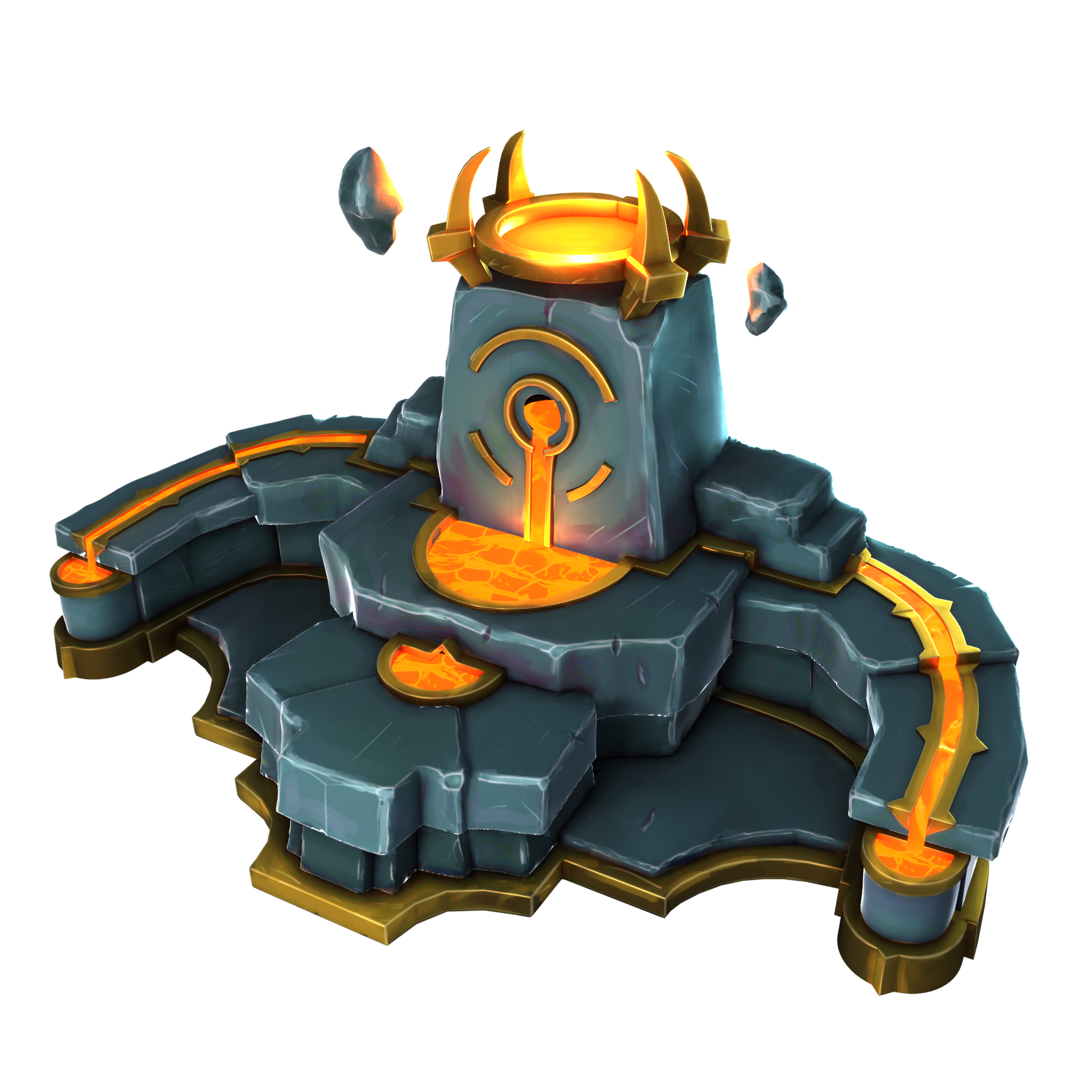
I continued my prop, sculpting it again to give it more damages and better edges. I think I will move on to texturing for now. After some research I decided to try the camera projected workflow to get a handpainted look.
 Esselle
Re: The Bi-Monthly Environment Art Challenge | September - October (80)
@Esselle Many thanks for the feedback 👍️ I would call it done for the most part, but I'm sure I will give it another pass before the end of the challenge. Nice progress on your side too. I think adding some gradients and color variation based on planes, as well as some tweaks to color and saturation would push it further:

About texturing process: Currently using a lot of Painter, plus some blender and photoshop for hand-painted textures. When the model has reached a certain state, I like to build a layer stack in Painter, mixing/modulating surface layers with object maps, then continue iterating the mesh and reimport. Probably also good to check the result in engine sooner than later to avoid a surprise 😅 Once the model close to being finished, there is adding some touches by hand.
 Fabi_G
3dsMax 2023.2
More videos here
What's new list.
Some goodies :)
https://www.youtube.com/watch?v=kzcAlF44KIo
gandhics
Re: The Bi-Monthly Environment Art Challenge | September - October (80)
Here's my trimsheet, but it's not yet finished.

I would say that the blockout is top notch, try going for with the chest or the statues.
About the sharp thingies, I guess I'll have to smooth the edges a bit more and add a bit more supporting edge loops. I'll be going for the more generic "substance painter style" stylized look.
The process for the egg statues explained with a picture. I made a simple (AAA class ;d) alpha from the concept, projected it on a egg shape so I could get basic form, sculpting, few times exported wip egg to the Unreal to get the feel if the shapes are working, and then at the end I eliminated the wobbly surface with booleans.
 creepyhooman
Tom Hardy, Game-Ready
https://www.artstation.com/artwork/B34gJ9


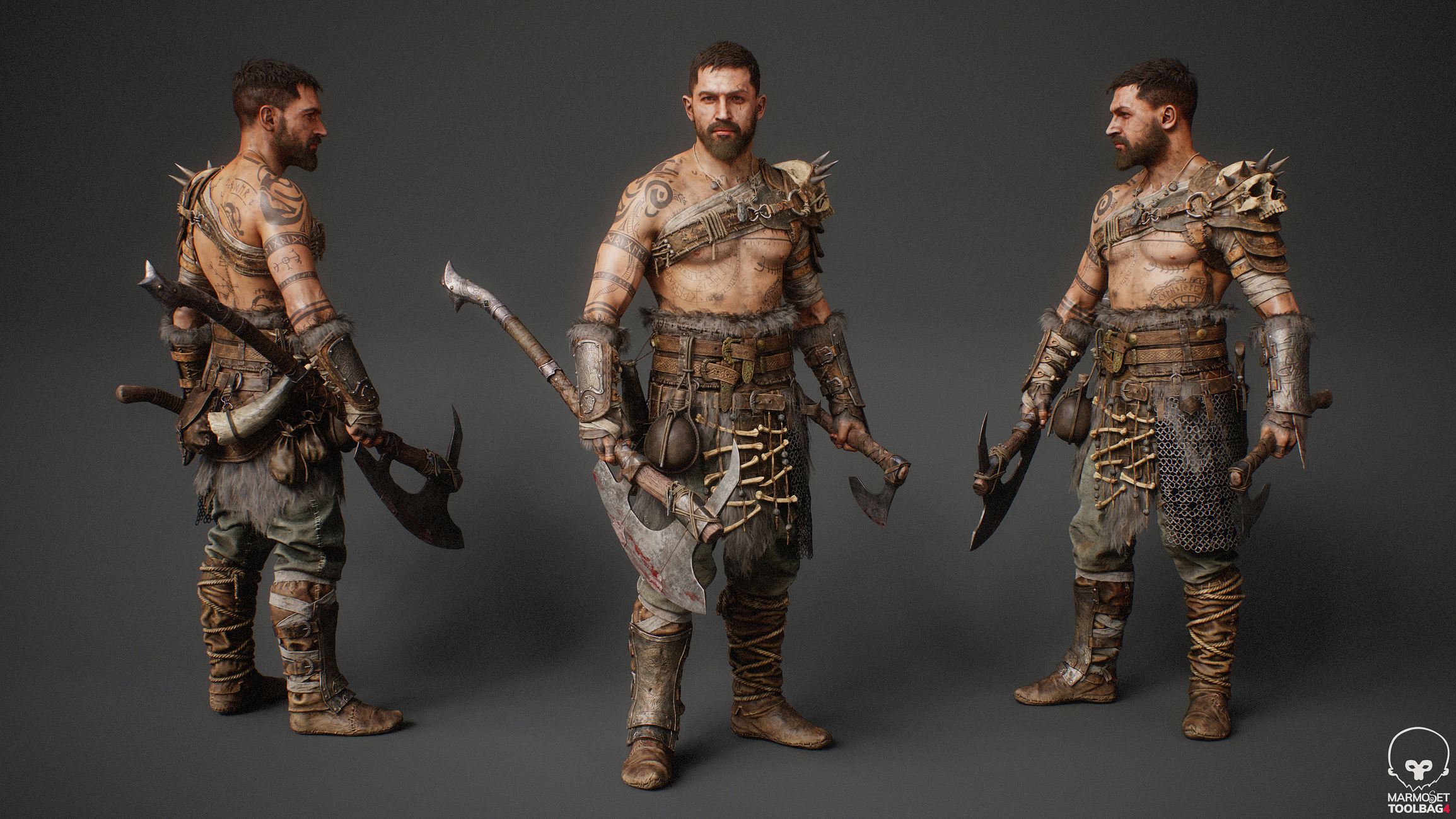


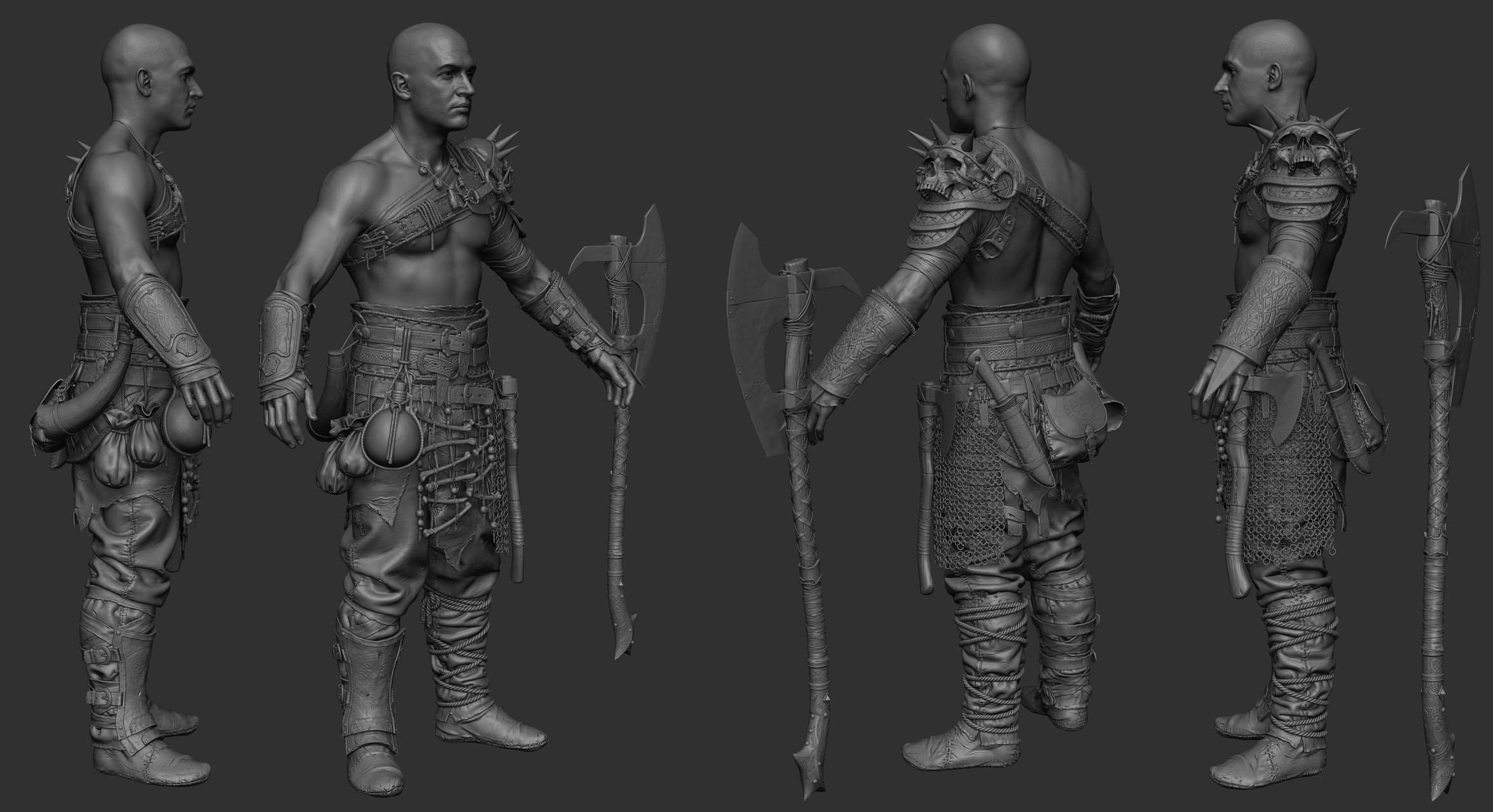


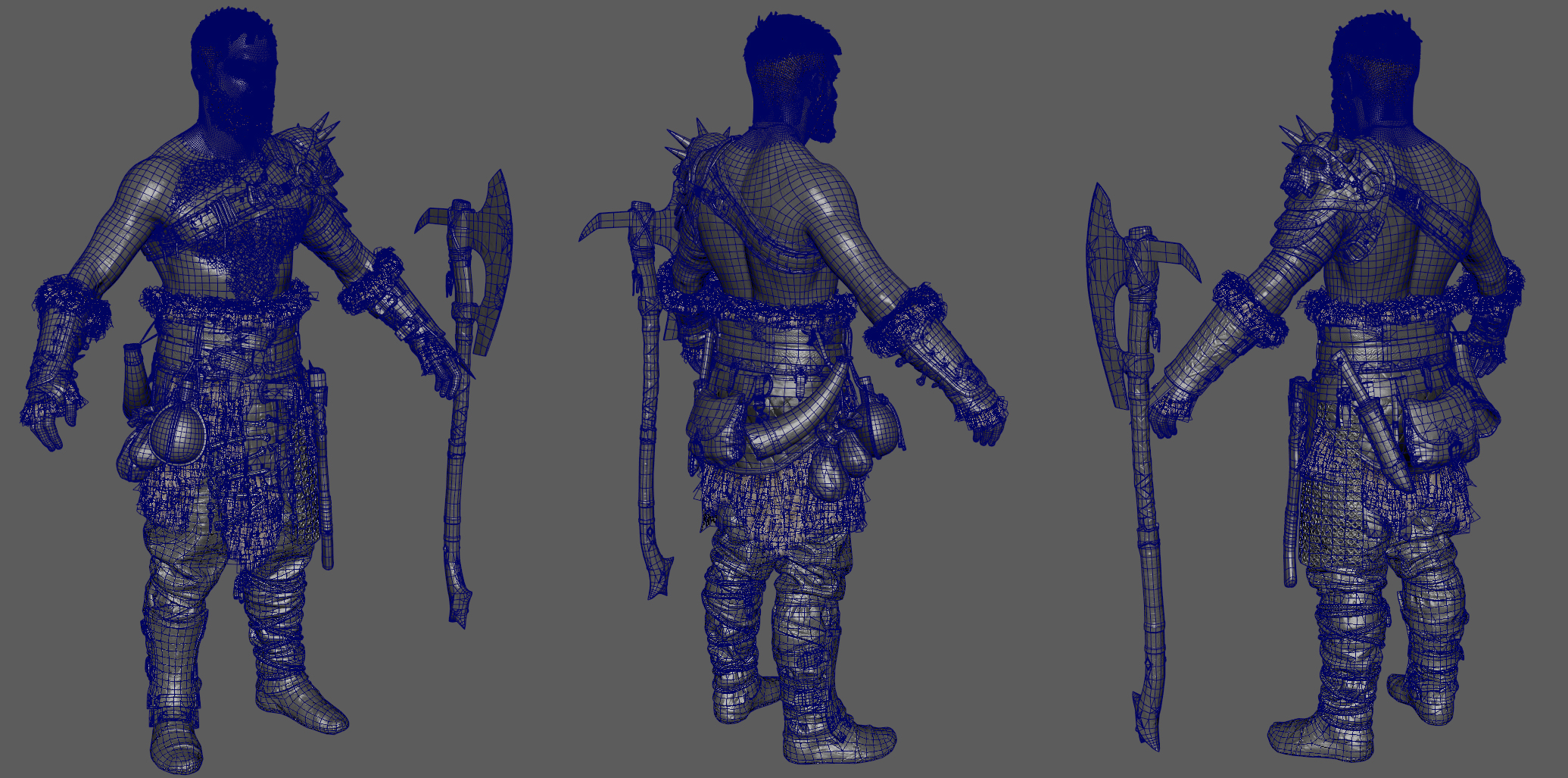
Game-Ready, Tom Hardy character, portraying a Viking of my own design - which is always how I see him (that or as Bane!)
Heavily inspired by his James Delaney look on Taboo as well as everything Viking related (God of War, Vikings Tv Series, etc).
- Everything sculpted in Zbrush from scratch;
- Maya for additional polymodeling (some armor parts, belts, etc);
- Marvelous for clothing (including straps) - with additional sculpting;
- Retopo using Topogun 3;
- UVs with Ryzom UV;
- Ornatrix for 3dsMax to generate the fur/hair for the fur/hair cards.
- Cards placement in Maya with the amazing GSCurve Tool.
- Fully baked and textured in Marmoset Toolbag 4 (additional use of substance on some other parts because marmoset doesn't support udims);
- Rigged and posed inside Maya
- Rendered in Marmoset Toolbag 4.
12 Texture sets in total
- Head; Torso; UpBody; MidBody; LowBody; Accessories; Main Weapon; Hair (including chest hair); Hair Cap; Fur; Eyes and Mouth
Total tris count is close to 200k. Optimized and game-ready.
I'll be making a separate post on UE5 since that was whole different battle in and of itself!
Thank you for watching!
 RaulTavares
Re: The Bi-Monthly Environment Art Challenge | September - October (80)
Hey, nice progress 👍️
I continued with the clock. I will deviate from the design in the concept (from what I interpreted) and break up silhouette more:
 Fabi_G
Re: SLIGHTLY Autistic ARTIST, worried about work place politics!?
Game development work attracts a certain kind of person - if you are attracted to it, does it not make sense that the other people who are attracted to it share a similar mindset?
My experience has been that most people are there cos they enjoy their work - that's enough to keep a lid on most petty rivalries.
I sort of agree with Alex. a smaller studio can be a place where people are more accountable and dependable but its far from a guarantee. The less people there are, the more influence and control an individual can exert - when you have an arsehole with influence, everyone suffers.
Everywhere is different, nowhere is perfect, very few places are actually horrible.
One thing to bear in mind is that you can always vote with your feet. You got one job - that means you can get another one if you don't like the one you have.
poopipe
Re: The Bi-Monthly Environment Art Challenge | September - October (80)
I've also picked this one and here's the blockout.

I've found some resources for the falling sand (for UE);
and this one
creepyhooman