

Best Of
Re: Sketchbook: Frank Polygon
@orangesky Thanks for the comment. Glad the write-ups have been enjoyable and informative.
The short answer is: it depends. Context is really important because, even from a broad perspective, there's some significant differences between organic and hard surface modeling. While there's definitely some overlap in the fundamentals of subdivision modeling, these two broad fields are still completely different disciplines. Each with specific sub-focuses that require somewhat unique skill sets. What's acceptable in one instance may not be ideal for another.
It's the same sort of situation when it comes to 3D modeling for different types of media. E.g. animation, game, VFX, and visualization projects all tend to have specific technical requirements. The various studios that specialize in each of these fields will generally have their own preferred workflow(s) and best practices. Which are sometimes made public through articles, discussions, documentation, interviews, presentations, etc.
Information that references sources with firsthand experience is probably more accurate than personal opinion. As an example: use cases for triangles and n-gons are discussed in documentation for OpenSubdiv and booleans are also mentioned in other user docs and articles about artists that have worked on feature length animations at the company in question.
In general though, most technical elements are relatively easy to measure. That's probably why it's tempting to try distilling creative processes down into a set of fixed rules. While this sort of approach can work well enough when just learning the basics. It also tends to restrict problem solving by oversimplifying things and optimizing for binary decision making. Which generally produces less than optimal results when dealing complex problems over a longer period of time and contributes to the perpetuation of technical dogma.
Just in game art alone, the relatively short evolutionary period of the design tools has already seen several inflection points where established workflows have changed suddenly and artists that were unwilling to at least entertain the idea of doing things differently were completely left behind.
The switch to PBR texturing workflows and the subsequent rise of dedicated texturing applications is one fairly recent example. Another, which is adjacent to the earlier shift towards sculpting organics, is the rapid evolution of the boolean re-meshing workflow that's now seeing 3D DCC's being replaced with CAD applications. Parametric modeling is accurate and relatively fast. Two things that, arguably, old school, grid based subdivision modeling is not.
These kinds of rapid paradigm shifts are often focused on moving to processes that offer significant improvements in efficiency and visual fidelity. Something that a lot of the older workflows just can't compete against. That's not to say that elements of these older workflows aren't still relevant. It's just that the weaknesses now outweigh the strengths. Traditional subdivision modeling is no exception to this. Especially when it comes to hard surface content.
Booleans, modifiers and n-gons speed up different parts of the modeling process but it's important to remember that they're just intermediate steps and aren't the entire workflow. When combined with effective block outs and segment matching strategies, the n-gons in a base mesh can be resolved to all quads if required. So all quad geometry isn't necessarily exclusive to slower, traditional modeling methods like box, point inflation, edge extrusion or strip modeling.
The takeaway from all this is that the technical elements should be chosen to serve the creative elements that further the story. Not the reverse. Part of improving as an artist is learning to work within resource constraints to creatively solve aesthetic and communication problems while maintaining a cohesive narrative. Which admittedly does require technical understanding. It's just that understanding has to be tempered with other creative skills that might be neglected during these types of discussions.
Sometimes it's helpful to look at the technical elements of a workflow with a more pragmatic lens. Focusing less on tradition and more on comparing the cost of the inputs [time, emotional capital, etc.] to the value generated. Exploring different workflows also provides some needed contrast that helps identify weaknesses in current workflows. It's that sort of iteration and reflection that moves things forwards.
Polycount's career and education section is also a great resource for learning about what's expected from artists working in a specific field and is probably a better venue for discussing building a portfolio to land an animation, VFX or film job. Definitely worth the time to read through the advice offered there by other experienced artists that have worked on similar projects.
 FrankPolygon
7 ·
Re: What Are You Working On? (3D) 2022

Just finished my personal project JagdKommando Knife.
enjoyed working on it.
SatpreetSingh04
3 ·
Re: What Are You Working On? (3D) 2022
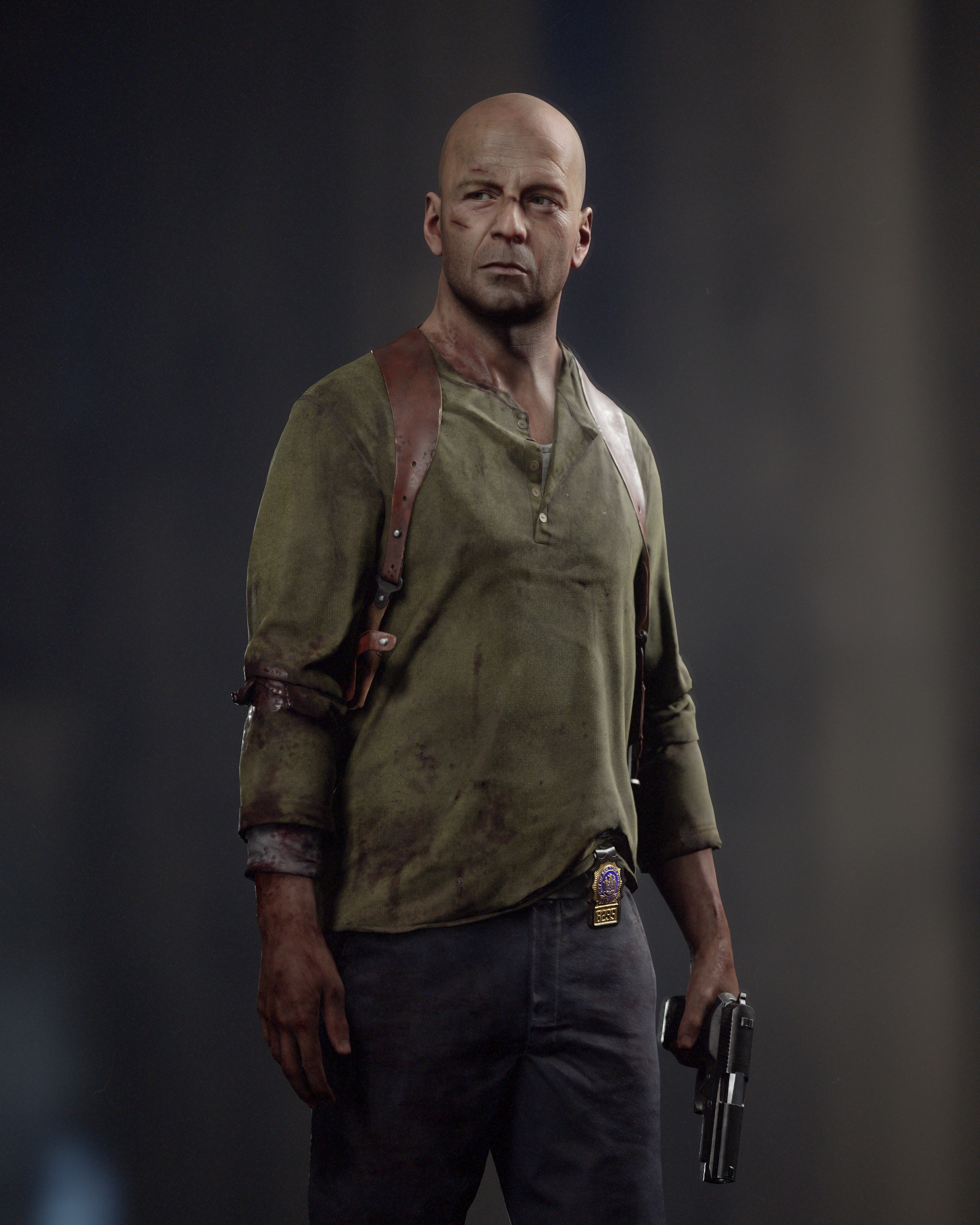
Shameless crosspost https://polycount.com/discussion/231802/john-mcclane-real-time-character/p1
I've been working on this character for quite some time in between jobs, mentorship and other personal projects, but now it's finally done.
Here's my take on Bruce Willis as John McClane in Die Hard 4(Live free or die hard). Thank you all who've been supportive on stream while I've worked on this and let's move on to a new one.
As usual textured and rendered in Marmoset Toolbag.
The whole process was streamed on Twitch and will be available on my Patreon
https://www.twitch.tv/nimlot26
https://www.patreon.com/nimlot
More images and videos here: https://www.artstation.com/artwork/QnvKzB
Cheers!
 nimlot26
6 ·
Re: How The F*#% Do I Model This? - Reply for help with specific shapes - (Post attempt before asking)
@hututuzhang The distortion is caused by reducing the loops instead of carrying them across the shape.
While it is generally possible to manually compensate for this type of shape distortion, some broader context is also required. Catmull-Clark subdivision smooths by averaging the existing vertices. This recursive smoothing tends to be visually appealing but can also reduce the accuracy of the shape once it's been smoothed.
If a high level of accuracy is required then the starting geometry of a subdivision model will generally need to be quite dense. Which can be difficult to work with when using poly modeling tools. This is why it's generally easier and more efficient to work with parametric modeling tools, like NURBs or other surfacing tools in CAD applications, for these kinds of tasks.
Most game and VFX models don't require this high level of surface accuracy and the relatively minor accuracy issues inherent to subdivision modeling are generally acceptable. Softer shape transitions aren't necessarily a bad thing either. Sharp corners that are exposed tend to be knocked down or chipped off during general use. Since the shape distortion in this example is constrained to a very small section at the top of the bore and is relatively subtle, it's actually a fair representation of a visually realistic surface.
The example below shows how this type of subtle deformation is generally constrained to the area between the two support loops. An easy way to resolve this unintended shape deformation is to move or scale the corner vertex outwards. Which will compensate for the smoothing stress that's pulling it backwards. Keep as many of the existing surfaces co-planar as possible when making these kinds of manual adjustments. This will help prevent creating any additional smoothing artifacts.

Most models won't be viewed from strictly isometric viewpoints either. Which is why it's important to consider the player's average view distance when making decisions about the width of support loops and whether or not minor smoothing inaccuracies are worth resolving. The flip side to all of this is that once the edge sharpness drops below a certain size, relative to the overall scale of the model, subdivision modeling starts to make less technical sense.
The example below shows how narrower support loops concentrate the additional geometry in a smaller area. Requiring more work to resolve the shape inconsistencies caused by disrupting the segment spacing of the intersecting cylinder and potentially introducing other types of shading artifacts.
If this level of deformation is unacceptable, especially with this tight of an edge highlight, it may make sense to increase the amount of geometry in the base shapes or if surface accuracy is more important than visual readability then it may make sense to look at alternate modeling workflows that don't smooth the shapes by averaging the existing vertices.
 FrankPolygon
5 ·
Re: Airbørn
THis took a tiny bit longer than expected... as usual hehe
well it's post gamescom isnt it?
https://www.artstation.com/airbornstudios/albums/6869014
artstation just released our art blast, where you can find tons of highres images and some making of material.
if you have any questions, just shoot! :)
Unlike most of our projects, here we can break down anything, and are willing to do so!
 Neox
Neox
4 ·
Re: Airbørn
the fuzz was something we experimented quite a bit with. while i am not perfectly happy with what we have in the end, i am pretty happy overall.
we thought about doing it similar to how we did fur on crash bandicoot. with planes placed by hand, transferring normals and UVs. but with that you usually have these weird spots where you can look flat on the plane, which i didnt wanna have here. you can do the best job in the world placing these, but you will always have these moments where the illusion breaks, no matter how much time has been spent
like here on the chest of crash:

So i thought it would be nicer to have this done with particles. It was a bit tricky to set up the shaders but @katzeimsack found the solution for it.
So what we do is spawn 3 different particles on the mesh, based on a RGB mask that tells the particle system "spawn particle A here, B here and C there"

I used to paint these masks but turned out, some randomized camo patterns work just as well.
then we grab the normals, roughness, metalness etc from the mesh it spawns on and apply this to the particle


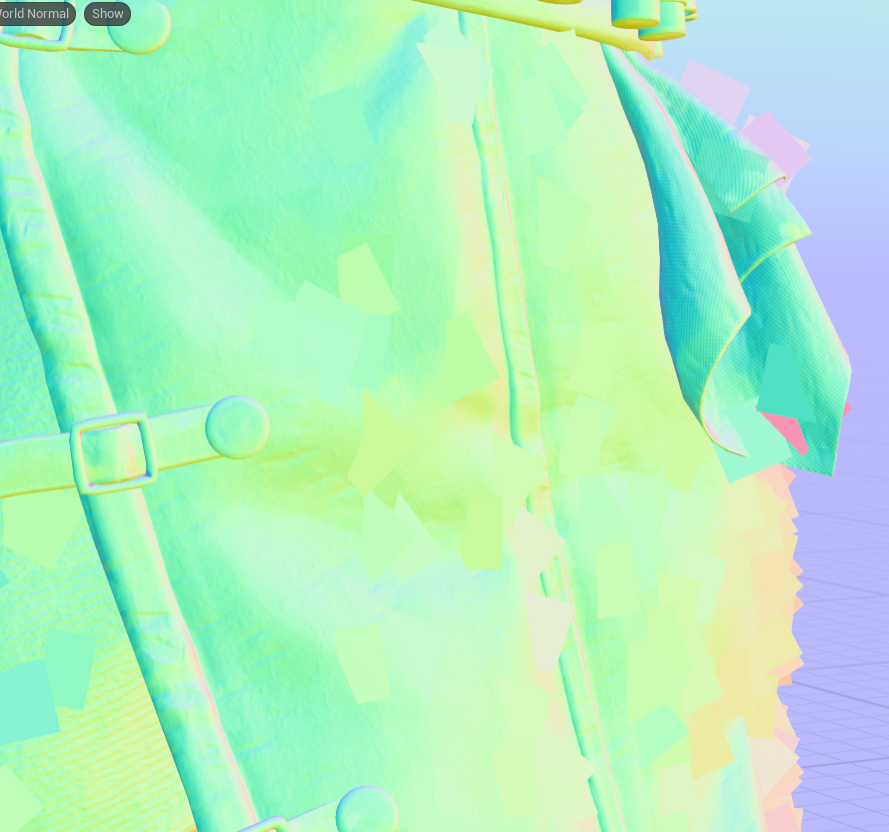
blend them into the mesh using dithered pixel depth offset (like the moss above)

after that we apply one of the 3 different alphas to the particle UVs, randomize rotation and scale within some boundaries and

the result is this:
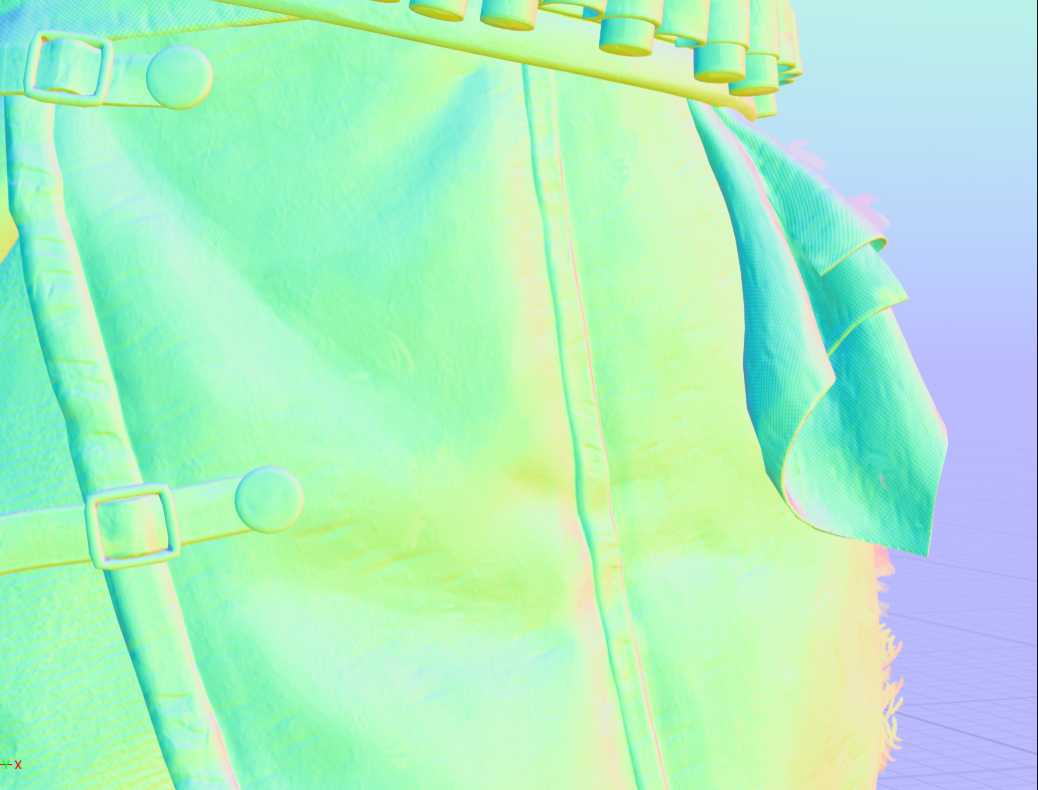

the downside is, the particles are spawned at random locations. An alternative would be placing them by hand in your dcc like the fur but orienting them to the camera like the particles in unreal. so we have perfect control over placement. but yeah, lot of manual work for that :)

for the future i would limit the random rotation as well so we do not have occasions like above where a shape floats on top. but it was good enough and we are never thaaaat close.
Neox
22 ·
Re: How would you land your first 3D job TODAY?
Tbh.
Make avatars for pay for VChat and VTubers

Re: The Bi-Monthly Environment Art Challenge | November - December (81)
Hello everyone,
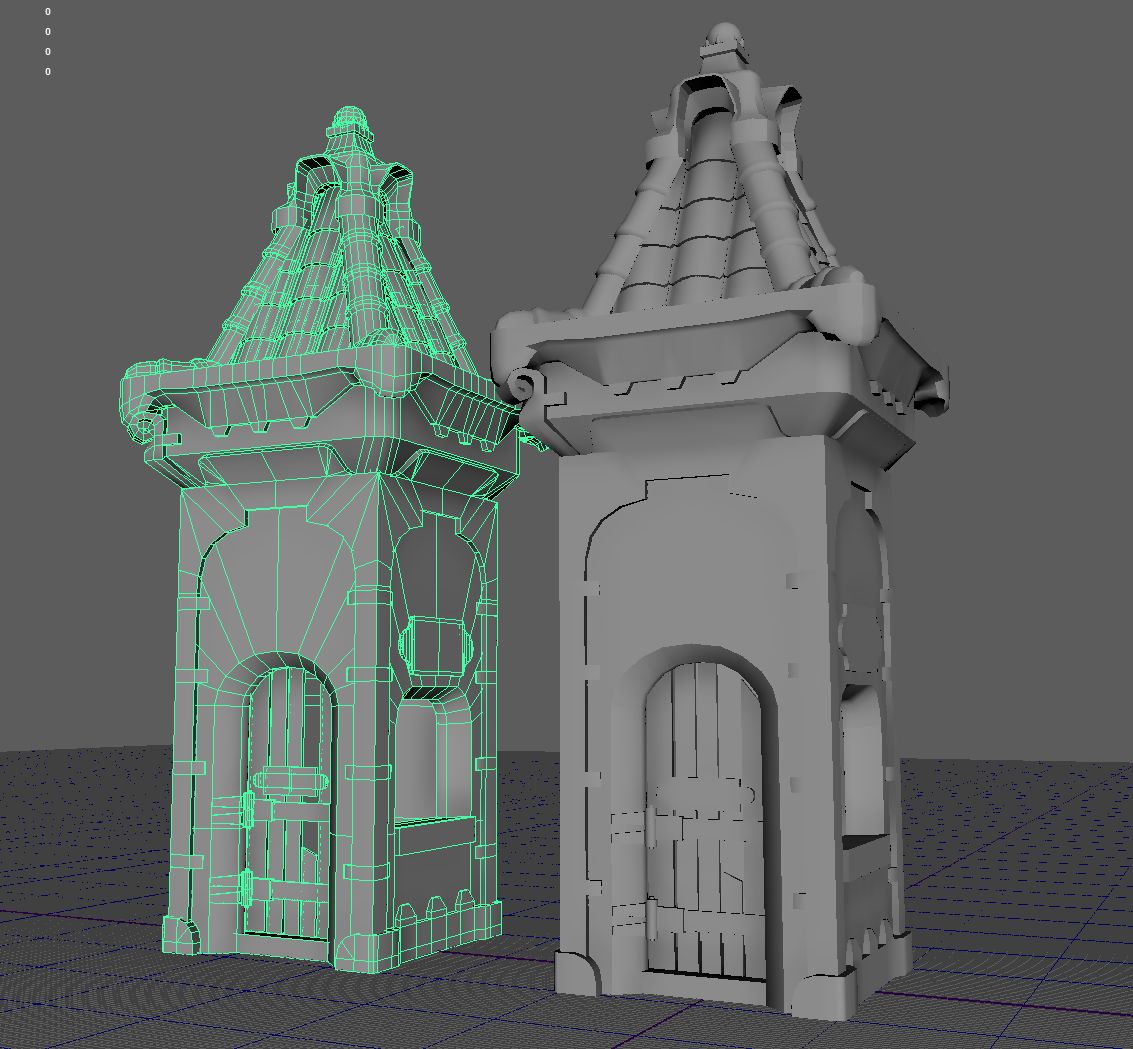
Here's a quick WIP. I've decided to challenge myself with the hard surface environment. Today I finished working on the geo, which is currently a combination of final lowpoly and some mid-poly for sculpting. I'm planning on sculpting mostly everything. Most of the objects will have bespoke textures. I'll use trim sheets with some parts, like the wood or metal beams. I'll see if I can get away with 3 materials for the walls and the tower.
I'd love to hear your feedback!
Thanks!



 YairMorr
4 ·

