I'm sorry I missed this discussion when it was started a decade ago, and I'm sorry that the links above are broken, but I'll add my comments now for the record.
I published a paper about pie menus in the proceedings of 1988 ACM SIGCHI conference called “An Empirical Comparison of Pie vs. Linear Menus”, in which we measured the performance of pie menus versus linear menus and found them to be 15% faster and have significantly lower error rates, and I presented pie menus at that conference and many other conferences and trade shows, and implemented them in many products, including The Sims from Maxis/Electronic Arts.
https://donhopkins.medium.com/an-empirical-comparison-of-pie-vs-linear-menus-466c6fdbba4b
I love the idea of integrating pie menus into all of the Adobe Creative Cloud products, and recently I've been evangelizing them to Adobe as a member of one of their user interface focus groups.
I'm trying to get to the bottom of why after so many decades Adobe still does not support pie menus in any of their products. I would like to hear from user interface designers and product managers at Adobe why after all these decades Adobe products still don’t support pie menus. Certainly it’s not because nobody’s heard of them or seen them before, so there must be another reason, which I would like to know.
My question for Adobe is if the code really that complex and brittle and deeply mired in technical debt and legacy decisions from decades ago, that they're technically unable to implement something as simple as pie menus, or if it is a cultural problem that makes it politically impossible to implement anything Adobe didn’t invent themselves.
Blender has them. Maya has them. The Sims has them. Here they are running on a PDP-7 at the University of Cambridge in 1967 in a CAD system called PIXIE. So why doesn’t Photoshop have them yet, in 2022? Does Adobe not employ any user interface designers who have ever heard of them, or do Adobe’s user interface designers have any convincing arguments or immovable barriers against using them? Or do Adobe’s cowardly lawyers prohibit their user interface designers from improving their products, because they’re terrified of getting sued by Autodesk because they believe their FUD?
Here are lots of other pie menu examples and citations, and there are many other high-end applications that use them like Houdini and Maya. User customizable pie menus would significantly improve all aspects of Photoshop’s user interface and workflow across the board. Menu selection is an extremely frequent operation in Photoshop, and speeding that common repetitive task up by 15% while lowering the menu selection error rate would have dramatically and measurably more impact than any number of nickle-and-dime tweaks to the Gaussian blur dialog. Especially if users could design and share their own custom task and workflow-specific pie menus, just like the happy users of Maya and Blender and many other products have been able to for decades. In comparison to so many other successful commercial products and games and open source tools with pie menus, not only Photoshop but ALL of the Creative Cloud products look and feel like they were designed in the stone age, and needlessly waste huge amounts of their user’s time.
Links:
Here is a 30 year retrospective of work I and other people have done with pie menus. Why hasn’t any of this ended up in any Adobe products? Not Invented Here Syndrome? But Adobe keeps buying companies and presumably incorporating the best ideas of those products into their own, so why has Adobe been so resistant to implementing ideas you didn’t invent themselves? Does Adobe only buy other companies like Figma to eliminate competition and innovation, then never bothers improving their own products because they’ve wiped out the competition through monopolistic anti-competitive practices, in spite of and to the detriment of their own users?
Michael Knubben's post about "Pie menus are infinitely less powerful than Marking Menus, and absolutely not the same thing" is incorrect, and he is the victim of misinformation and FUD spread by Alias employees Gordon Kurtenbach and Bill Buxton. I wish Michael had read the comment I posted on that video 10 years ago, which would have corrected his misunderstanding. I wrote:
Don Hopkins, 10 years ago: "These "typical pie menus" are not at all typical -- they're just "straw man pie menus". Typical pie menus (like the pie menus in The Sims) don't behave the way this straw man implementation demonstrates, and don't suffer from the disadvantages demonstrated here. Typical pie menus support "mouse ahead" gestures and scale independence, and it's disappointing that the authors of this video weren't aware of that, and attempt to define marking menus in terms of a straw man definition of pie menus."
It's unfortunate that Gordon Kurtenbach and Bill Buxton purposefully made such a deceptive video that lied about the definition of pie menus in order to make marking menus seem better, because he knew very well that pie menus supported both submenus and mouse ahead display pre-emption, since I told him personally in an email discussion in 1990.
Here is the email thread in which we discussed pie menus and marking menus in 1990, and I told him all about pie menus. His first email to me explicitly stated that "We are very interested in the fact that you can mouse ahead with them" which totally contradicts what he subsequently claimed in his own videos, research papers, and patent applications.
From: Gordon Kurtenbach <gordo@dgp.toronto.edu>
To: Don Hopkins <hopkins@sun.com>
Date: Fri, Nov 30, 1990, 11:41 PM
Subject: pie menus!!!!
Hi Don. I'm a Ph.D. student at University of Toronto. Bill Buxton is my supervisor. We are interested in doing some experiments with pie menus and developing some novel ways of using them. We are very interested in the fact that you can mouse ahead with them and would like to explore this feature further. SInce you are the grand implementor of some hot pie menu stuff I have a couple of questions:
1) is their any public domain code for them?
2) have you published any more papers other than the CHI Washington paper?
Thanks in advance.
Cheers
Gord
From: Don Hopkins <hopkins@sun.com>
To: Gordon Kurtenbach <gordo@dgp.toronto.edu>
Date: Dec 1, 1990, 3:44 AM
I'm glad to hear from you! The code I've written is freely redistributable without restrictions, and the idea is not patented or proprietary, and I encourage you to experiment with them and find out how to use them best! I'll send you some more stuff I've written about pie menus, and the code that implements them for NeWS, using the "Lite" toolkit. I have a very very old implementation for X10 on top of uwm, but all of the interesting features are in the NeWS code. I also have a bunch of strange mutant pie menu subclasses I implemented whenever I got weird ideas. NeWS is good that way, the crazier the idea, the more fun it is to implement!
If you want to implement them from scratch, I'd be glad to discuss some mouse tracking strategies I've developed! There are some fine points relating to correct *predictable* handling of mouse ahead, menu display supression, popping menus up at the edge of the screen and pointer warping, and other kinds of interactions. With pie menus, the important thing is how you move your hand, not how you move the cursor. Working with Bill Buxton, I'm sure you know what I mean!
If you like, give me a call at work at (415) 336-3171, any time. I'm usually here until all hours. There's too much to say to type it all in!
At Sun, I am working on TNT 2.0, an Open Look toolkit written in object oriented PostScript for NeWS. In my spare time, I have implemented pie menus for TNT, and I would like to develop them further. Would you be interested in getting a version of TNT for Open Windows when it becomes available, to evaluate and play with? The feedback we've gotten from the people testing the toolkit has been fantastic, and it will be well supported by Sun! If you are into exploratory user interface implementation, rapid prototyping, look & feel customization, interactive object oriented programming, and that kind of stuff, you'll be in paradise! For example, it would be easy to dynamically modify an abstract class in the system, so that certain interactions with certain componants would be timed and logged to a file, to gather data for an experiment.
-Don
From: Gordon Kurtenbach <gordo@dgp.toronto.edu>
To: Don Hopkins <hopkins@sun.com>
Date: Dec 10, 1990, 8:36 PM
Don: TNT sounds great and yes I would be interested. Can you comment on the accuracy of the timing we could get from it? Here's what we are investigating. I'm interested in using markings as an input technique. What I mean by markings are gestures with the mouse or stylus that leave an ink trail. Now the problem with markings is that unless you use mnemonic marking symbols its hard to remember what strange marking corresponds to what command. You may say well then use mnemonic markings. But the problem is that mnemonic markings may not always exist, may be hard to recognise and may be slow to articulate with mouse or stylus. So my approach has been to use very simple marks such as up, down, left right etc. These marks are easily to articulate and very easy to recognize. Now how do pie menus fit into this? The great things about pie menus is that for non-heirarchical ones selection is a simple gesture and this gesture matches the movement needed to make a simple mark!!! So here's the way things could work: novice's mouse down and get the pie menu because they need that amount of support. Its slow but when your a novice you just want to survive not operate at top speed. The the cool thing is that expert can mouse ahead like you've talked about but they get an ink trail so they have a better idea what they've selected without even bothering to wait for the menu to come up. Essentially the markings are a language of glyphs which are really accelerators. Furthurmore if you make a mark and keep the mouse down at the end of it a pie menu comes up so you can verify that you did the right mark. The idea here is that this will give novices a "smoother" transition to an expert user who has the menu layout memorized and can make selections without needing to look at the menu.
So in support of this stuff we are conducting an experiment to see how number of items in a menu and the layout strategy will affect the ability to articulate the gesture to select and how quickly people learn the layouts of menus and are able to "mouse ahead" which in our world is "use the mark instead of the menu".
In the future, I hope to try this stuff on hierarchical menus to create richer marking languages. Plus I'm experimenting with other novel menu gadgets where a marking can correspond to the selction movement.
Ok, hope this wets your appetite. Thanks for the info.
Gord
From: Don Hopkins <hopkins@sun.com>
To: Gordon Kurtenbach <gordo@dgp.toronto.edu>
Date: Dec 1, 1990, 3:44 AM
I think TNT can provide you with excellent timing accuracy. Events are location and time stamped, and you can respond to them in the NeWS server where they are happening. There is a global event manager, a light weight PostScript process running in the NeWS server, that provides synchronization, using a centralized "services" architecture. The global event manager catches certain events and passes them off to local event managers, who are responsible for managing objects who asked for certain classes of events. Any event that would change the input distribution, by expressing or revoking interests, or changing the canvas hierarchy, will cause the input queue to be blocked until the changes have been made and it's safe to continue event distribution. This means that the events get to where they were supposed to, and mouse ahead works very very well, even when the system is loaded and lagging behind. This architecture also saves us a whole lot of time and space (sharing interests and event managers), and makes it much easier to program an object to respond to events (because all the hard stuff is done behind the scenes by the system).
-Don
MOCAP WILL KILL ANIMATION!!!
Eric Chadwick
Added the treasure chest! Been tuning the lighting some more as well as the textures on the egg statues. Went with an unlit shader for the treasure chest in the first render and a lit shader in the second. Not sure if I like all the details blown out although it does have a cool glow effect thats nice for treasure. Thoughts?
I still need to adjust the line thickness for the trim sheet as now it seems even more faint. Planning on getting to that when I add some sand next.
squarebender
Hi everyone,
I love to handpaint normal maps using just photoshop without doing any highpoly at all. I only do this when the polycount is kept quite low and the texture size is as small as possible.
When I work like this 90% of the work is done with the pencil tool in one pixel size (not the brush tool). The rest 10% of the work is done using any tool that photoshop can provide. I also have the "NVidia normal map" filter, but I barely use it. I only use it when I handpaint an organic "height map" and I whant its normal map, or when the UVs contains alot of diagonals. But when I use this filter I never use the resulting image, because with the texture sizes I'm working on are very small, the resulting image that the filter produces usually is quite blurry and messy. So, whenever I use the filter, I only use the resulting image as a reference to then paint my own normal map.
The images I'm going to show you are my own projects, they are not done for any actual game or anything. I just do them because I enjoy it so much. The first images I'm going to show are basicaly simple objects, and then I will show more complex objects at the end. The shaders I use for this are very simple, they only use difuse map, normal map and specular map. The screenshots are taken directly from 3dsMax, not using any game engine.
I hope you like it!
Bathroom:
Tools 1:
Tools 2:
Food 1:
Food 2:
Livingroom:
Scorpion Evo3 :
H&K MP5:
More guns:
I like guns, so I made a few. Polycounts and texture sizes are consistent with the rest of the objects.
Vehicles:
There is something I whant to say for the last object. I did this object and the normal map back in 2011. Since then I have improved alot, so today I would have done things quite diferent. I'm not particularly pround of the underneath part of it, but at that moment I was already too bored with the object, so I kept it as it is. Also, I never did the difuse texture, so I've created a very simple one just to show you how it could look (No specular map here). Still I think is good looking enough to show you.

Yunir
Thanks for the feedback 🙏 Lighting is definitely something I still have to improve - And all of the assets too ofc 🤓
@SORENU If you don't already, you could use the different planes as masks to push color/value range and readability:
@PaulJChris hi! I think it looks good overall, although I find it a bit hard to read with the different colors.
Some nitpicks: I would interpret the concept so that the ground plate on the right extends to the wall of the forge, some larger chips could already be tackled in blockout, curvature of the the lavapools appear to be more pointy, lava-channels appear are bit narrow. Might be changes you made deliberately, just saying 🙂. If you are going the highpoly - lowpoly route, I wouldn't care to much about polycount at this stage, as one would likely do a retopo anyways. More polys, less facetted look - unless you apply subdiv modifier. Or do you plan to keep the blockout as the lowpoly? Keep it up!
@Esselle I think it would be cool to see the model set up in a game engine or 3d viewer. I like to use sketchfab, as it's pretty simple (not so many settings to get lost in).
edit: added most recent screenshots
Fabi_G
Hi! I am back with progress 😊 I decided to go fully handpainted, I started to work on the stone and gold but I feel like something is off with the stone, it doesn't feel as shiny as the reference... Maybe I should add more contrast? What do you think I could improve?
You guys did nice progress too!
@squarebender I love what you did with the egg statues, they look very handpainted it's super nice 😄 To make them even better maybe you could add some spot of handpainted light as we can see on the reference
@Fabi_G Wow you did a lot of progress, did you do all the props? They look nice! I feel like the image is a little bit too contrasted in comparison with the reference but maybe you're not done with lighting yet
I got help from @R3D on making this live edge desk. Cut it, sanded it, lacquered it, and ordered a standing desk frame. Now have a desk which I'm super happy with (and protective of). Its thiccc and heavy af, and it feels so right.
Ashervisalis
Sometimes i wish i could be a gardener. Just planting flowers and driving a lawn mower. And looking at butterfies and bees.
To add to what's already been said and hopefully clarify a few things: there's a number of different reasons why an artist would choose to use a triangle instead of a quad when creating an arch. The relevance of any specific answer really depends on the model's intended use and the desired outcome for the project. Looking at those two images, it's not entirely clear whether this model is just a block out or a final low poly.
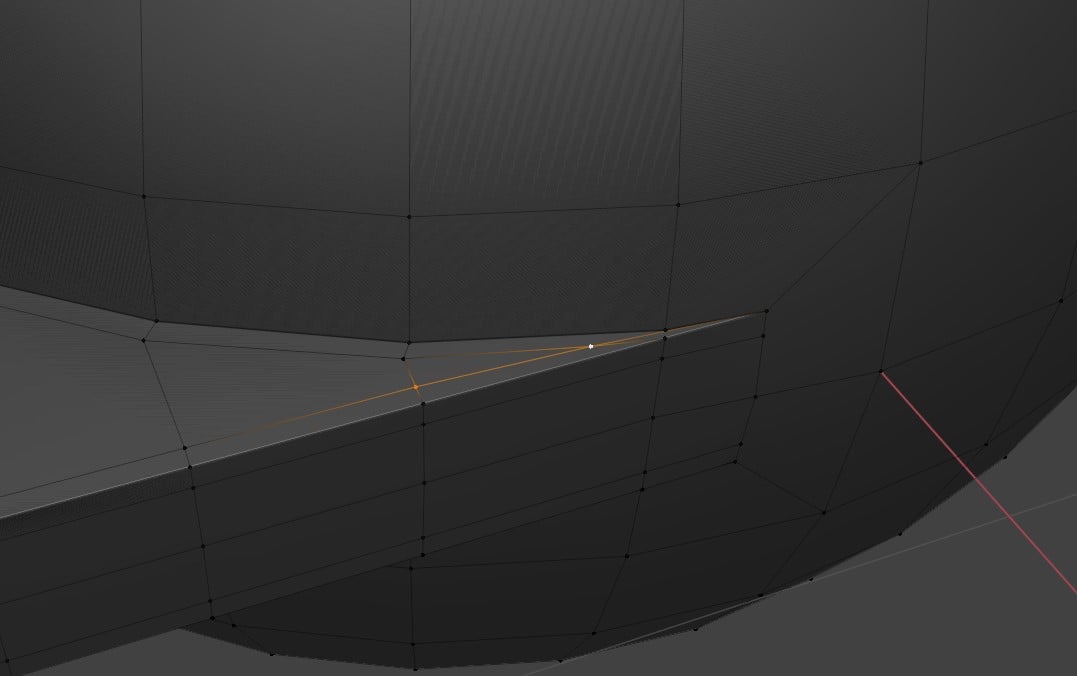
If it's a block out then it's possible that the triangles provide some additional edges that are required for subsequent modeling operations. Quad corners work well for most linear edge transitions and some types of curved intersections but they can also disrupt the curvature of adjacent edge loops. N-gon corners produce a similar effect.
While it can be beneficial to model with quads and n-gons, triangles can also be useful for pulling support loops inwards along a curve. Below is an example of how quad and n-gon corners can create subtle smoothing artifacts near curved surfaces. Converting these corner faces to triangles produces edge tension that can help reduce the visibility of smoothing artifacts near surfaces that transition from flat to curved.
If it's a low poly model then the mesh may need to be triangulated in certain areas to make seam placement and UV unwrapping easier. While most applications can display quads and n-gons, there are a variety of different triangulation methods and there's no guarantee that the order of the underlying edges and faces will be the same in every application. Which is why it's generally considered best practice to triangulate the final low poly model before exporting for baking and texturing. This will ensure that the model's geometry and smoothing behavior is consistent as it moves through the production pipeline.
Here's an example of just how varied the triangulation methods can be when moving the same mesh between two different applications. This sort of geometry miss match isn't a deal breaker for most simple modeling operations or basic material authoring but it can cause significant issues when working with tangent space normal textures.
Severe gradation in the normal map is often caused by the differences between the shading behavior of the high poly and low poly surfaces. This additional color information is specific to the state of the meshes during the bake. Alterations to the order of the low poly mesh will tend to produce normal artifacts, unless the difference between the shading behavior and baked normal information is resolved.
Which is why normal bakes from meshes without any smoothing splits tend to be sensitive to triangulation changes. The example below shows how the direction and intensity of the normal values changes, based on the low poly's shading splits and edge order.
While it possible to find workarounds for actively controlling mesh triangulation and using smoothing groups, these types of "Never fail, quick and easy!" solutions tend to ignore the fundamentals of established, current generation workflows. Granted there are some situations where it may be beneficial or necessary to use single smoothing groups or add support loops to the low poly or rely heavily on normal data transfers but a lot of the application specific workarounds tend to fall apart when working with a team that uses a wide variety of tools and regularly moves models between applications.
Creating a low poly model with consistent shading behavior goes a long ways towards making tangent space normal bakes a one or two shot deal. Adding smoothing groups is large part of that but controlling mesh triangulation is another important element in the optimization process. A lot of current, industry standard applications use MikkTSpace. Which makes it relatively easy to create assets in a synced tangent workflow. Yes, there are edge cases but that really isn't a good excuse for actively avoiding contemporary tools and workflows for content destine for popular engines like UE or Unity.
While this following example is far from best practice, it does demonstrate that using smoothing splits, in conjunction with a synced normal workflow, is fairly robust when it comes to accidental or unintentional changes in the triangulation after baking. All of the meshes have the same hard edges and only use the texture baked from the quad / n-gon low poly. Much less impressive when considering that the application automatically triangulated the low poly during the baking process but still a reasonable demonstration of how important it is to control the shading behavior with smoothing splits.
As shown below, when using a single smoothing group, even quad geometry doesn't guarantee that the triangulation order won't affect the surface shading and normal data. Using hard edges [smoothing groups] with a synced normal workflow tends to produce clean bakes that can be more resilient but curved surfaces and single smoothing group workflows tend to be more sensitive towards changes to the edge and face order after baking.
Another thing to consider about triangulation order is that the placement of the edges can skew surface details. Which, though it's often quite subtle, can have a negative impact on the overall quality of the bakes. In the example below, the diagonal surface elements have a slight distortion wherever a low poly edge crossed over a change in the high poly's surface.
While it may be possible to resolve some of these issues with a skew map or custom low poly cage, it's worth noting that the low poly that has a triangulation order with similar diagonal edges does have less overall distortion. Simple stuff like this can help avoid unnecessary complexity and extra work that comes with trying to resolve visible baking errors that are caused by letting the software choose the triangulation method on critical areas.
In a workflow with synced tangent space and smoothing splits, edge triangulation in low value areas can be largely ignored, provided it remains consistent during the baking, texturing and importing. However, it is worth running some quick test bakes to evaluate how the current low poly triangulation is affecting areas that are right in-front of the player.
The mesh used to demonstrate these principles is fairly simple, so the issues are quite subtle but carelessness towards these sort of things tends to compound in a way that produces a lot of small errors that bring down the overall quality of a project. Often with no tradeoff for a tangible benefit. Below is a short animation that compares a few different triangulation methods and better highlights how these changes impact the details baked into the normal texture.
There's a lot of great resources on these topics here on polycount and on the help pages of the various texturing applications. Here's a few links that are a good jumping off point for additional self guided learning:
https://polycount.com/discussion/41232/lowpoly-or-the-optimisation-appreciation-organisation
https://polycount.com/discussion/163872/long-running-technical-talk-threads
https://www.youtube.com/watch?v=ciXTyOOnBZQ
https://marmoset.co/posts/toolbag-baking-tutorial/
https://substance3d.adobe.com/documentation/spdoc/baking-109608997.html