Best Of
Re: Sketchbook: Frank Polygon
Subdivision sketch: truncated cones.
These examples show how segment matching can be used to join truncated cones to curved surfaces.
When the support loop around an intersecting shape disrupts the segment spacing of an existing shape, it tends to cause unintended deformation that can generate visible smoothing artifacts. Simplifying the support loop routing, by using the geometry of the existing shape to support the shape intersection, maintains consistent segment spacing and helps reduce the visibility of smoothing artifacts caused by abrupt changes in the topology.

Truncated cone joined to cylinder: This will generally behave like a simple cylinder to cylinder intersection. Align the segments in both shapes and simplify the support loops around the shape intersection whenever possible.

Truncated cone with adjacent cylinder joined to cylinder: Adjust the number of segments in each shape to maintain a relatively consistent geometry density while also aligning the edges around the shape intersection.

Truncated cone with radially clocked cylinder joined to cylinder: Start by aligning the segments in the shapes then add perpendicular support loops, as required, to match the support loops around the base of the shape intersection.

Truncated cone with adjacent cylinder joined to truncated cone: Get the alignment as close as possible then constrain any differences in the shapes to the area between the inner and outer support loops around the shape intersections.

Truncated cone joined to chamfered cylinder: Rotate the intersecting geometry as required and adjust the number of segments in each shape to align the edges around the base of the intersection. Perfect alignment isn't always possible but close enough is usually good enough. Perpendicular edge loops can be routed across the intersecting shape or reduced with a triangular quad.

Angled cylinder joined to truncated cone: Steeper tapers and proportionally larger intersecting shapes tend to amplify the difference between the segment spacing around the extreme ends of the shape intersection. Using the minimum amount of geometry required for each shape can help reduce the overall complexity and make it a lot easier to join the two shapes, without generating unintended shape deformations.

Recap: Adjust the number of segments to align the edges around intersections while also preserving the accuracy of the underlying shapes. Simplify topology routing and use the existing geometry to maintain the segment spacing of curved surfaces. Rotate intersecting geometry to align the edges without adding unnecessary mesh complexity.
 FrankPolygon
Re: Artstation.com funny business practices.
One word posts like that are likely to cause suspicion that you're a bot.
If you comment on an artists work it should address specific aspects of the piece, and/or be a well reasoned critique. Like if you like an artists work, why do you like it? What specifically made it interesting / inspiring / thought provoking to you?
 PolyHertz
Re: The Bi-Monthly Environment Art Challenge | November - December (81)
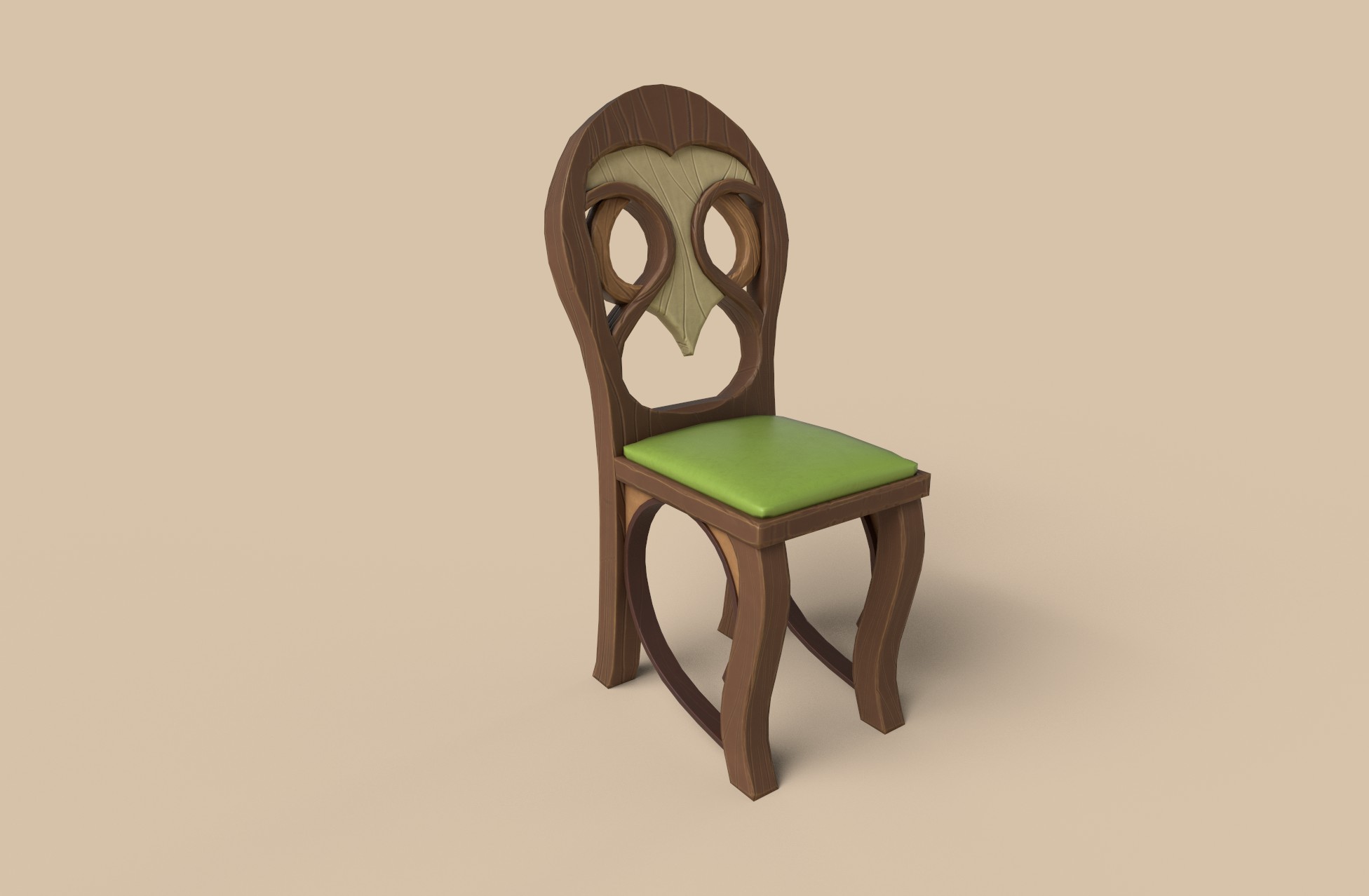
Hello everyone! I thought I'd start with the chair. Here's my current WIP. I spent the better half of a day on this as I tried to get a final model ready.
Upon closer inspection I think the back's shape could be tweaked a little bit more to match the reference.
Also, which grain style do you think works best here? The thin pattern, like on the legs, or the thick pattern like on the back area?
Almost forgot - I used Maya for modelling, Zbrush for sculpting and Painter for texturing. The rendered were made in Painter with iRay.
I would love to read your comments!


 YairMorr
Plague Marine Bust (finished)
Over the last two months, I was working on this Warhammer 40k Plague Marine bust to become more comfortable with collectible and miniature sculpting. Building all these layers of details and digging deeper into the Warhammer lore was a huge fun. Currently, I'm working on the printable version so stay tuned.


 Crazy_pixel
Re: The Bi-Monthly Environment Art Challenge | November - December (81)
Love the choices! My absolute favourite is the stylized post office so I will go with that for this challenge. It is plenty of lovely little props and details which should keep me quite busy for the next two months :)
Esselle
Looking for someone to create an image for 3d printing
Hello, I am located in Michigan.
I need a 3D image created and suitable for my Prusa 3d printer. It is a small car part ( see attached)
I can mail the part to you or can provide measurements. The drawing would have to address a small broken piece on this part.
Kevin
kwelch02
Re: LOW-POLY ART


Something i did once, loved the car so i made it.
 DavidCruz
Re: LOW-POLY ART
Realtime Eye Pratice for Games
Hello guys, I need this eye and I decided create a ready eye for my characters. Thanks for Alfred Roettinger xyz tutorials!
Iris PBR textures created from bitmap on Substance Designer.
Total tris; 3600
All Textures PBR
2 LOD
https://www.artstation.com/yunuskilic
www.yunuskilic.com


 yunuskilic
Re: LOW-POLY ART

 lsgrandchamp


