Best Of
Re: The Desert(What can you do with no diffuse maps?)
Admin edit: fixed most of the broken images (forum software now requires https: for all embeds).
 Eric Chadwick
2 ·

Re: [3ds Max 2025] FBX Export with Path deform for Unity
Just tried it, and the Spline IK is a very good addition.
Note that the important part in step 5 is to replace the XYZ position sub-controller with a path contraint (or use a list controller like seen in the image). He probably started to write that, but then jumped ahead to the bezier float. Or maybe that used to be the default setup of the controllers for the Spline IK back then.
Note that the important part in step 5 is to replace the XYZ position sub-controller with a path contraint (or use a list controller like seen in the image). He probably started to write that, but then jumped ahead to the bezier float. Or maybe that used to be the default setup of the controllers for the Spline IK back then.
 Noren
Noren
1 ·
Re: [3ds Max 2025] FBX Export with Path deform for Unity
The controllers look good to me.
As for the motion paths, how fast is your shutter unrolling? If each straight line is the motion from one frame to the other, then a slower animation would give you more "segments".
As for the points not lying exactly on the spline, that might just be due to geometry. Your bones are straight and can't stretch (both points move at the same speed) so they can't follow each and every curvature perfectly. At least that would be my guess. The distance to the IK goal can shrink, but only by bending the overall chain, which would result in some bones moving away from the spline.
But maybe you could try putting a Normalize Spline modifier on your path and see if that helps.
As for the motion paths, how fast is your shutter unrolling? If each straight line is the motion from one frame to the other, then a slower animation would give you more "segments".
As for the points not lying exactly on the spline, that might just be due to geometry. Your bones are straight and can't stretch (both points move at the same speed) so they can't follow each and every curvature perfectly. At least that would be my guess. The distance to the IK goal can shrink, but only by bending the overall chain, which would result in some bones moving away from the spline.
But maybe you could try putting a Normalize Spline modifier on your path and see if that helps.
Noren
1 ·
Re: Sketchbook: Zetheros
The lumbering pastry chef, rolling pin held aloft in a meaty fist, turned to his protege. "Son, it's time to bake."
Have a great week!
Have a great week!
 zetheros
2 ·
Re: AI Art, Good or Bad? A (hopefully) nuanced take on the subject.
Yeah we’ve seen people straight up using ChatGPT/Gemini/CoPilot to post feedback, and it’s pretty gross.
Though I think the feedback d1ver is posting is solid, well thought out and beneficial.
So then I’m thinking we could ask people to include source for their feedback, whenever some sort of automation is being used. Particularly when using AI, but this could include other software-enhanced augmentation I think.
So then I’m thinking we could ask people to include source for their feedback, whenever some sort of automation is being used. Particularly when using AI, but this could include other software-enhanced augmentation I think.
Something like: “I ran your image thru ___ ai, and my thoughts are __”. Or something like “I used Photoshop generative-fill to ___ and my thoughts are ___”. That kind of thing.
Eric Chadwick
2 ·
Re: AI Art, Good or Bad? A (hopefully) nuanced take on the subject.
Personally I've found that best use case for generative AI is using chatGPT as a search engine tool if google isn't turning up anything for me. If I need really obscure information, and just don't know how to word it or search for it. I'm making an MMO, and have no idea how to setup servers and anticheat and key programmer language, but I'll certainly be asking AI how to get started before doing a deep dive, so that I know how and where to start.
AIgen, particularly for use in feedback, while well intentioned, is risky, and ultimately a bit lazy IMO. Feedback should be teaching people about the fundamentals; how and why an image looks the way it does, why it looks good, so that they have the knowledge to create what they want and quickly identify what's wrong.

AIgen, particularly for use in feedback, while well intentioned, is risky, and ultimately a bit lazy IMO. Feedback should be teaching people about the fundamentals; how and why an image looks the way it does, why it looks good, so that they have the knowledge to create what they want and quickly identify what's wrong.
The issue with all generative AI is that it does not understand context. The generator here added a really harsh lighting to the scene that I don't think compliments stylistic painterly art at all. d1ver is correct in talking about fore, mid, and background, but in the generated image the camera angle is completely different, putting the tower in a valley instead of up on a hill. The perspective and angle of the roofing is parallel with the ground, instead of angled up to create the sense of fresh air, adventure, and freedom in the alps. The image went from "Oh I'm playing WoW! Happy, fun times!" to "I'm slaughtering monsters as Geralt." Which is also pretty happy fun times, but a different kind for sure.
As some added feedback for MBauer17, you can think about negative and positive space as well, and possibly having less background and more tower (so crop the sides more, scoot the trees in), as it's the focus of the image. Depth of field would also be a good thing to add (or increase). The flowers in the generator is a good idea, but it's completely out of focus and a blurry mess that detracts from where you want the audience to focus on; the tower. The smoke trail is also purposefully artistic, I'd expand even more on that, maybe look into World of Warcraft's Mists of Pandaria artwork for inspiration there. If I don't have time to give feedback, the least I could do is send them to someone who can; I always thought fengzhu school had a lot of really good tutorials for concept work and teaching basics like this. https://www.youtube.com/@FZDSCHOOL/videos
Dave Rapoza is also pretty awesome, he does 2d art but art fundamentals are basically 1:1 transferable to 3d. https://www.youtube.com/@DaveRapoza/streams
As some added feedback for MBauer17, you can think about negative and positive space as well, and possibly having less background and more tower (so crop the sides more, scoot the trees in), as it's the focus of the image. Depth of field would also be a good thing to add (or increase). The flowers in the generator is a good idea, but it's completely out of focus and a blurry mess that detracts from where you want the audience to focus on; the tower. The smoke trail is also purposefully artistic, I'd expand even more on that, maybe look into World of Warcraft's Mists of Pandaria artwork for inspiration there. If I don't have time to give feedback, the least I could do is send them to someone who can; I always thought fengzhu school had a lot of really good tutorials for concept work and teaching basics like this. https://www.youtube.com/@FZDSCHOOL/videos
Dave Rapoza is also pretty awesome, he does 2d art but art fundamentals are basically 1:1 transferable to 3d. https://www.youtube.com/@DaveRapoza/streams
While I'm at it here's some more
https://www.youtube.com/@JamesGurney
https://www.youtube.com/@StevenZapataArt
https://www.youtube.com/@abcwithsamwise-ABC
https://www.youtube.com/@JamesGurney
https://www.youtube.com/@StevenZapataArt
https://www.youtube.com/@abcwithsamwise-ABC
zetheros
2 ·
Re: [WIP] RED V-Raptor camera, Plasticity practice
Front part is ready. Except screw holes. I'll add details to them at the very end.


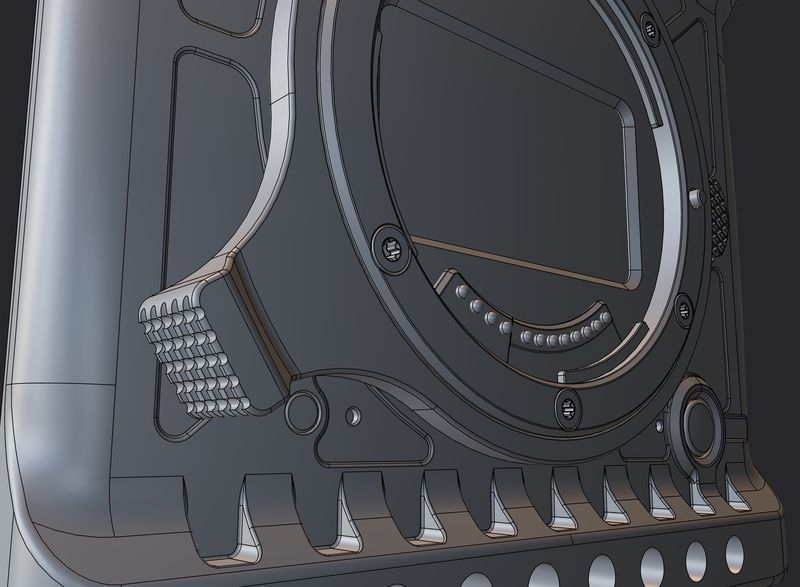

Are 800px wide images ok to see the details? Or someone needs full res?
Are 800px wide images ok to see the details? Or someone needs full res?
 3d_legionary
4 ·
Re: AI Art, Good or Bad? A (hopefully) nuanced take on the subject.
[Orthogonal take incoming]
Or ... one could simply consider that there is almost never any need for constructive criticism and feedback to be "fancy-looking" anyways, as crude red lines to outline shapes, arrows representing light sources and rough cross-hatching to indicate shadows have always been enough to communicate edits, and also have the benefit of leaving room for interpretation - as opposed to throwing humiliating AI slop (like that ChatGPT "piss-edit" of the scifi street corner piece above) at the face of someone trying to learn. Heck, I have found memories of bouncing feedback back and forth with an AD over screenshare using mouse scribbles, not even a tablet. And if more accurate indications of values and colors need to be done, they can be done as a small thumbnail, a summary of sorts.
Here's a Dragon Ball storyboard followed by a correction made by Akira Toriyama himself. This is for a million-dollar franchise, way more important than someone's attempt at a portfolio piece in Unreal. This isn't even the original storyboard and correction, just a recreation by the artist and it kindof looks like childs drawings. And it doesn't matter, everything's there.

Full-on paintovers are actually of somewhat poor taste if not explicitely sollicited anyways.
At the end of the day, if someone needs an AI to crunch numbers for them in order to provide feedback ... that just means that they simply have no feedback to provide to begin with.
Or ... one could simply consider that there is almost never any need for constructive criticism and feedback to be "fancy-looking" anyways, as crude red lines to outline shapes, arrows representing light sources and rough cross-hatching to indicate shadows have always been enough to communicate edits, and also have the benefit of leaving room for interpretation - as opposed to throwing humiliating AI slop (like that ChatGPT "piss-edit" of the scifi street corner piece above) at the face of someone trying to learn. Heck, I have found memories of bouncing feedback back and forth with an AD over screenshare using mouse scribbles, not even a tablet. And if more accurate indications of values and colors need to be done, they can be done as a small thumbnail, a summary of sorts.
Here's a Dragon Ball storyboard followed by a correction made by Akira Toriyama himself. This is for a million-dollar franchise, way more important than someone's attempt at a portfolio piece in Unreal. This isn't even the original storyboard and correction, just a recreation by the artist and it kindof looks like childs drawings. And it doesn't matter, everything's there.
Full-on paintovers are actually of somewhat poor taste if not explicitely sollicited anyways.
At the end of the day, if someone needs an AI to crunch numbers for them in order to provide feedback ... that just means that they simply have no feedback to provide to begin with.
 pior
pior
11 ·
Re: 1900's Western Fields
I just joined Polycount and am having my first look around. I, too, am developing a Western environment and was attracted to yours. (My world is a bit earlier, circa 1884.)
I'm at the beginning of the development process. I'm creating a unique mining camp, a classic Western town bursting at the seams, and the ranches and farms in between. But enough about me.
Seeing the evolution of your project has been impressive. You've made some great-looking models, and your scenes are coming together. Some tips for photographing a Western landscape you may want to try: 1) Have a focus, a 'subject', that single element that draws the eye. 2) Strict adherence to the 'Rule of Thirds.'
'How the West was Won' in true Cinerama format must have been amazing to have seen in the theater. I've seen a lot of films at the Cinerama Dome in Hollywood, but nothing in the 3-projector setup. (Apocalypse Now and Terminator 2 were pretty spectacular in 65mm, Gone with the Wind, not so much.) And I'll toss in another suggestion to study for truly fantastic widescreen composition in a Western: The Sergio Leone/Clint Eastwood "Dollar" trilogy. I LOVE Leone's framing.
Good luck with your project, I'll keep checking in.
 Rarendipity
1 ·