Search
-
Re: Zbrush character to animation general question

 Make the meshes contiguous, as much as possible, this will reduce headaches later when binding the vertices to the bones (skinning). For example, take a look at how the shirt transitions to the pants, or the pants to the shoes. Street Cop by Mashru Mishu. More examples here http://wiki.polycount.com/wiki/BodyTopology
 -
Re: Low poly base mesh, what are you priorities?
Put her image behind your model, and adjust proprtions until they match. Your hands are pretty small for example. Take a close look at the groin in the Hippydrome examples, and compare with yours. A rectinlinear grid like yours is bad topo for deformation, and also bad for sculpting. -
Re: My works in Blender for 2025
 Wow these are really cool! Love the stylization on these, and the mix of 3d and lighting with hand-painted details. I would love to see more thoughtful attention to variable line widths. You have some different widths, but each line is the same width along its length. Here's a nice example of how variable line weights…
 -
WIP – Chemical / Paint Waste Disposal Bin (Practice Prop)

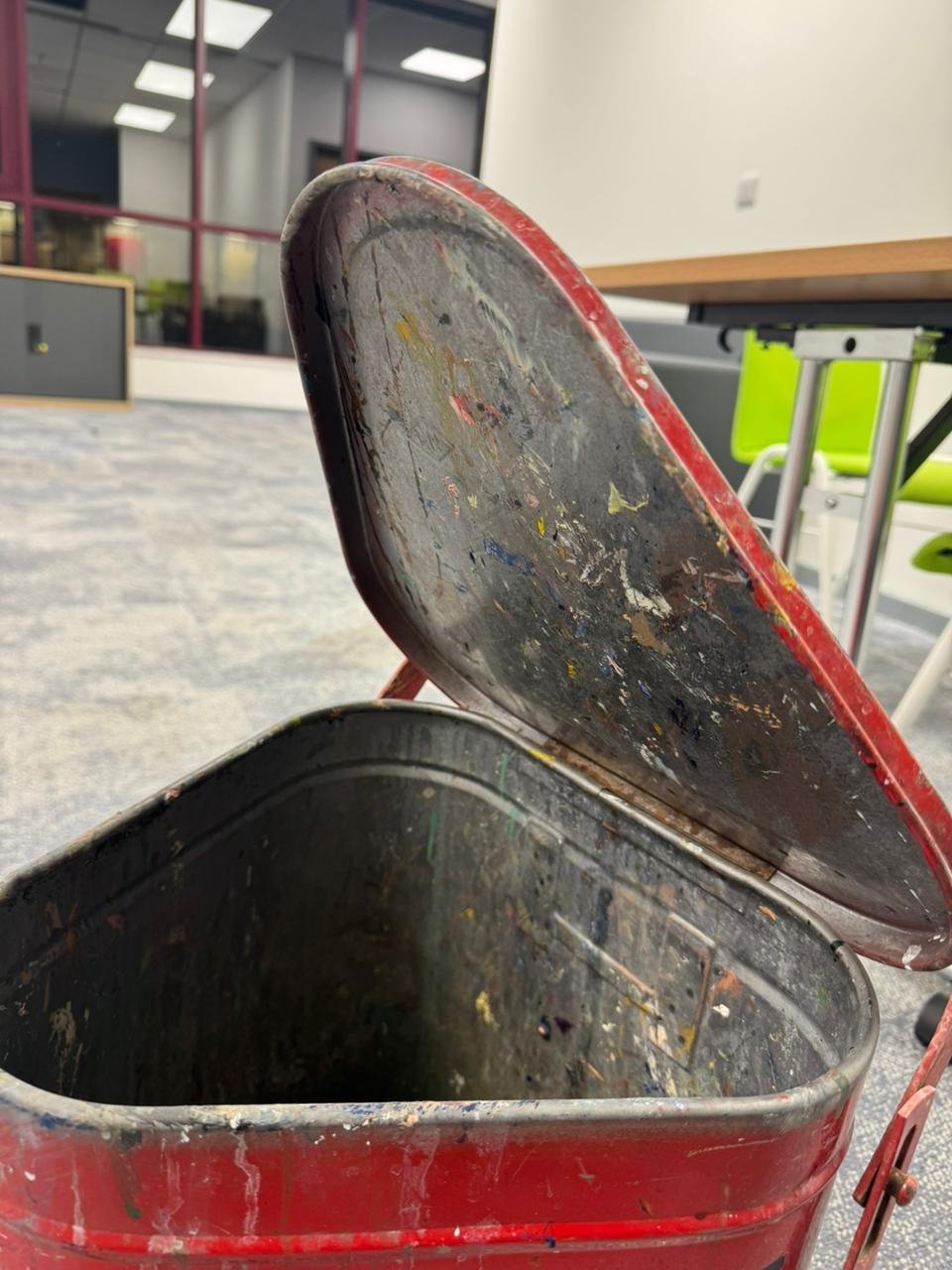 Hey everyone, I’ve started working on a new practice prop. Its a chemical/paint waste disposal bin. I found this one and thought it would be a great study piece because it has a lot of subtle form changes, surface damage, and material storytelling. My goal with this project is to: * Keep as much real-world detail as…
 -
Need Low Poly Greybox Structures
 I want to commission some low poly greybox ancient and futuristic structures for a personal game project. I would like to know how much it would cost for a small structure, medium structure, and large structure. Small structures could be a small ruins or tower or bunker, medium could be a more complex ruins or a base with…
 -
Re: Feedback - Location from Blade Runner 2049
We have a bunch of things on our wiki about making assets for games, for example: http://wiki.polycount.com/wiki/Modular_environments -
Re: Age of an artist
 I just recently read* something about "late bloomers", and it specifically used artists as an example. Conventional wisdom has it that most great works are done in an artists early years, but the facts just don't hold that true. Cezanne was the one of the examples used. *Book was..What the Dog Saw, Malcolm Gladwell
 -
Re: Carpet UV Tile using Substance Designer?
You can overlap the edge pieces in UV space, like how Kio Works shows in this post. Another example of this method can be found here. http://polycount.com/discussion/144838/ue4-modular-building-set-breakdown/p1 And even more examples are here. http://wiki.polycount.com/wiki/Modular_environments -
Re: Ysalex Anatomy Practice Thread (nsfw)
 Although I certainly don't qualify as an "amazing polycount anatomy artist", I think I can share some useful input, so here it goes. For starters, are you using any specific reference for your poses? I think this is pretty critical for figurative work. You've definitely got your anatomy and proportions under control. But,…
 -
Re: Need a Paintover
 Use reference and remember landmarks to more accurately create forms and find balanced proportions. Balance your perspective so your anatomy will looks accurate. Your proportions need to follow the basic rules of perspective for an angle like the one you're using. It frames the muscular composition. Green A & B are nice…
>27408 results