Search
-
Re: Airbørn
 i'm not that much into the whole environment process so all my answers might not be totally right, so what i know Manuel is baking the lightmaps with maya, i built a directional lightmap shader that takes the normalmap into account for blending the lightmaps, i did this with the help of some technical documents from…
 -
Re: [WIP] Teapot spirit - Character Art

 This looks like a fun project! Looking at the concept before reading your description, I thought the liquid appendages were supposed to be tea, not honey. Coming as they are out from a teapot and all. So you might want to seek ways to clue the viewer in that it’s honey, like adding some bits of honeycomb, or maybe some…
 -
Re: How much time does it take for you?
 Still other questions need to be answered first. 1. What time period was this made? Medieval times? WW2, Modern Day, Future? 2. What is it made out of? Wood, Concrete, Metal... 3. Do you go inside? 4. How close do you get to it? 5. How damaged is the structure? 6. Is it abandoned or upkept All important questions to be…
 -
Re: The BRAWL² Tournament Challenge: Judgement!

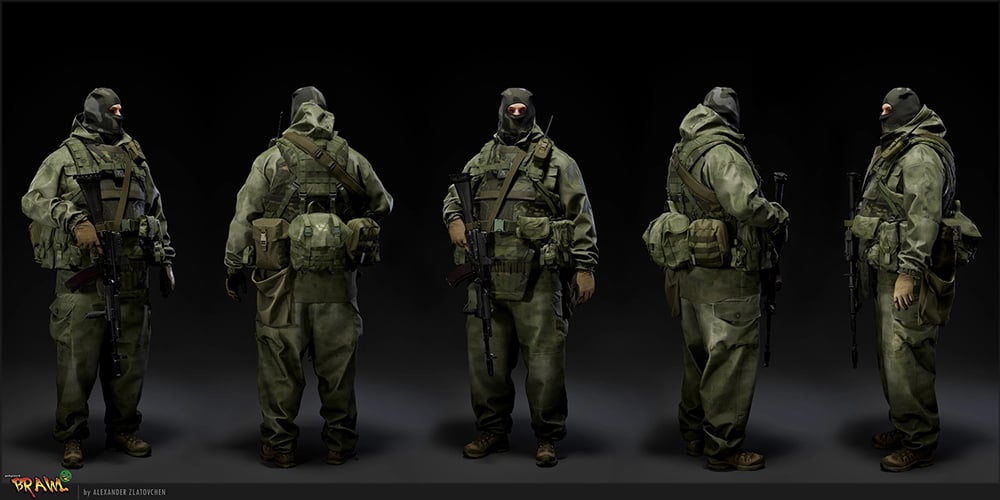 1st Dorado - Alexander Zlatovchen The model looks incredible, great job on the clothing and accessories. Top level. You did an excellent job in Marvelous Designer; those small details really make a difference. The level of detail is amazing. I would’ve liked to see images of the texture maps and UVs. I also wish I had seen…
 -
[CRITIQUE] Head sculpt and retopo

 (I'm very new to Polycount, so if I'm posting this in the wrong place or something, let me know.) I've challenged myself to make a new head (almost) every day, sculpt, then materials or retopo or both if I have time. I want to improve my sculpting skills and learn how to make decent characters that aren't weird or uncanny…
 -
Re: Sketchbook: leche
 Created a base model and applied texture using stencil painting. The texture is a Midjourney-generated image, enhanced with custom masks to control color and displacement mapping. By layering multiple displacement nodes, I added surface depth, blending the details for a realistic effect. The mask allows precise control…
 -
Re: Is tri-planar related to 45 degrees or something?

 You sample the texture on three axes, and then blend these 3 samples based on the surface normal at that pixel. Images taken from the excellent Ronja tutorial on the topic: Sampling the texture once on each X, Y, Z axis and blending these 3 samples with the same weight (AKA an average): The normals of the mesh: Using the…
 -
Re: The Bi-Monthly ENVIRONMENT ART Challenge | September - October (68)
 @Donato I think you're on the right track, but the blending between the two materials is too soft. This kind of blend works great for things like grunge, rust or moss, but weathered/peeling stucco tends to have a very hard edge from what I can see. Grab some more references (like this) and try to break down what is…
 -
Re: Streching Texture on some parts of level + Other issues
 Issue 1: You could use the world position as the texture coordinates and then blend between the X, Y and Z tiled textures based on the direction of the normals. For the tiling, using one color map for the whole terrain + a mask for different materials (grass, rock etc.) and then blending in the detail diffuse maps and…
 -
Re: Is vertex painting a typical way to break up overlapped-UV texturing?
First, overlapping UV does not equal symmetry. You only get symmetry if you mirror a UV. Most environment UV tiling is done by simply scaling the UV larger than the 0-to-1 UV square. That causes the texture to repeat across the model. Not causing symmetry, which means creating a rorshach or "butterfly" pattern. If you're…
>11460 results