Finished - Scout Hover Bike — Sci-Fi Checkpoint Bay
Hi everyone, 
I’m starting a new project: a sci-fi Scout Hover Bike set within a small urban perimeter checkpoint bay. The scene will have an overcast, damp, slightly neglected atmosphere, but the location should still feel operational and believable.
For this project, I want to explore mechanical sci-fi and hard-surface design through a hero vehicle placed within a small urban checkpoint environment. The goal is to create a believable scene where the Scout Hover Bike, supporting props, and surrounding space all feel connected and functional.
The initial inspiration for the vehicle comes from Star Wars speeders and Destiny 2 Sparrows.
I used AI-generated sketches as part of the early ideation phase to explore broad shapes and silhouettes. The final design, modelling, materials, and presentation will be developed by me.
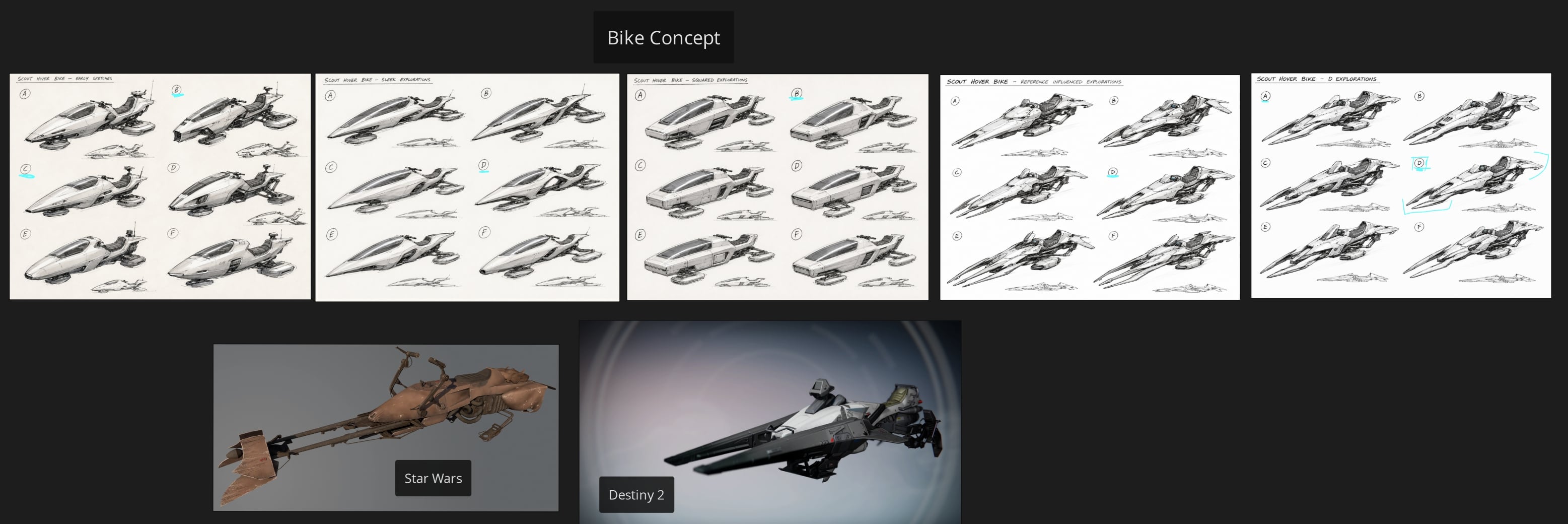
When choosing which concept to go for, I considered overall silhouette, style, mechanical visibility, and how well the design could support a game-ready hard-surface workflow. I decided to move forward with a sleek scout-bike design that balances speed, function, and exposed mechanical detail.
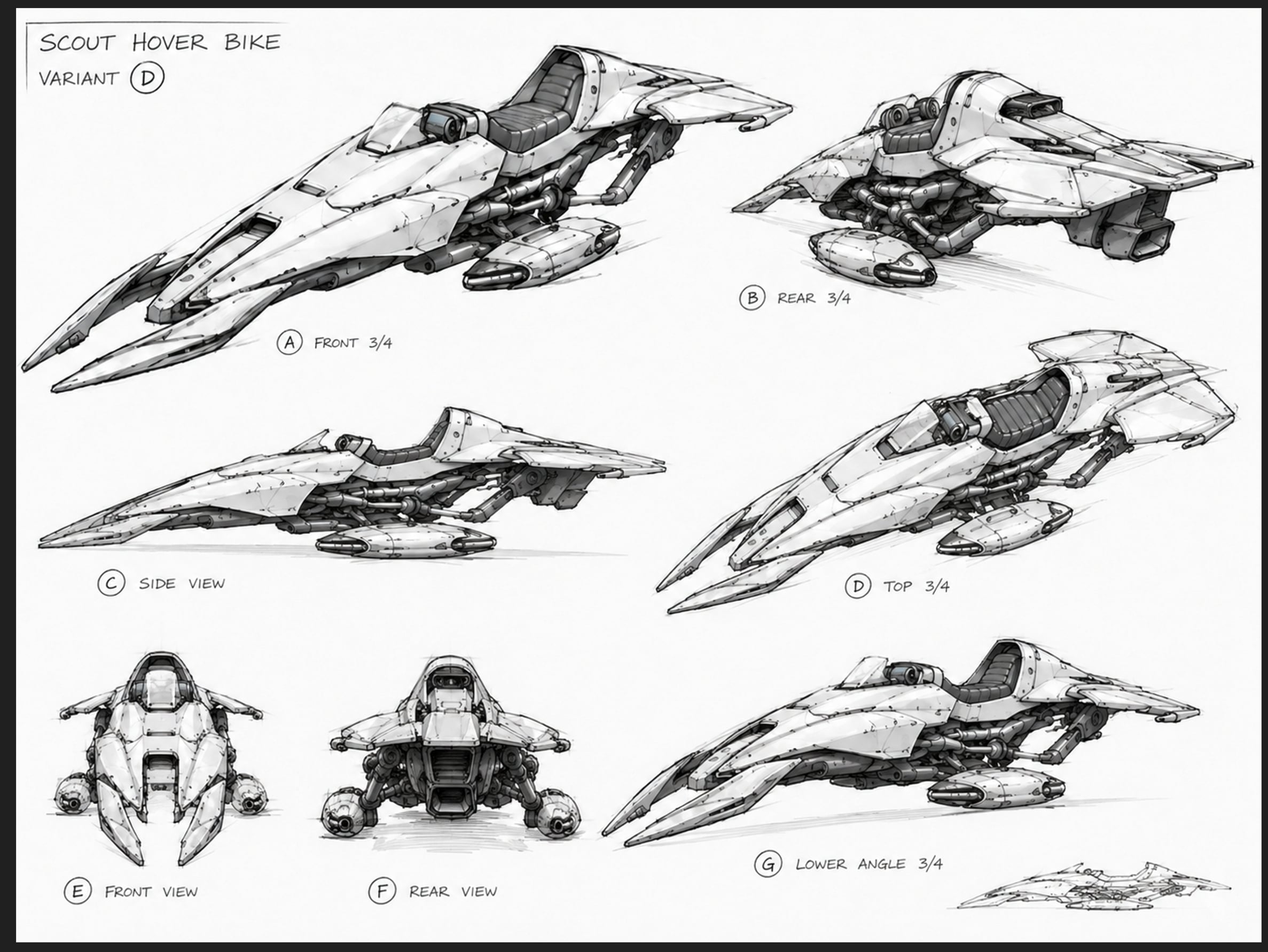
Key design features:
- Long split-prong nose
- This gives the bike a strong sense of speed and a recognizable silhouette.
- Low windscreen and compact cockpit
- Keeps the vehicle feeling fast, lightweight, and only lightly protected.
- Ribbed single seat
- Adds human scale and creates an opportunity for material contrast.
- Visible underbody mechanics
- A key area for hard-surface detail, including arms, brackets, pistons, cables, vents, and hover pod mounts.
- Compact rear fins and tail section
- Supports the fast silhouette without making the vehicle feel too much like a full spacecraft.
- Small hover pods
- Helps communicate the function of the vehicle and keeps it readable as a hover bike rather than a jet sled.
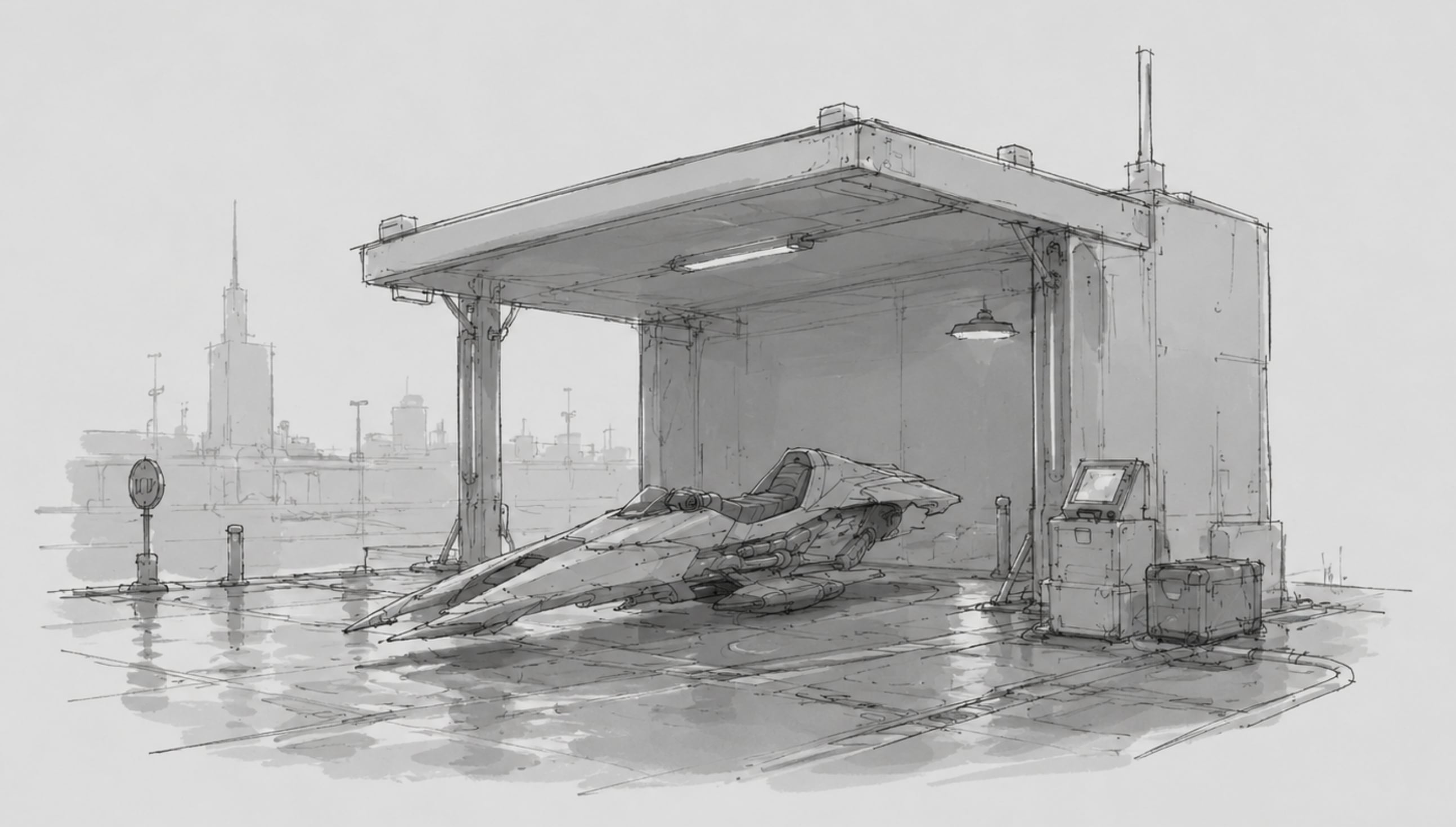
An early concept of the environment and the setting:
My main goals for this project are to improve:
hard-surface modelling and clean form construction
mechanical component design and believable functionality
high-poly to low-poly workflow
baking quality and normal map cleanup
material realism using PBR textures
panel breakup, decals, and surface wear
real-time presentation in engine
creating a small supporting environment that grounds the vehicle without taking focus away from it
The Scout Hover Bike will be the hero asset, set within a compact urban checkpoint bay that supports the vehicle, establishes scale, and grounds the scene in a believable world.
I’ll be sharing progress as I go and would really appreciate feedback along the way.
Replies
The aggressive split-prong silhouette was one of the main things that drew me to this direction. I’ll try to keep that as a strong feature while making sure the mechanical parts still feel functional and believable.
A brief blockout update:
I’m currently focusing on locking in the main proportions and silhouette before moving into cleaner shapes and mechanical connections. The front prongs, seat area, and rear fins are still rough, but the overall direction is starting to come together.
I've started on the seat and I have all the main pieces finished for the blockout. The gaps and empty spaces, that is where mechanical components will go.
Feedback on silhouette/proportions is very welcome.
Progress Update:
I’ve made a lot of progress on the modelling over the past week, with many of the smaller and more intricate components now starting to come together.
I’ve begun creating the exhaust system and the underlying structural frame that supports the main body and mechanical components. I’ve also added more of the pipework, refined the seat, developed the rear axle assembly, and adjusted the front silhouette and panel shapes.
There is still plenty left to build and refine, but the overall vehicle is starting to feel more believable. Things are coming together.
Any feedback is always welcome.
I'm planning to do a proper retopology pass later, definitely not the most exciting part of the process haha!
I think coming up with a design/ concept is a whole separate field that takes time to get good in. Without sensibility, one can't see (and subsequently correct) anything looking off/ making no sense in an AI-generated design. Even if the final 3d execution was top tier, weakness inherent to the design would likely still show through. I imagine the reference vehicles from Star Wars and Destiny went through an extensive design process to make everything work functionally, which I assume also contributed to the way they ended up looking.
On the scope side of things, would probably simplify. Perhaps make it two projects A- Environment B- Vehicle. Makes it easier to keep focus.
But that's just how I view it. Perhaps you have it all planned out.
Good luck!
Thanks for taking the time to write such a detailed response, I really appreciate it.
You're absolutely right that concept design is its own discipline, and that's one of the reasons I'm not treating the AI images as blueprints. For me they're more of a starting point to generate ideas and point me in a general direction. As I build the vehicle, I'm constantly making my own design decisions rather than trying to recreate the image one-to-one.
One of the main things I'm paying attention to is exactly what you mentioned: ergonomics and functionality. I'm thinking about how someone would actually mount and operate the vehicle, where the controls would be, and whether the proportions make sense. I've also been looking at real motorcycles and other reference to help ground the design rather than simply following the AI output.
The idea is that this is a hover bike, but only while powered on. When it's switched off, it rests on the ground. I've spent some time working on the stand to make sure it could realistically support the vehicle's weight. It doesn't necessarily need to retract either, since it wouldn't interfere while the bike is hovering.
Lately I've also been refining the rider contact points, such as the handlebars, their placement, the footrests, and the overall frame. I've been trying to make the frame feel more substantial and structurally believable.
I've also started putting together a environment in Unreal. Nothing overly complex, but enough to place the bike in a setting where it feels natural and lets me evaluate the design in context.
I'm still undecided about the fog density. My intention is for the city skyline in the distance to fade naturally into the atmosphere, but I'm still experimenting to find the right balance.
Regarding the scope, that's definitely something I've been thinking about as well. The environment remains the primary focus, with the vehicle acting as a supporting hero asset rather than a separate standalone project.
Thanks again for the feedback. It's given me a few more things to keep in mind as I continue refining the design.
A brief update.
I’ve been working on some supporting props, including the bay console, while continuing to refine the hover bike with additional details and adjustments.
As requested, I’ve also included an image showing the connection points. A simple sketch, but you get the idea.
In Unreal, I tested a rain VFX pass for the environment. After seeing it in motion, I think the better direction may be to suggest recent rainfall instead. Focusing on wet-looking materials and surfaces rather than active rain in the scene.
I’ve also started adding simple materials to the environment to begin tying the space together visually.

Any ideas or feedback is always welcome.
Here are some pictures from Blender. So you can see the real skeleton of the bike. And just under the central area is the main power core just behind the steering, as well as the transmission.
I've been spending the past several days refining the environment and moving into what I would consider the fine-tuning phase.
One of the bigger noticeable changes has been the weather. I adjusted the rain so it's much more subtle and transparent. My goal wasn't a heavy downpour, but rather to create the impression that the environment has recently experienced rainfall. Combined with the wet materials, I think it sells that look much more convincingly.
I've also continued adding supporting details throughout the scene: decals, additional lighting, and smaller props to help break up the space and make it feel more lived in.
The biggest milestone, however, has been bringing the hover bike into Unreal and applying its first material pass.
This is genuinely my first serious attempt at designing a vehicle from scratch. Rather than recreating something from Star Wars, Destiny, or another existing IP, I wanted to design something that felt like my own while still taking inspiration from real-world engineering and motorcycles.
Throughout the process I've tried to think beyond just the visual design and consider how the vehicle would actually function. Things like ergonomics, rider comfort, accessibility, steering, and general practicality have all influenced the design.
For example, I repositioned the footrests so they sit further away from the engines to avoid what would realistically become a heat hazard. The steering is mounted around a central pivot, with the idea that pushing the controls forward would accelerate the bike while pulling them back would engage reverse. I also kept the interface intentionally simple, with a green button for power on and a red button for power off.
Another small addition was the metal windscreen. Beyond its appearance, it's there to help shield both the controls and the rider's hands from debris while travelling at speed.
Overall I'm happy with the direction it's heading, but I'm definitely still in the polish phase. I'm continuing to refine materials, lighting, composition, and the smaller details that help bring the environment together.
As always, I'd really appreciate another set of eyes. If anything stands out, whether it's the environment, the vehicle design, materials, lighting, or composition. I'd love to hear your thoughts.
Hey everyone!
I think I’m ready to call this project finished. I’m excited to share it here, and I’m very curious to hear what you all think.
This started as a vehicle-focused challenge and eventually grew into a small sci-fi checkpoint scene built around the hover bike. The bike itself was the main focus: I wanted to create a full vehicle from my own design, then present it in Unreal Engine with materials, lighting, rain, VFX, and a small environment that supported the asset without taking over.
For the design, I wanted the bike to feel more like a practical scout/recon vehicle rather than a flashy racer. That influenced the color choices quite a bit. I went with more neutral, subtle, earthy tones. Especially the lighter brown panels, because I didn’t want it to stand out like a race car or luxury vehicle. The idea was that it should feel functional, believable, and suited for moving through a rainy urban checkpoint or patrol area.
A lot of the project became about problem-solving: making the vehicle feel structurally believable, adding landing supports, thinking about where the rider’s feet and controls would go, keeping the silhouette readable, and making sure the mechanical parts felt connected rather than just decorative.
I also created a small presentation environment around it, with wet surfaces, rain, lighting, decals, rear lights, and subtle hover thruster VFX to help the scene feel grounded and alive. I later made a separate bike showcase setup as well, so the asset could be viewed more clearly without the full environment around it.
The biggest challenge was the vehicle itself: developing an original design, building a believable structure, and carrying the asset through modeling, UV mapping, texturing, and final presentation in Unreal Engine.
One of my main goals was to create a believable machine, not just a cool-looking sci-fi shape. I wanted the hover bike to feel mechanically complex, functional, and grounded enough that the viewer could imagine how it might actually work. That meant thinking about the structure, landing supports, rider ergonomics, foot placement, controls, engine placement, panel breakup, material wear, and how all the mechanical parts connect together.
Looking back at the final result, I do feel like I achieved that goal. There are always things I could continue tweaking, but I’m happy with how the bike reads as a solid, practical scout vehicle rather than something purely decorative.
Another goal was to build a small supporting environment that would ground the vehicle without taking focus away from it. The rainy checkpoint bay gave the bike a believable setting, while also letting me push the mood, lighting, wet surfaces, and real-time presentation in Unreal Engine. I’m especially happy with how the rain and wet surface effects turned out, since they helped bring a lot of atmosphere and movement to the final scene.
Thanks to everyone who gave feedback along the way. It genuinely helped me push the piece further and make better decisions throughout the process.
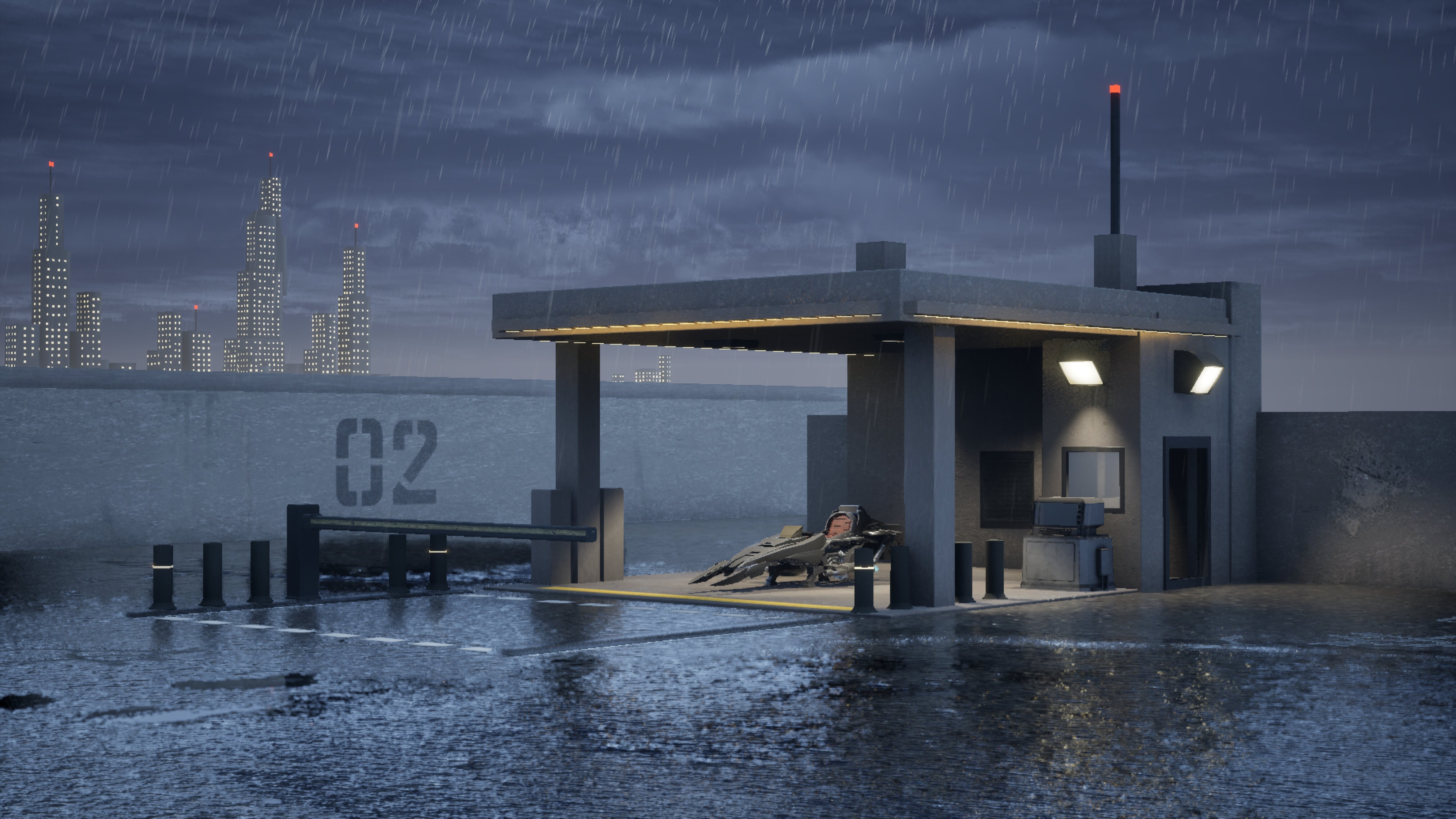
Final ArtStation post here: https://www.artstation.com/artwork/31obo2
Here it is:
Power On:
Power Off:
Bay Console:
detech said:
Thank you very much.