Some thoughts about learning, problem solving, and feedback.
Answer this question honestly when it feels like you're falling behind on a project or stuck on a particular problem: how much are you learning and how much are you getting done?
Each project has it's own unique challenges. Sometimes it takes more time to learn something new or build up the skills needed to complete something else. Everyone screws up from time to time and sometimes it takes more than a couple tries to get something done. So avoid making overly simplistic value judgements. Focus instead on improving your process without being overly critical of yourself.
Make samples. Compare different workflows. Evaluate each process based on the results. Take the time to figure out what works and what doesn't. Look for alternative solutions and specific things that could be improved. Talk to other artists and learn from them. It's often much easier to avoid problems and make sweeping changes earlier in a project so try different things and ask for help or feedback sooner rather than later.
When asking for help or feedback:
State the problem clearly, provide examples of the goal.
Look for existing answers, think about or ask how they could be applied.
Explain what you have tried, what you think isn't working, and what your next approach would be.
Evaluate and implement relevant feedback. Consider that multiple things can be true at the same time. Not everyone has the same goals. Not everyone has the same access to tools. Not everyone enjoys working one way or the other. More often then not there's no one simple answer to complex problems.
Most importantly:Be willing to start over or re-work things that need improvement.
Yes, finishing work is important. Even when it's not perfect but an important part of learning is identifying and fixing the workflow issues that cause repeat problems. Incremental improvement is great but sometimes it's just easier and quicker to start fresh, without having to deal with a bunch of accumulated compounded errors. So be open to trying different approaches and be willing to start over.
Also, avoid becoming so overly invested in any one particular approach or outcome that viable alternatives get dismissed out of hand. It's one thing to say you don't want to do something because you don't like the process or the way it looks and something else entirely to ignore it or say it can't be done because of some random reason or no reason at all.
If you don't like a particular workflow or are genuinely struggling with a particular process then just be honest about it.
There's no real shame in asking for help working through things to improve but there's certainly bound to be frustration in not learning or not improving and arguing about why it is the way it is. Sometimes it's uncomfortable to look at where things are at and working through that is an important part of personal and professional growth. So try to frame sharing work in progress and feedback as more about learning than anything else.
Feedback can also be a good indicator of when it's time to call something done. If the feedback is very broad or vague then that tends to correlate with things being further away from where they need to be. Especially if there's a long list of technical improvements or aesthetic suggestions. If the feedback is very concise and specific, focused on a few smaller details, then you know you're closing in on the desired quality target because you've resolved a lot of the potential issues and captured the look of what's in the concepts or references.
Recap: Ask for feedback early, ask for feedback often, and compare
feedback from multiple sources but make the creative decisions yourself
and avoid using one critique as a foil against the others. Ask
questions. Outline what you think the problem is, what you think the
possible solutions are, what you've tried, what works and what doesn't.
None of the internal spring components need to be modeled.
Consistent loop distribution to maintain surface quality.
Basic boolean block out. All the geometry is generated by simple mesh shapes and non-destructive modifiers.
Most of the shape intersections are self supporting, due to the mesh density, but there's a few areas where support loops were added using old school destructive modeling operations. It works but better segment matching would enable automatic loop placement with bevel / chamfer modifiers.
Pretty basic but it has some interesting shapes with soft, rounded transitions and it's a quick project. Not the best. Not the worst.
Stuff like this isn't all that inspiring but practice is practice and it helps keep things fresh.
Low stakes projects like this can be a good place to start if you're new to modeling and a good way to jump back in if you're out of practice.
Replies
Some thoughts about learning, problem solving, and feedback.
Subdivision sketch: non-locking accessory carabiner.
Just a simple modeling exercise.
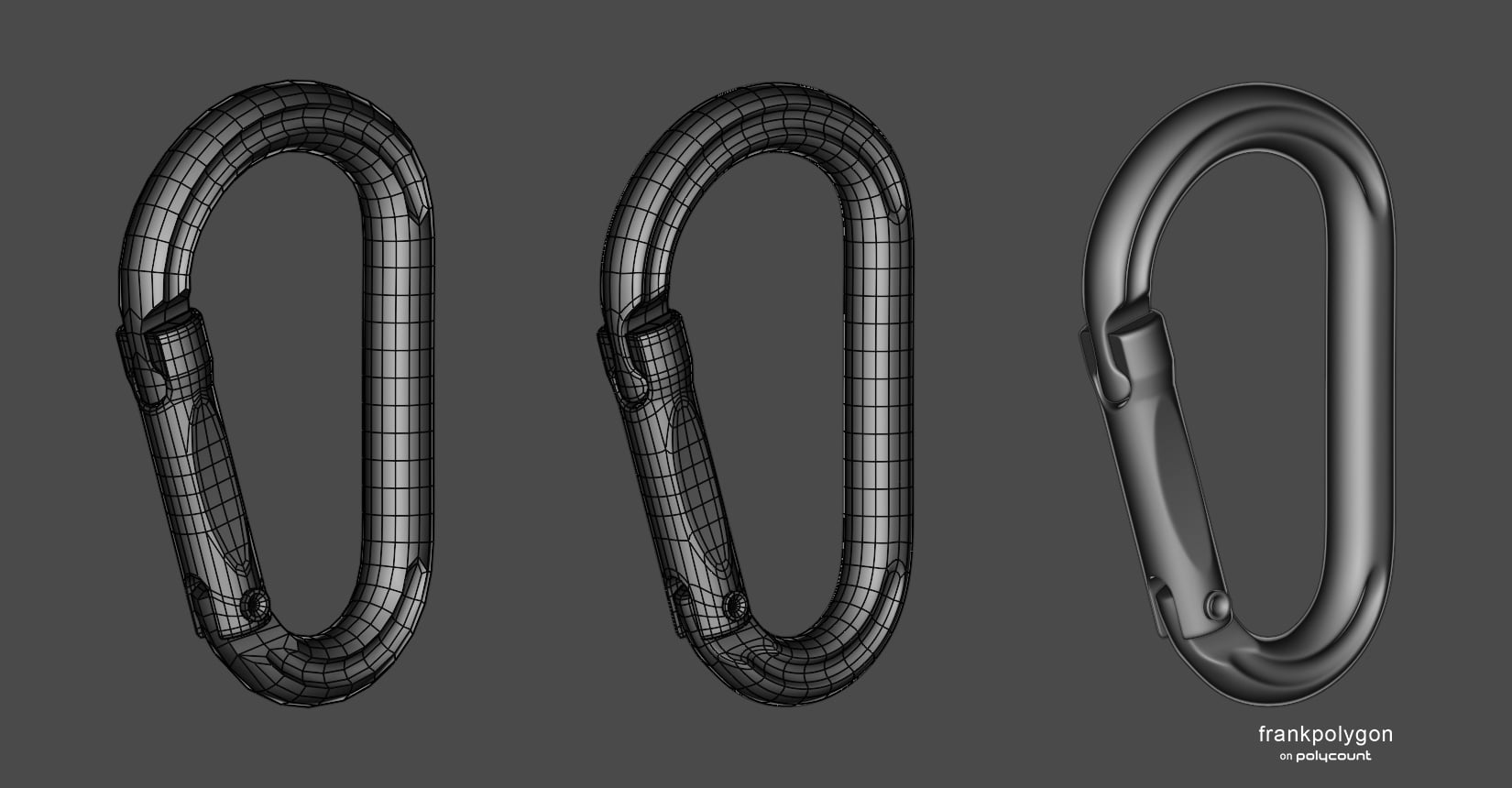
Most of the shape intersections are self supporting, due to the mesh density, but there's a few areas where support loops were added using old school destructive modeling operations. It works but better segment matching would enable automatic loop placement with bevel / chamfer modifiers.
Stuff like this isn't all that inspiring but practice is practice and it helps keep things fresh.
Low stakes projects like this can be a good place to start if you're new to modeling and a good way to jump back in if you're out of practice.