Search
-
Re: Lighting Artist's please
 I have not found many websites, but instead just reading sporadic articles related to film/VFX lighting and talking with other experienced lighting artists both in house and externally over the web and such. Here is some general workflow/tips I have gathered over my short tenure so far as a lighting artist: One major point…
 -
Re: [Hand-painted/Sculpt] Defining Materials
 So much of this hinges on whether we’re talking about texturing for a diffuse-only engine, or for PBR. For PBR all that evidence suggests that you paint in any highlights or form shading very weakly (if at all) and let the engine do its thing to generate reflections. All the cool extra detailing comes from the normal map…
 -
Re: WIP Sword, feedback and Critique please
 Just a few things to note. If you are moving to a PBR workflow you are going to want to check out these: https://www.marmoset.co/toolbag/learn/pbr-theory https://www.marmoset.co/toolbag/learn/pbr-practice Moving to PBR you are going to have to rework your diffuse and specular map. With your diffuse you are going to want to…
 -
Re: Autodesk 3ds Maxscript: How To Get Pixels From Opened Bitmap?
 You may just use theBitmap = selection[1].material.diffusemap --or for batching, stuff like : sel = selection as array for obj in sel do ( theBitmap = obj.material.diffusemap -- ) as your bitmap file is already loaded. Maxscript help says to avoid getpixels for every pixel and use it per row, but else code is working for…
 -
Re: The Art of Pablo Garcia 2025

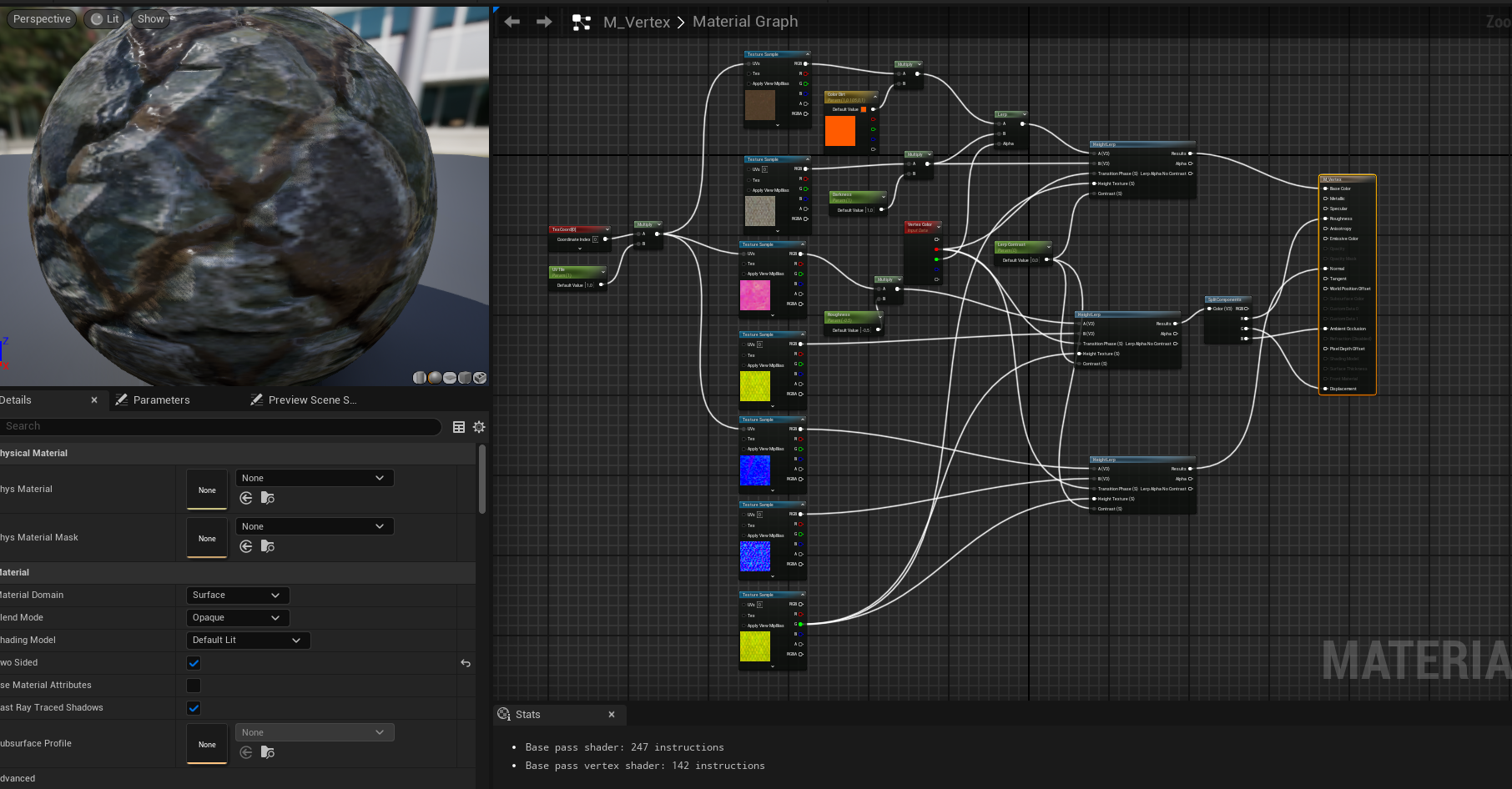 #WIP #Vikings #Project new #material of the #roof painting in #Unreal5 #3d #3dart #gameart #lowpoly #realistic #gamedev #pbr #realistic #unrealengine #videogame #environment #viking #fantasy #gameasset #medieval
 -
Re: Some artist's using metallic values in painted metal for guns?
In the context of PBR texturing (with the metalness workflow) the phosphate coatings aren't pure metals but they can have visual properties similar to metals so they'd fall into the metalloid category. A lot of stuff is still approximate and there can be contextual differences so it's important to experiment with your… -
Re: Show your hand painted stuff, pls!

 I’ll guide you through the process of modeling, creating PBR and hand-painted textures, and 3D printing, followed by painting the model. https://polycount.com/discussion/235911/creating-a-servo-skull-pbr-hand-painted-3d-printing-and-painting-techniques#latest
 -
Re: Opacity map isn't working?
 [GenericMaterial] FS Shader parameters/states log: [GenericMaterial] ------------------ [GenericMaterial] File index: [GenericMaterial] 0: shader-skeleton.frag.glsl [GenericMaterial] 1: shader-common.frag.glsl [GenericMaterial] 2: lib-utils.glsl [GenericMaterial] 3: pbr-alpha-test-dithering.glsl [GenericMaterial] 4:…
 -
Re: IN PROGRESS: Question about roughness maps and unreal engine 4.
That's because some parts of your texture are basically metallic. If you used metallic materials on your project, espetially metals like gold, bronze or titanium (as examples), you WILL have colours on your roughness map. You should check a PBR material chart, and also those amazing PDFs from Marmoset and Allegorithmic :)… -
Re: Tutorial about Texturing?
If my understanding of PBR workflow is correct, while some of the maps between legacy and PBR workflows share the same name, not all give the same ouput with the same input with their respective shaders. For instance, a specular map using pbr isn't the same as a specular map using legacy. The same with gloss. Really I…
>15784 results