Search
-
Re: Need help with an unwrap to get better resolution.
 There is this layered material for Toolbag: http://polycount.com/discussion/181390/released-material-blending-shaders-for-marmoset-toolbag-3 Its a common approach to blend a few tiling textures on large assets, so to avoid the issue you are facing right now.
 -
Re: How can I optimize materials with tillable material mask

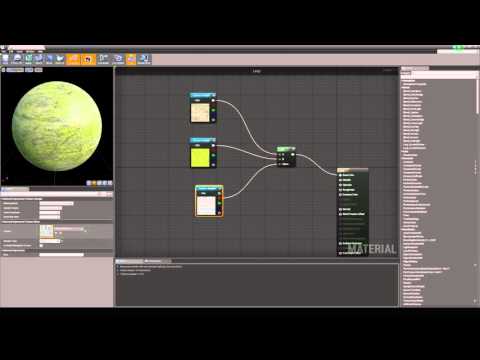 Material blending on that scale is generally done through shaders in engine. https://www.youtube.com/watch?v=-fLW2tLaVFE but for material blending in designer is done like this https://www.youtube.com/watch?v=s7sr1w3kXOs algorithmic has a ton of intro tutorials on their youtube channel.
 -
Re: Baking out Diffuse maps (for quick selecting in Photoshop)
 There is not AA on my exported texture, so no bleeding on this side. The only bleeding I have is from the vertex colors. The script is not available in stand-alone, but you can find it in my froTools. Here a little example :
 -
Re: Blood Elf Paladin Bust (replica) - hand painted
 Skin and hair are coming across as tinted monocromatic textures, are you perhaps directly blending a B&W AO with them? If so you may want to try changing the AO color to something more resembling / complementary to the underlying material before blending.
 -
Re: [UE4} Medieval Interior
 Hey bro! Like I said in the WAYWO thread, this is amazing! The first picture, the arch in the upper right, it looks like the flat wall texture is blending in beautifully with the corner of the arch. Was that some painful UVing and texturing, or is the shader procedurally blending those together?
 -
Re: Tokoyas Hand Painted Stuff
 It still blends in, I meant either make it really dark, like chocolate (and then you would make the writing in white or whatever), or make the map much lighter like an off-white. If you squint your eyes the map still blends into the table!
 -
Re: Practise animation, Feedback welcome :)
 Look at Animation Phonemes. http://animation.about.com/od/flashanimationtutorials/a/animationphonem.htm generally I create blend shapes of each phoneme mouth shape and you can blend between the mouth shapes to sync with sound. It depends on your workflow and type of rigging of course.
 -
Re: The Bi-Weekly Substance Challenge (Challenge 7, 8, 9, 10, 11 & 12)
 I really don't get the material blend mode at all, I skipped through all 4 official tutorials and felt like I didn't understand why I would use it over just the normal blend nodes. Just me?
 -
Re: IN PROGRESS: How to use Quixel with High Poly models?
 Hi :) Here you have the .blend file. It's basically a node group (WIP) that should be ready to just input the Quixel textures in. GRENADE BLEND FILE Hope you find it useful! PS: Eric, thank you! Looking forward on that guide :D
 -
Re: A lesson in photo manipulation.
 Lots of sites out there trying to explain them, I found these to be among the better ones... From an artist's perspective: http://www.myinkblog.com/2009/07/14/an-explanation-of-photoshop-blend-modes/ From a coder's perspective: http://www.nathanm.com/photoshop-blending-math/
>11463 results