Hey, i'm doing a study project of an katana and a buckler shield with this kinda of "cheap material" base style, like, both base pieces would be considered low quality pieces with this almost like parasite wooden branches that starts to spread along it, there's still some word to do on the blades of the katana and wooden planks on the shield but what i'm really looking for is feedback on the wooden branches, the ones in the katana we're done way before the ones in the shield so i need to comeback to it later
This is a really interesting concept with a lot of potential for environmental storytelling. (Broken items are abandoned then made useful again as the branches grow through them, branches continue to grow and strengthen the items as the player levels up, etc.)
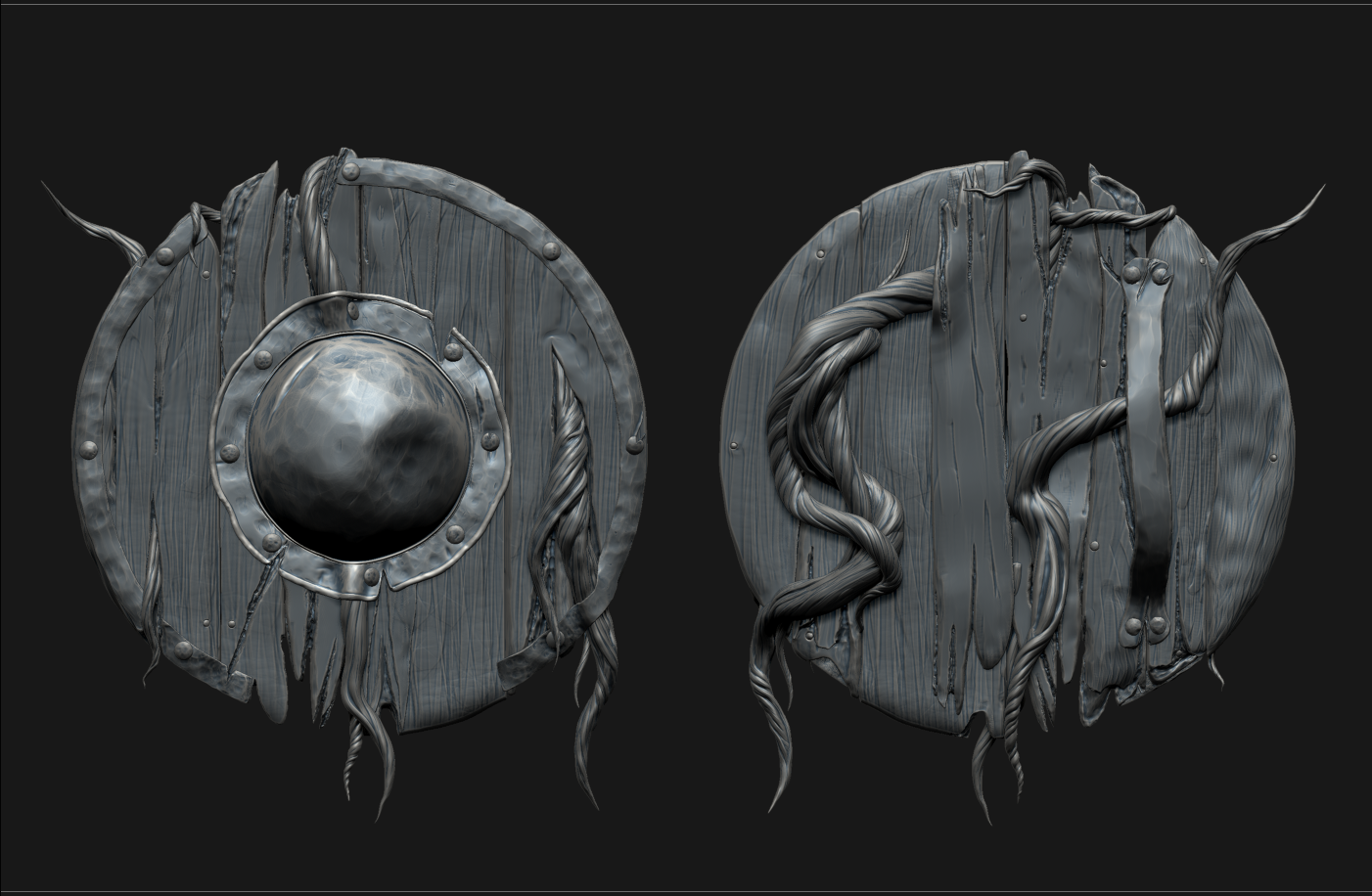
As far as the sculpting goes: the branches and roots that weave the two katana blades together reads more like horn than wood. That's not necessarily a bad thing it's just the surface texture and shapes don't quite match what's in the ref in terms of scale and visual rhythm / repetition. The branches on the shield seem to be more in scale and read more like wood.
The wood sculpt on the hilt looks good for a first pass but the grain pattern on the wooden boards looks a bit out of scale: too much detail width wise and not enough depth detail. It's simultaneously too much and too little in terms of surface detail. There are a couple boards on the back that have really nice damage patterns, without all the high frequency noise, and those larger details look about right in terms of scale.
Smaller grain details could be sculpted in or they could be added to the textures. Rust pitting on the iron and steel components looks good.
Searching
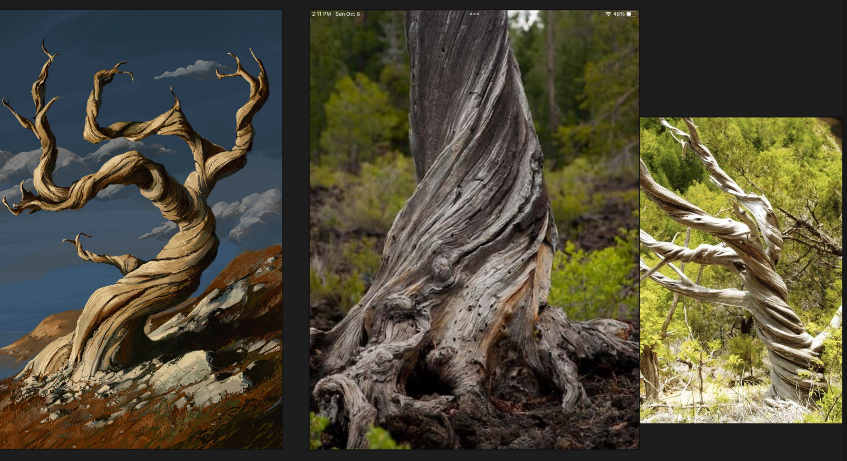
for similar reference images, it looks like those are juniper trees?
They have really gnarly roots with this animal like skeletal quality to
them. Which seems to work well with the theme. Driftwood also has a
similar appearance and could be another good source of inspiration.
Assuming this is for game art and the goal is a semi-realistic
asset: one of the big challenges of concepting props like this is
balancing visual appeal, in-game functionality, and mechanical /
thematic plausibility. Without any context on the world these are
supposed to exist in it leaves a lot open to taste and that's fine but
sometimes design constraints are helpful since it's easier to weed out
ideas that don't fit the project goals.
One of the things that stands out is the katana having two blades that are back to back. It looks cool but it's kind of immersion breaking because it would be unwieldy and changes or limits how the sword would be used. If there's a lore reason for it then it's probably fine but from a design standpoint it's kind of unbalanced both visually and mechanically. Another thing that stands out is the round shield. If it's just part of a general sculpting study or concept exploration then that's fine. Thematically though it does weaken the presentation of the concept a bit because the katana is typically used without a shield.
As far as the branches and roots themselves: the biggest challenge is incorporating them into the objects in a way that makes sense from both a visual and mechanical design perspective. The holes in the katana blade open the question of who put them there and why? Is there a better way to connect the blade to the hilt? Would the branches and roots of a tree grow through or around something like a shield?
Some other things to consider: how does the player acquire these items? Do they have to cut them free from a branch that's still growing or did the tree die, leaving brittle branches that are easily snapped? Is there magic in the branches or roots? If there is, how can that be visually communicated?
A lot of the branches and roots in the refs have this curved or spiral
growth pattern that can be incorporated into both concepts. Trees will
often grow around objects and it's almost impossible to remove them
without harvesting the tree.
Taking those sort of queues from the references really helps with both
balancing the visual design and the plausibility aspects of the
mechanical design.
(The double katana design could be improved by balancing out the size of
the blades and increasing the size of the branches while also
incorporating them as more of the handle itself. If the branches grew
for long enough they'd completely fill the holes and that'd be a really
solid attachment point.
Similarly, the shield would probably be
split by the branches so it might make more sense to have the branches
envelop the outer perimeter of the shield or just one corner with only a
couple of smaller branches growing through an open knot hole or missing
board.)
It's also helpful to have references of similar objects to borrow
design queues from and to double check how things are built so the
mechanical details of the concept are at least visually accurate and
plausible. There's a couple of different sword designs that would work
well with the branch and root concept: particularly basket hilts, cup
hilts, and crown hilts.
Rattan and wicker crafts could be another good source of inspiration: both have a martial history and involve bending stiff plant material to make durable goods. Including shields, scabbards, armor, etc. Bonsai could also be another reference source for ideas on how to form the branches and roots around different things in an aesthetically pleasing way.
While it is possible to concept entirely in 3D, it may be worth exploring a few different ideas with basic 2D sketches, block out paint overs, or photo bashes first. Since it's a lot easier to get a feel for how everything will look when it's done and it's also a bit easier to make a lot of adjustments quickly then compare them, without having to commit to fully modeling any one of them.
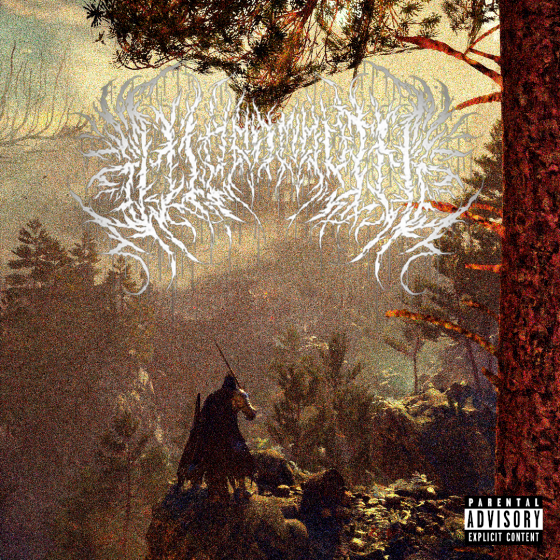
Here's a few explorations of this concept using paint overs and photo bashing.
This first concept replaces the double Katana blades with a single Kris style blade that compliments the natural curvature of the branches and roots. The hilt also incorporates a bonsai technique where back is stripped off but the tree still grows along the live branch. Some kind of talisman or decorative trinkets could be added to the hilt, underneath the exposed branches, to further develop the story line as the player levels up or hits certain milestones in the game.
The second concept looks at a simplified katana that was repaired with whatever wood was available. This is sort of a found objects story path and also has the added bonus of blending in with nature in a way that's fairly inconspicuous. After all, from a distance this just looks like an old stick. Moss growth could be used to track the passage of time and a flowering vine could be used to track the player's progress.
The third concept pairs the sword with the shield. This is a basket hilt highland sword with a very rusty blade. Clearly the branches and roots have reclaimed this long lost sword. What happened to it's previous owner? How did it get here? Where will the player take it? Branch re-growth from a single bud could be used to track the player's power level and the blade would be polished as the player progresses.
The fourth concept is just a simple exploration of how the branches and roots could envelop a smaller buckler or a full size round shield. Here the wicker buckler is being absorbed by the driftwood. How does it work? Magic... Somehow that makes the buckler stronger. The larger round shield is wedged between the roots of a juniper tree. Clearly this has been here a while since there's a whole tree sprouting out of it. Or maybe the player is really high level. Who knows? Choose your own adventure. (These are both scaled 1:1 relative to each other. Bucklers tend to be fairly small.)
Overall, the branches absorbing gear is a really cool concept. Sculpting process looks good. Really just comes down to refining the size and placement of the branches. There's so many places you could go with it. Hope it's alright that I ran with the base concept a bit: feel free to model off my concept explorations if they're helpful.
i still think there's too many really thin, small branches, even for a 'hero' asset
try retopologizing, baking, and putting it in your favourite game engine, you'll see what I mean. The hilt especially will be difficult to lowpoly and bake. If you want dense, vein-like parasitic branches have them blended into the surface so the normal map handles most of them
This is a really interesting concept with a lot of potential for environmental storytelling. (Broken items are abandoned then made useful again as the branches grow through them, branches continue to grow and strengthen the items as the player levels up, etc.)
As far as the sculpting goes: the branches and roots that weave the two katana blades together reads more like horn than wood. That's not necessarily a bad thing it's just the surface texture and shapes don't quite match what's in the ref in terms of scale and visual rhythm / repetition. The branches on the shield seem to be more in scale and read more like wood.
The wood sculpt on the hilt looks good for a first pass but the grain pattern on the wooden boards looks a bit out of scale: too much detail width wise and not enough depth detail. It's simultaneously too much and too little in terms of surface detail. There are a couple boards on the back that have really nice damage patterns, without all the high frequency noise, and those larger details look about right in terms of scale.
Smaller grain details could be sculpted in or they could be added to the textures. Rust pitting on the iron and steel components looks good.
Searching
for similar reference images, it looks like those are juniper trees?
They have really gnarly roots with this animal like skeletal quality to
them. Which seems to work well with the theme. Driftwood also has a
similar appearance and could be another good source of inspiration.
Assuming this is for game art and the goal is a semi-realistic
asset: one of the big challenges of concepting props like this is
balancing visual appeal, in-game functionality, and mechanical /
thematic plausibility. Without any context on the world these are
supposed to exist in it leaves a lot open to taste and that's fine but
sometimes design constraints are helpful since it's easier to weed out
ideas that don't fit the project goals.
One of the things that stands out is the katana having two blades that are back to back. It looks cool but it's kind of immersion breaking because it would be unwieldy and changes or limits how the sword would be used. If there's a lore reason for it then it's probably fine but from a design standpoint it's kind of unbalanced both visually and mechanically. Another thing that stands out is the round shield. If it's just part of a general sculpting study or concept exploration then that's fine. Thematically though it does weaken the presentation of the concept a bit because the katana is typically used without a shield.
As far as the branches and roots themselves: the biggest challenge is incorporating them into the objects in a way that makes sense from both a visual and mechanical design perspective. The holes in the katana blade open the question of who put them there and why? Is there a better way to connect the blade to the hilt? Would the branches and roots of a tree grow through or around something like a shield?
Some other things to consider: how does the player acquire these items? Do they have to cut them free from a branch that's still growing or did the tree die, leaving brittle branches that are easily snapped? Is there magic in the branches or roots? If there is, how can that be visually communicated?
A lot of the branches and roots in the refs have this curved or spiral
growth pattern that can be incorporated into both concepts. Trees will
often grow around objects and it's almost impossible to remove them
without harvesting the tree.
Taking those sort of queues from the references really helps with both
balancing the visual design and the plausibility aspects of the
mechanical design.
(The double katana design could be improved by balancing out the size of
the blades and increasing the size of the branches while also
incorporating them as more of the handle itself. If the branches grew
for long enough they'd completely fill the holes and that'd be a really
solid attachment point.
Similarly, the shield would probably be
split by the branches so it might make more sense to have the branches
envelop the outer perimeter of the shield or just one corner with only a
couple of smaller branches growing through an open knot hole or missing
board.)
It's also helpful to have references of similar objects to borrow
design queues from and to double check how things are built so the
mechanical details of the concept are at least visually accurate and
plausible. There's a couple of different sword designs that would work
well with the branch and root concept: particularly basket hilts, cup
hilts, and crown hilts.
Rattan and wicker crafts could be another good source of inspiration: both have a martial history and involve bending stiff plant material to make durable goods. Including shields, scabbards, armor, etc. Bonsai could also be another reference source for ideas on how to form the branches and roots around different things in an aesthetically pleasing way.
While it is possible to concept entirely in 3D, it may be worth exploring a few different ideas with basic 2D sketches, block out paint overs, or photo bashes first. Since it's a lot easier to get a feel for how everything will look when it's done and it's also a bit easier to make a lot of adjustments quickly then compare them, without having to commit to fully modeling any one of them.
Here's a few explorations of this concept using paint overs and photo bashing.
This first concept replaces the double Katana blades with a single Kris style blade that compliments the natural curvature of the branches and roots. The hilt also incorporates a bonsai technique where back is stripped off but the tree still grows along the live branch. Some kind of talisman or decorative trinkets could be added to the hilt, underneath the exposed branches, to further develop the story line as the player levels up or hits certain milestones in the game.
The second concept looks at a simplified katana that was repaired with whatever wood was available. This is sort of a found objects story path and also has the added bonus of blending in with nature in a way that's fairly inconspicuous. After all, from a distance this just looks like an old stick. Moss growth could be used to track the passage of time and a flowering vine could be used to track the player's progress.
The third concept pairs the sword with the shield. This is a basket hilt highland sword with a very rusty blade. Clearly the branches and roots have reclaimed this long lost sword. What happened to it's previous owner? How did it get here? Where will the player take it? Branch re-growth from a single bud could be used to track the player's power level and the blade would be polished as the player progresses.
The fourth concept is just a simple exploration of how the branches and roots could envelop a smaller buckler or a full size round shield. Here the wicker buckler is being absorbed by the driftwood. How does it work? Magic... Somehow that makes the buckler stronger. The larger round shield is wedged between the roots of a juniper tree. Clearly this has been here a while since there's a whole tree sprouting out of it. Or maybe the player is really high level. Who knows? Choose your own adventure. (These are both scaled 1:1 relative to each other. Bucklers tend to be fairly small.)
Overall, the branches absorbing gear is a really cool concept. Sculpting process looks good. Really just comes down to refining the size and placement of the branches. There's so many places you could go with it. Hope it's alright that I ran with the base concept a bit: feel free to model off my concept explorations if they're helpful.
Keep up the good work!
Hi Frank, first of all, thank you so much for taking the time to write this in-depth feedback. I’m really grateful that you did that.
The branches on the sword really don’t look like the ones on the shield, i definitely need to go back and redo a lot of stuff. i’ve already made some changes, ditched parts that I felt that didn’t suit it well, like the “crown” at the connection between the blade and the handle. as for the wooden boards, I left them to do the tertiary details once I finish the branches. I got Pablo Muñoz’s wooden brush pack a while ago, so i’ll be doing a lot of tests to see what fits better.
Just to clarify the concept I have in mind: in a game context, this would be for an enemy with many variants both human and even animal-like. i’m still trying to figure out the whole concept, but it’s heading in the direction of; imagine these branches functioning somewhat like a fungus, but with some kind of consciousness.
So for example, a battlefield with lots of corpses and weapons. the parasite doesn’t fully understand what is useful and what isn’t, but based on the memories of its host, it gathers info that one item is offensive and another is defensive, so it takes whatever could be useful. The katana, for instance, wouldn’t be ideal for a human, but the host of the parasite has superhuman strength, so even a worn-down blade that can’t cut could still be used as a concussive weapon (in DnD terms), due to the host’s strength. that also implies it would be used one-handed, similar to how Maki from Jujutsu Kaisen fights
If I decide to explore the concept visually a bit more, the host would probably be a dead human (maybe in some state of decomposition) with branches growing out of it — I imagined them emerging from the eye sockets, wounds, etc.
Also, thanks for the insight about photobashing. I really wish I had a 2D artistic background like many 3D artists do, but Ii kind of dropped into this out of the blue. i really need to take some time to learn at least the basics so i don’t waste so much time trying to come up with everything directly in 3D. i plan to someday (maybe next year) at least start trying to make my own game. i already have some knowledge of rigging and I’m working on improving my anatomy awareness, but I’ll try to make some room to learn at least a bit of 2D concepting because I know it’ll save me a lot of time.
i still think there's too many really thin, small branches, even for a 'hero' asset
try retopologizing, baking, and putting it in your favourite game engine, you'll see what I mean. The hilt especially will be difficult to lowpoly and bake. If you want dense, vein-like parasitic branches have them blended into the surface so the normal map handles most of them
ya also bucklers are usually center-grip.
The wood looks better than before, good work
now that you said i'm really felling that some branches are really too small, in a isometric perspective most of them wouldn't even be visible and would be wasting resources, i really will go back to fix that, i will also try to do those veins on the planks, for the buckler i was using some like those as reference because i felt that it can move more freely with the arm and the wrist position don't matter that much, thanks for your feedback
I did some changes on the both pieces, but i'm still not so sure about the branches on the katana, i like how they look but i still hesitant about the volume and the shape of the branches, i will try to do some of the veins that @zetheros mentioned and i will ditch the very small branches, i did some test and they are barely visible in the setting that i have in mind and will only consume resources, even tho isn't gonna be used i wanna try to have the mentality of what should be correct in a real use case , i would like to hear more feedback on thati still need to do some changes to the shield but i REALLY like how it's looking now, the branches growing on the side really gave it more personality
This is the best way that i found to do the branches the way that i want, i tried some other methods but this gave me the best result in almost no time, it obviously need some sculpting after but it establish a very solid base.
For a real use case, nothing better than just doing it; so retopology, unwrap, bake and paint, drop it into your engine of choice. I think if you do that here with these props you'll quickly see how and what to improve. You don't need a perfect sculpt to do this, in fact I would recommend going ahead and try doing it now instead of sculpting more
Bonus points if you can attach it to a character, like the UE5 mannequin, and make adjustments to the camera to create the isometric perspective you want
Replies
Assuming this is for game art and the goal is a semi-realistic asset: one of the big challenges of concepting props like this is balancing visual appeal, in-game functionality, and mechanical / thematic plausibility. Without any context on the world these are supposed to exist in it leaves a lot open to taste and that's fine but sometimes design constraints are helpful since it's easier to weed out ideas that don't fit the project goals.
Some other things to consider: how does the player acquire these items? Do they have to cut them free from a branch that's still growing or did the tree die, leaving brittle branches that are easily snapped? Is there magic in the branches or roots? If there is, how can that be visually communicated?
(The double katana design could be improved by balancing out the size of the blades and increasing the size of the branches while also incorporating them as more of the handle itself. If the branches grew for long enough they'd completely fill the holes and that'd be a really solid attachment point.
Similarly, the shield would probably be split by the branches so it might make more sense to have the branches envelop the outer perimeter of the shield or just one corner with only a couple of smaller branches growing through an open knot hole or missing board.)
Keep up the good work!
try retopologizing, baking, and putting it in your favourite game engine, you'll see what I mean. The hilt especially will be difficult to lowpoly and bake. If you want dense, vein-like parasitic branches have them blended into the surface so the normal map handles most of them
ya also bucklers are usually center-grip.
The wood looks better than before, good work
Hi Frank, first of all, thank you so much for taking the time to write this in-depth feedback. I’m really grateful that you did that.
The branches on the sword really don’t look like the ones on the shield, i definitely need to go back and redo a lot of stuff. i’ve already made some changes, ditched parts that I felt that didn’t suit it well, like the “crown” at the connection between the blade and the handle. as for the wooden boards, I left them to do the tertiary details once I finish the branches. I got Pablo Muñoz’s wooden brush pack a while ago, so i’ll be doing a lot of tests to see what fits better.
Just to clarify the concept I have in mind: in a game context, this would be for an enemy with many variants both human and even animal-like. i’m still trying to figure out the whole concept, but it’s heading in the direction of; imagine these branches functioning somewhat like a fungus, but with some kind of consciousness.
If I decide to explore the concept visually a bit more, the host would probably be a dead human (maybe in some state of decomposition) with branches growing out of it — I imagined them emerging from the eye sockets, wounds, etc.
Also, thanks for the insight about photobashing. I really wish I had a 2D artistic background like many 3D artists do, but Ii kind of dropped into this out of the blue. i really need to take some time to learn at least the basics so i don’t waste so much time trying to come up with everything directly in 3D. i plan to someday (maybe next year) at least start trying to make my own game. i already have some knowledge of rigging and I’m working on improving my anatomy awareness, but I’ll try to make some room to learn at least a bit of 2D concepting because I know it’ll save me a lot of time.
now that you said i'm really felling that some branches are really too small, in a isometric perspective most of them wouldn't even be visible and would be wasting resources, i really will go back to fix that, i will also try to do those veins on the planks, for the buckler i was using some like those as reference because i felt that it can move more freely with the arm and the wrist position don't matter that much, thanks for your feedback
Bonus points if you can attach it to a character, like the UE5 mannequin, and make adjustments to the camera to create the isometric perspective you want