Search
-
Re: Hard Edges on mesh
 https://polycount.com/discussion/81154/understanding-averaged-normals-and-ray-projection-who-put-waviness-in-my-normal-map/p1 this should help with the second issue. the first one feels like you didnt bake with the same mesh and hard edges as you show to preview. or if you did, you didnt split uvs on the hard edges? tho i…
 -
Re: Baking Issues
there are certainly other reasons why not to use super sharp edges but claiming they do not exist in the real world is certainly not one of them. there are sharp materials in reality, perfectly cut ones, even if the edge isnt 100% perfect on an atomic level, edges can be a lot sharper than texture resolutions would allow… -
Re: Baking normals with artifacts in Blender
 These baking artifacts are caused by the convergence of a number of separate but related issues. Material artifacts: The material on the high poly model is generating additional surface information that's causing normal baking artifacts. Removing the material from the high poly model resolves this issue. The material on…
 -
Re: Maya 2022

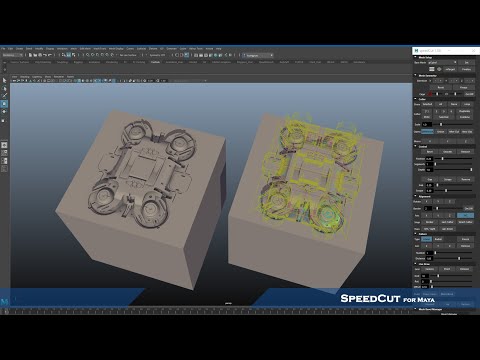 Now included in the Bonustools. https://youtu.be/VoEemCSYR7Y https://apps.autodesk.com/en/Detail/Index?id=8115150172702393827
 -
Re: Cylindrical Normal Map Problem
https://polycount.com/discussion/81154/understanding-averaged-normals-and-ray-projection-who-put-waviness-in-my-normal-map/p1 -
Re: Recommend Plugins for Maya 2020?
https://create3dcharacters.com/zoo2/ are high on my list. And USD to explore the new pipelines. https://github.com/Autodesk/maya-usd/releases/tag/v0.6.0 Also the BonusTools. https://apps.autodesk.com/en/Detail/Index?id=8115150172702393827 PolyRaven for UVS. https://www.polyraven.com/uv/ -
Re: Maya model is missing... sort of ? Weird display
try messing with the clip planes https://knowledge.autodesk.com/support/maya/learn-explore/caas/CloudHelp/cloudhelp/2020/ENU/Maya-Rendering/files/GUID-D69C23DA-ECFB-4D95-82F5-81118ED41C95-htm.html -
Re: Unwrapping a bit more complex cylindrical shape (issue with vertical faces)

 There's always going to be some distortion. There's always going to be a slight variance in pixel density. You could turn all those circles into strips if you wanted. Then scale them to match densities. It's all about optimizing, not finding the perfect solution. The front face of your cylinder will always be distorted…
 -
Re: Writing a research paper for school - Subject : Normal maps
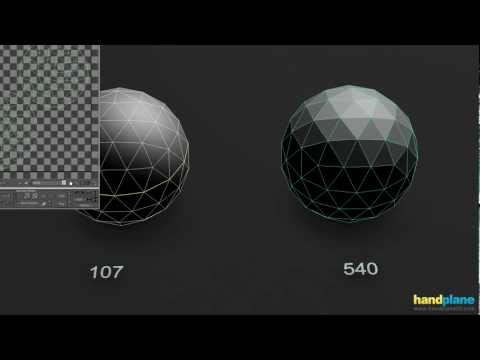 Two of the go-to resources I recommend are Joe Wilson's baking tutorial and Alec Moody's video about controlling shading behavior. The Marmoset Toolbag 3 baking tutorial:https://marmoset.co/posts/toolbag-baking-tutorial/https://marmoset.co/posts/toolbag-baking-tutorial/?page=Map…
 -
Re: How can I bake high poly detail onto a smooth surface and maintain the smoothness?
There are several ways to approach this but a good starting point would be to identify the minimum number of unique UVs needed for all the road wheels. As an example: the front faces of the outer road wheels could all have unique UVs to support painting unique camouflage patterns but the inner road wheels, back sides and…
>1113 results