Search
-
Re: How The F*#% Do I Model This? - Reply for help with specific shapes - (Post attempt before asking)
 It's not so different from what you described your "usual workflow".. model it step by step.. you might have look at this to study the topology: https://sketchfab.com/3d-models/free-193839-vairogs-v2-new-version-e3a9b187643c4bbb84c485b1dd2a53a3 ..IDK if this is already to "highpoly" for what you want/need. So for a more…
 -
Re: How The F*#% Do I Model This? - Reply for help with specific shapes - (Post attempt before asking)

 @christrom It looks like you're headed in the right direction. Like Eric already mentioned, what you have would be fine for baking in most high to low game art workflows. As far as a light technical critique of the model and topology: if the goal is to create accurate, detailed high poly assets with a relatively even…
 -
Re: How The F*#% Do I Model This? - Reply for help with specific shapes - (Post attempt before asking)
 2300511685 Overall it looks like you're already on the right track. It really just depends on what the model is for. If it's for games: the brake has a very rough surface finish and it's a very small part that's typically further away from the player's main point of view. So the current high poly is more than passable…
 -
Re: How The F*#% Do I Model This? - Reply for help with specific shapes - (Post attempt before asking)
 @Laon A few posts up, there's a couple of relevant examples that cover how to use segment matching to connect a cylinder to a curved surface and how to route the topology around the base of a cylinder that connects to an angled surface. The basic principles of these fundamental modeling strategies can be combined to…
 -
Re: How The F*#% Do I Model This? - Reply for help with specific shapes - (Post attempt before asking)
To elaborate on that: Perfectly glossy reflections will amplify even the smallest changes in surface direction, because the angle of the reflection moves twice as much as the surface normal, and vertex interpolated normals/shading is prone to show gradients to begin with. So that's simply how it works. I agree that your… -
Re: How The F*#% Do I Model This? - Reply for help with specific shapes - (Post attempt before asking)
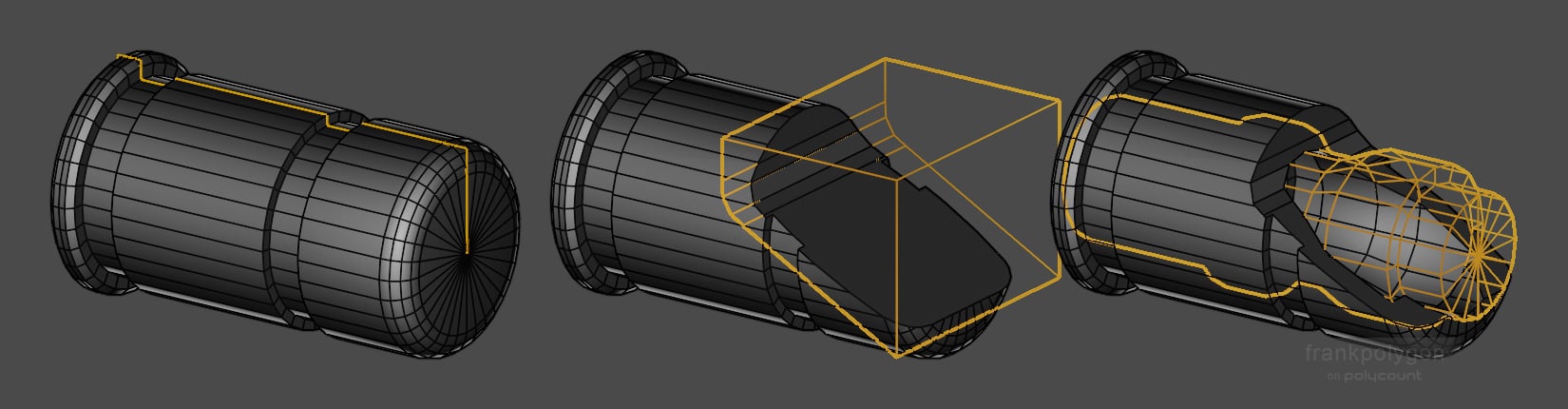
 Check out FrankPolygon's sketchbook. He has a ton of great step-by-steps posts, for example here's one dealing with how to merge two cylinders: https://polycount.com/discussion/comment/2746328/#Comment_2746328
 -
Re: How The F*#% Do I Model This? - Reply for help with specific shapes - (Post attempt before asking)
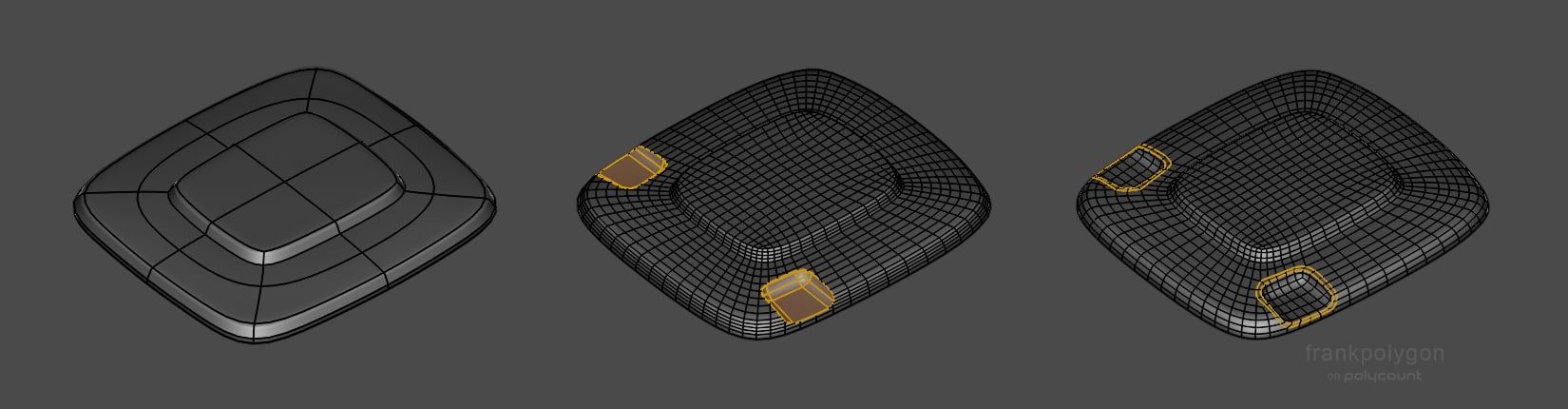
 @anotherdoseofcorey Translating approximate 2D shapes to a reasonably accurate 3D volume can be challenging so it's best practice to start off by blocking out the basic shapes to figure out how it all fits together. Below are three possible options for creating the recessed area around the small cylinder. The first example…
 -
Re: How The F*#% Do I Model This? - Reply for help with specific shapes - (Post attempt before asking)
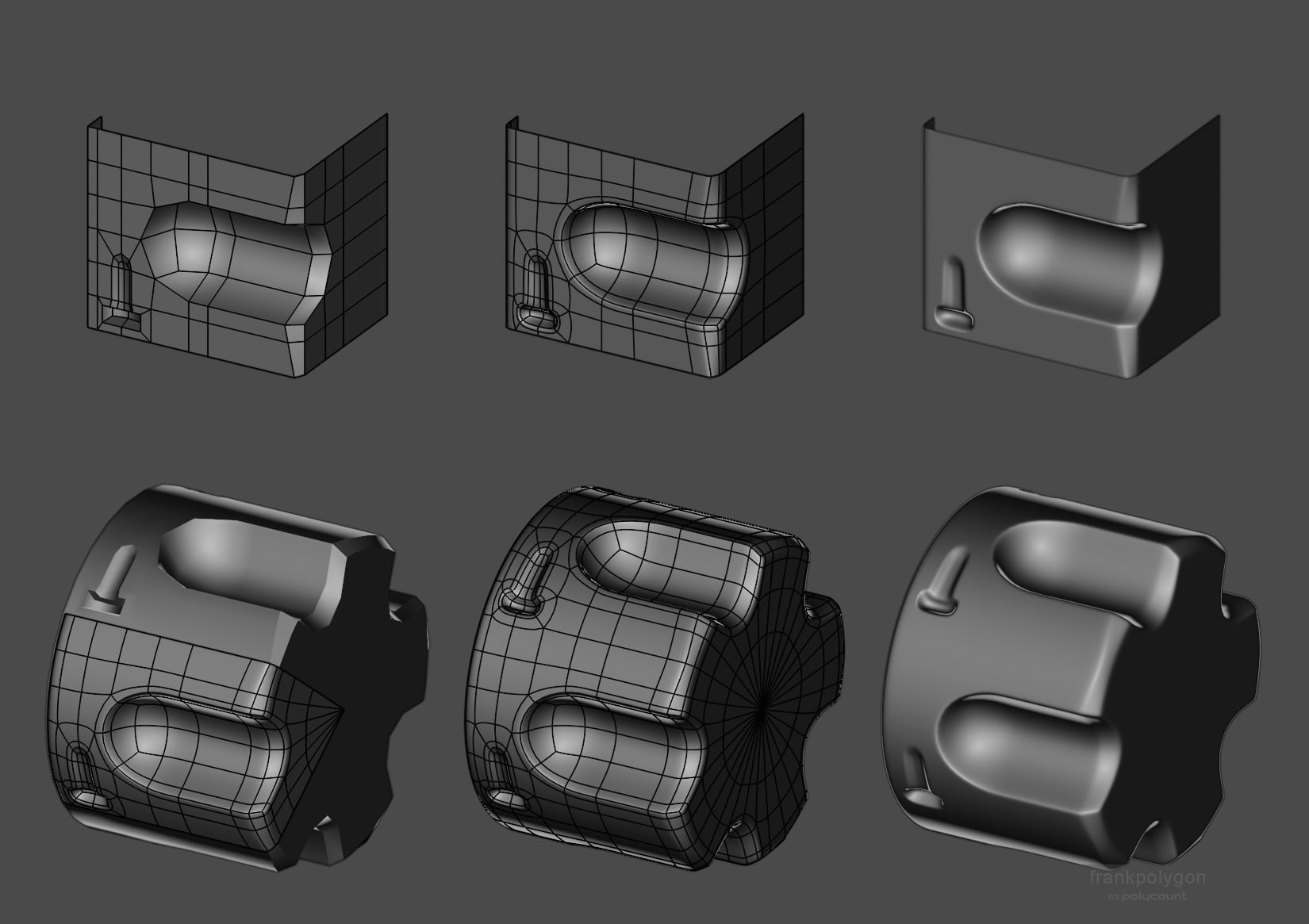 @hayunchooi Welcome to Polycount. Consider checking out the forum information and introduction thread. The really short answer is: there needs to be enough geometry in the larger curve to support the smaller details cut into it. How much more geometry is required really depends on the tools and order of operations used to…
 -
Re: How The F*#% Do I Model This? - Reply for help with specific shapes - (Post attempt before asking)
 @solitudevibes There's a couple of different ways to approach modeling a lighter hood. A direct approach would be to block out the major forms with a simple quad grid then subdivide to create the necessary support geometry for the holes. @wirrexx explains this modeling process, with a great visual example, in another…
 -
Re: How The F*#% Do I Model This? - Reply for help with specific shapes - (Post attempt before asking)
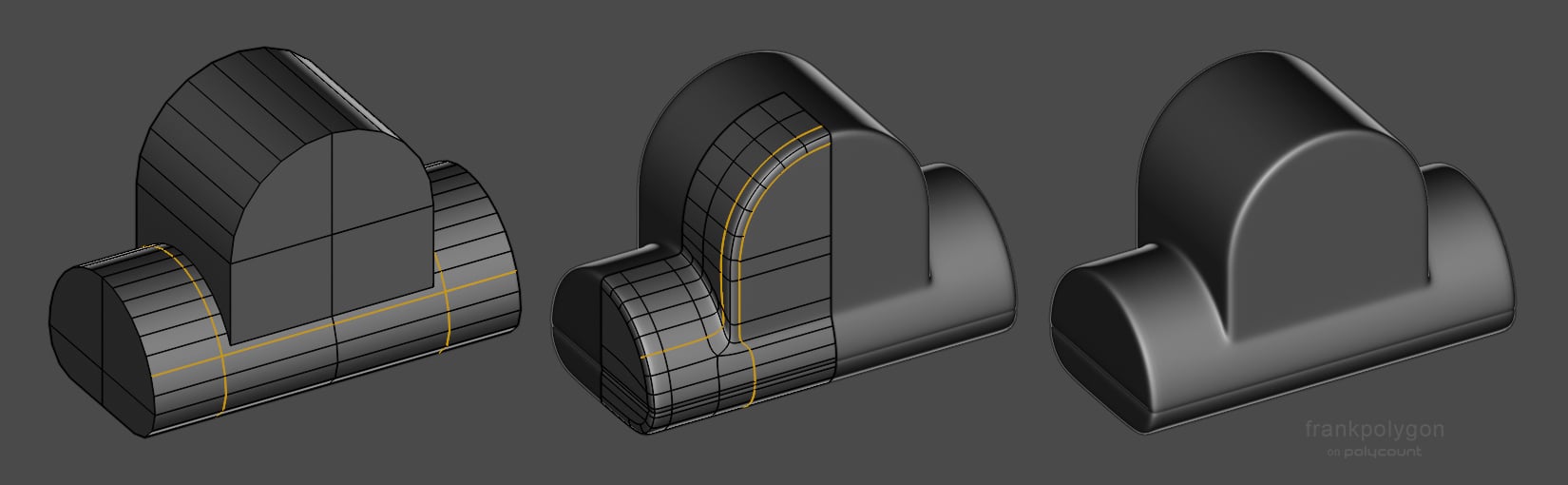 @praba_art Welcome to Polycount. Consider checking out the forum information and introduction thread. Try blocking out both shapes before connecting them and use the existing geometry in the curve as part of the support loops around the base of the intersecting cube. That way the support loops on the intersecting shape can…
609 results