Search
-
Texture /photo straightening techniques?
 I often need to make straight a piece of photogrammetry or just a photo I want to project onto certain regular geometry . With "straightening" I mean something irregular and slightly deformed to become something having equal intervals and X/Y alignment typical for a texture. A baroque building facade for example or a road…
 -
Re: Texture /photo straightening techniques?
Yeah, thanks Eric I am trying to figure out if it's perhaps easier to do on 3dmax patch with texture projection -
Re: Texture /photo straightening techniques?

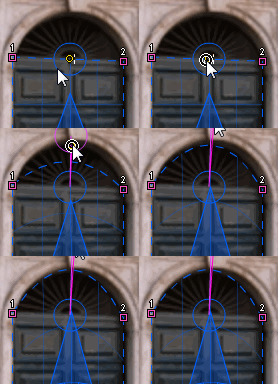 Shoebox Texture Ripper has some nice bezier controls. Pretty easy to use. https://renderhjs.net/shoebox/textureRipper.htm You can download it here for free: https://renderhjs.net/shoebox/ Shoebox was built on Adobe Air, which was then sold off to Samsung, so the runtimes are now here: https://airsdk.harman.com/runtime
 -
Re: Texture /photo straightening techniques?

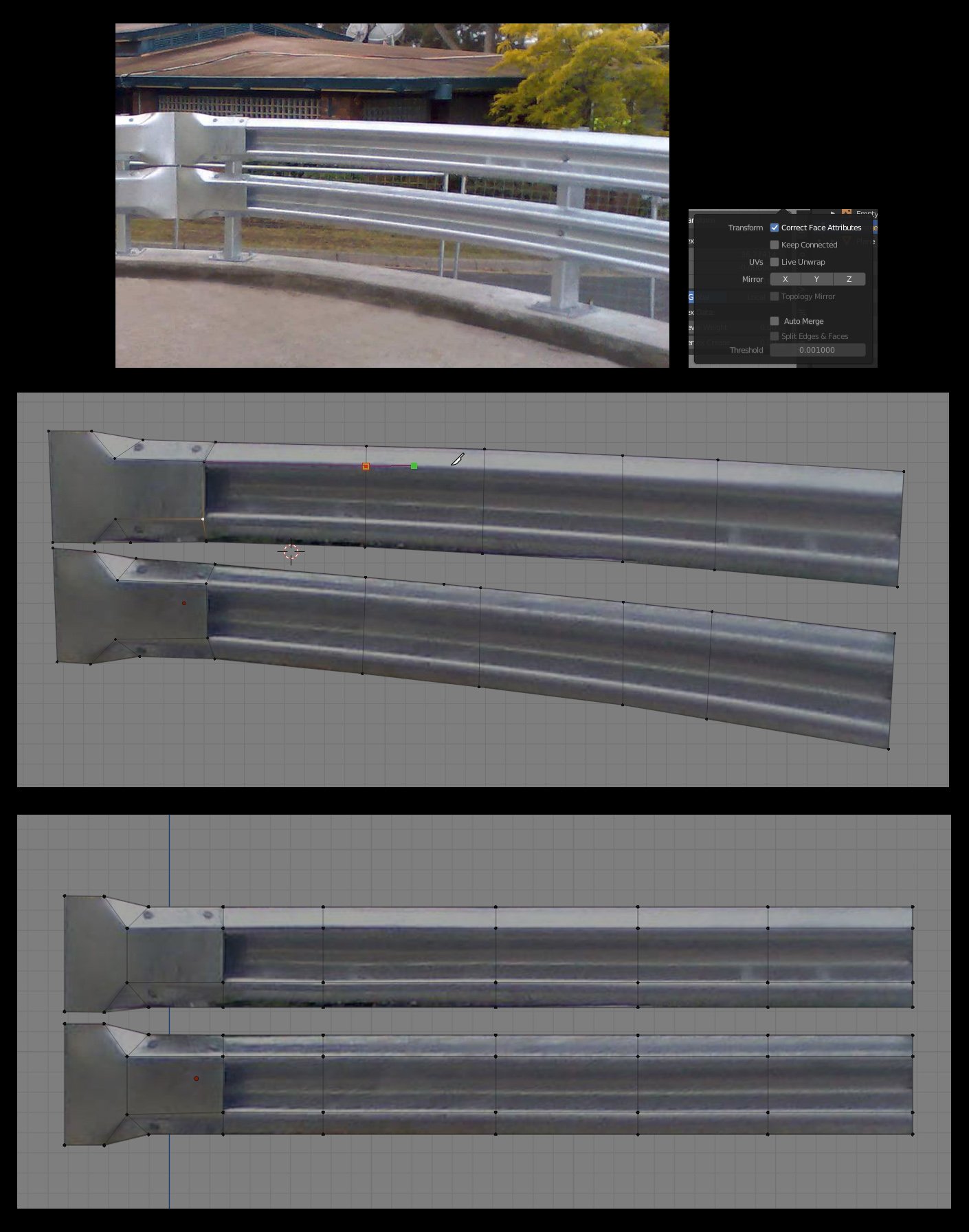 You could simply apply the source photo to a plane, cut in the the needed topology using the Knife tool and leveraging Preserve UVs on/off ("Correct Face Atttributes" in Blender) to match details ; removing the background ; then straightening things as needed. And then of course capturing the result to get the needed…
 -
Re: Texture /photo straightening techniques?
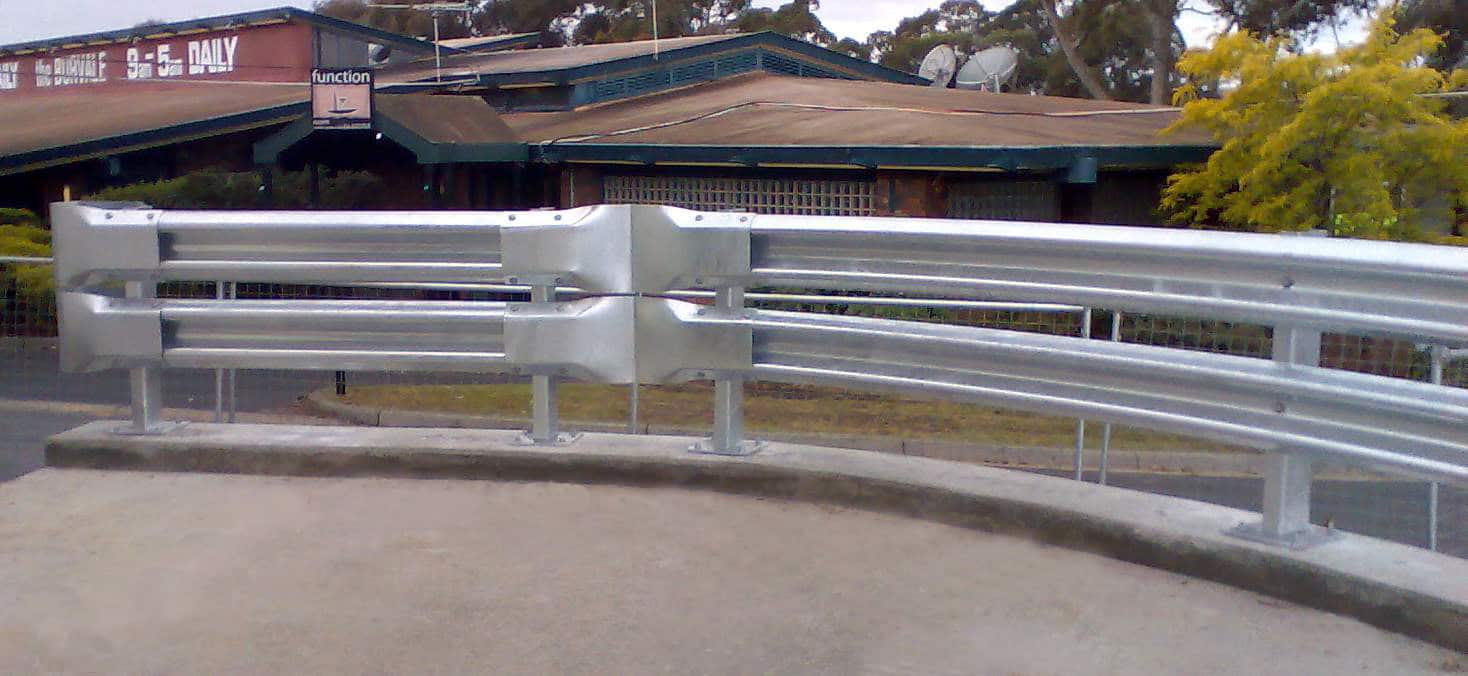 Sorry, with "straightening" I didn't want to sound odd in any way, my apologies, I merely tried to use it in a wider sense as an umbrella term describing not only unwrapping perspective projection into front ortho one but also making the image ready for tile-able texture and have regularly spaced repeating details ,…
 -
Re: Texture /photo straightening techniques?
Thanks a lot Celosia. I use a lot of Higgas groups too :) Have started something like this a while ago, then stacked and fallen deep into a rabbit hole. Your split sharp corners by attribute gave me a fresh idea. So simple. -
Re: Texture /photo straightening techniques?
 Something like this? This is a mesh transformed into curves then filled and passed through a triangle tessellation group, all with Blender's geonodes. Corners are preserved in the conversion to curves by being marked with a Boolean x Point attribute so they get temporarily split. You may need to tweak the Corner Angle…
 -
Re: Texture /photo straightening techniques?
yeah, it's a nice quick approach for simple things but quickly gets tiresome when you need to put lots of points precisely . I still would like something curve node control based with automatic tessellation. -
Re: Texture /photo straightening techniques?
You could try pior's idea, but using nurbs or patch modeling for a larger ref like that. -
Re: Texture /photo straightening techniques?
"the upper one is not perfectly straight having some points off" Yeah that's precisely why I think this barebones approach is interesting IMHO, as while the first pass involves straightening things on Z after placing the meshing, a later second pass is is always possible. Points can be added as needed and they can be…
15 results