Search
-
Re: Early-Late 2000s CGI/Game textures

 Hi there, I'd say you are thinking about this backwards. You are assuming things about the past based on what you know of game art and 3D software of today, which I suppose is an intuitive thing to do ... but this leads you to imagine things about previous tech and workflows that just don't apply at all. - First off,…
 -
Re: Early-Late 2000s CGI/Game textures
 Heh, that's funny. I was there when the deep graphics were written. In the early 2000s GPUs didn't have enough VRAM for baked normal maps, and didn't have enough zoomies to run more than 1 simple shader calculation per pixel. When you did see normal maps, it was only as tiny tileable detail normal maps that would help sell…
 -
Re: Early-Late 2000s CGI/Game textures
 the joys of creating a stair texture that "works" on an angled plane :/
 -
Early-Late 2000s CGI/Game textures

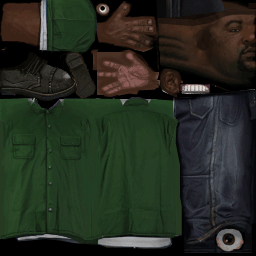 How/what software was used to create PBR textures in the 2000s? For example, Iron Man. The reflective metal is something I've always been curious on how it was done for the time period. Another example is the older GTA's and Half-Life's. How do these textures look so real on the colormap alone?
 -
Re: Early-Late 2000s CGI/Game textures
you can call an output texture whatever you like - not being able to view it in the DCC is a secondary issue that you can either ignore or fix by creating a material that supports it Historically I mostly used 3d software to generate normals, AO and masks rather than all the output channels. They'd then go into photoshop… -
Re: Early-Late 2000s CGI/Game textures
 technically its the same? you can create the same values and materials. just with different channels, gloss is the same as roughness. and making the diffuse black and coloring the spec isnt something that couldnt be authored much the same way. but besides all the regulations and simplifications that came from those. metal…
 -
Re: Early-Late 2000s CGI/Game textures
Hello, "How do these textures look so real on the colormap alone?" These diffuse textures look real because the artists who painted them understood the properties of a given material (similarly to how someone would assign roughness values), but *also* knew how to represent these materials like a figurative painter doing… -
Re: Early-Late 2000s CGI/Game textures
 Its so great to see all this stuff again, my favorite era of game art
 -
Re: Early-Late 2000s CGI/Game textures
Also, since the human body is (mostly) symmetrical, a three-quarter or similar view should give you all the points in space as far as visible in that one image. Any point on one half alone could be anywhere in space between the observer and infinity, but the symmetrical equivalent locks it in. Comes with the same caveats… -
Re: Early-Late 2000s CGI/Game textures
 It is indeed restricted and can't be borrowed with a regular account, probably as a consequence of a seemingly recent action by some publishers. https://www.reddit.com/r/ArchiveDotOrg/comments/16tincu/this_book_is_available_to_patrons_with_print/ There are copies available for as low as 10USD though.…
11 results