Search
-
Where can I learn how topology should look when smoothened ?

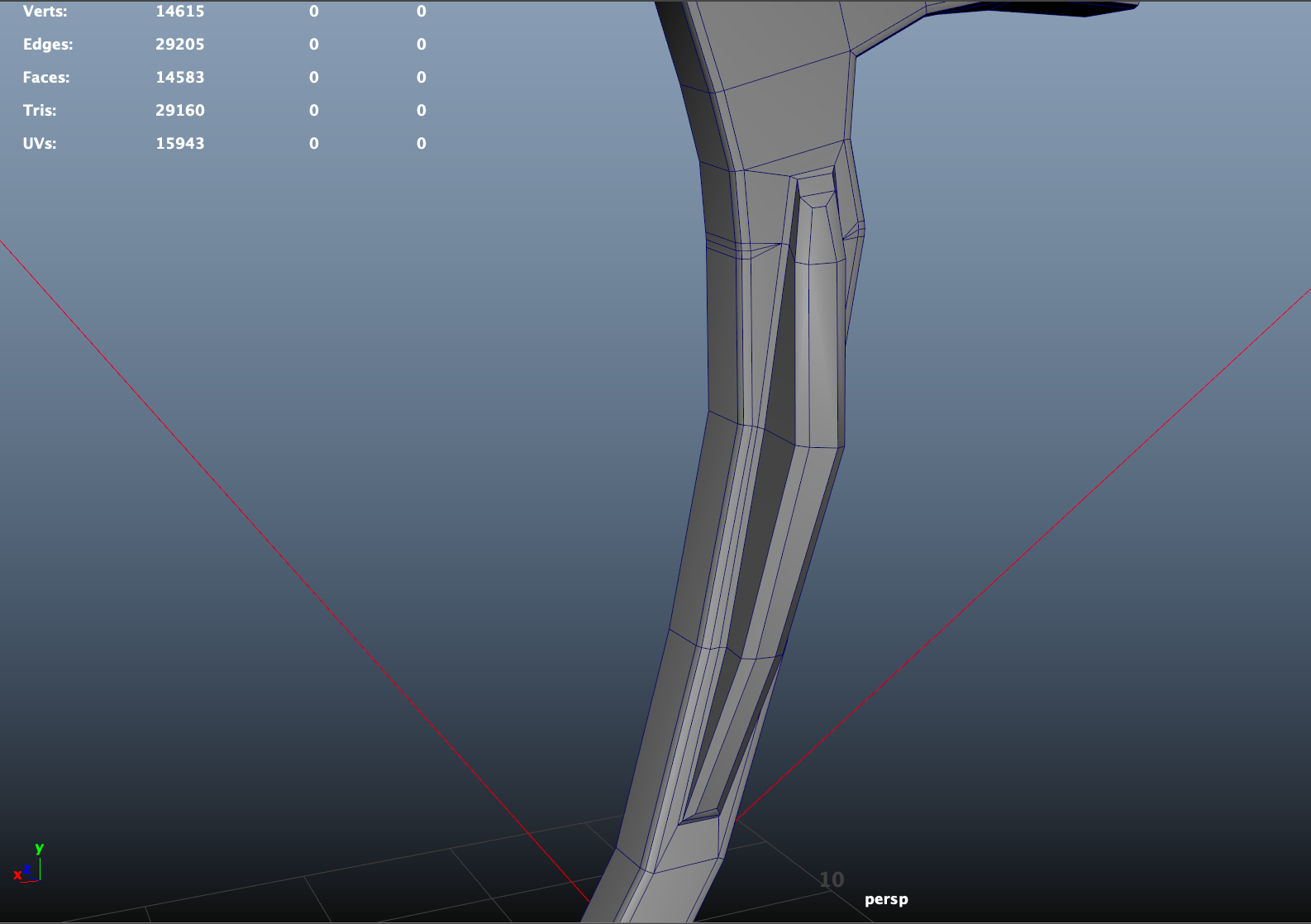 Does anyone have any resources on how edge loops should look when smoothened? I always see these kind of weird edge loops when doing SubD modeling, but I'm not sure if it's supposed to look like that, so where can I learn what topology is normal when doing SubD? edit: Here is another image of the model from the front,…
 -
Re: Where can I learn how topology should look when smoothened ?
 "I always see these kind of weird edge loops when doing SubD modeling, but I'm not sure if it's supposed to look like that..." well, you're only seeing expected behavior when a particular sub division algorithm (there are various types) is applied too a low poly cage, in which shading is controlled by edge loops "What's…
 -
Re: Where can I learn how topology should look when smoothened ?
 But it doesn't smooth properly? I would guess this is a static piece, non deforming just by the looks of it. But some basic subd knowledge is missing to make it work.
 -
Re: Where can I learn how topology should look when smoothened ?
https://polycount.com/discussion/56014/how-the-f-do-i-model-this-reply-for-help-with-specific-shapes-post-attempt-before-asking/p190 190 pages of this topic. I recommend looking for things by @FrankPolygon -
Re: Where can I learn how topology should look when smoothened ?
Hi, thanks for the insight I have updated my post to include the reference. -
Re: Where can I learn how topology should look when smoothened ?
 Sub D doesn't matter. Animated sub D matters. Low poly doesn't matter. Animated low poly matters. If it smooths properly, who cares? Your example above shows three edges converging to one so normally you would merge the other two, but maybe there is a reason for the three. There is a guy here who does a low poly of his…
 -
Re: Where can I learn how topology should look when smoothened ?
 Hi! The How The F*#% Do I Model This? is a great collection of different situations and place one can to turn to when stuck. Also share the reference, so people know what the goal is. The wiki might contain some useful for information and links relating to this and other topics. Frank Polygons sketchbook contains some…
 -
Re: Where can I learn how topology should look when smoothened ?
You can learn about the algorithm by googling for catmull-rom smoothing and/or bicubic interpolation What's most important to understand is that the position of a vertex changes after smoothing based on the relative position of it's first and second neighbours. If you want tips on how best to structure your input mesh,…
8 results