Search
-
Re: Sketchbook: Frank Polygon
 Some thoughts about learning, problem solving, and feedback. Answer this question honestly when it feels like you're falling behind on a project or stuck on a particular problem: how much are you learning and how much are you getting done? Each project has it's own unique challenges. Sometimes it takes more time to learn…
 -
Re: Sketchbook: Frank Polygon
 @orangesky Thanks for the comment. Glad the write-ups have been enjoyable and informative. The short answer is: it depends. Context is really important because, even from a broad perspective, there's some significant differences between organic and hard surface modeling. While there's definitely some overlap in the…
 -
Sketchbook: Frank Polygon
I'll be using this sketchbook thread as a place to warehouse write-ups that wouldn't really fit anywhere else. Most of the content will cover concepts and fundamentals related to hard surface modeling with some broader commentary on the creative process. -
Re: Sketchbook: Frank Polygon
 Art fundamentals: test samples and process validation. Creating test samples, to explore different workflows or approaches to solving a specific problem, is something that takes a bit of extra time but can be a very powerful tool for validating ideas without having to commit to taking a specific path. It's tempting to skip…
 -
Re: Sketchbook: Frank Polygon
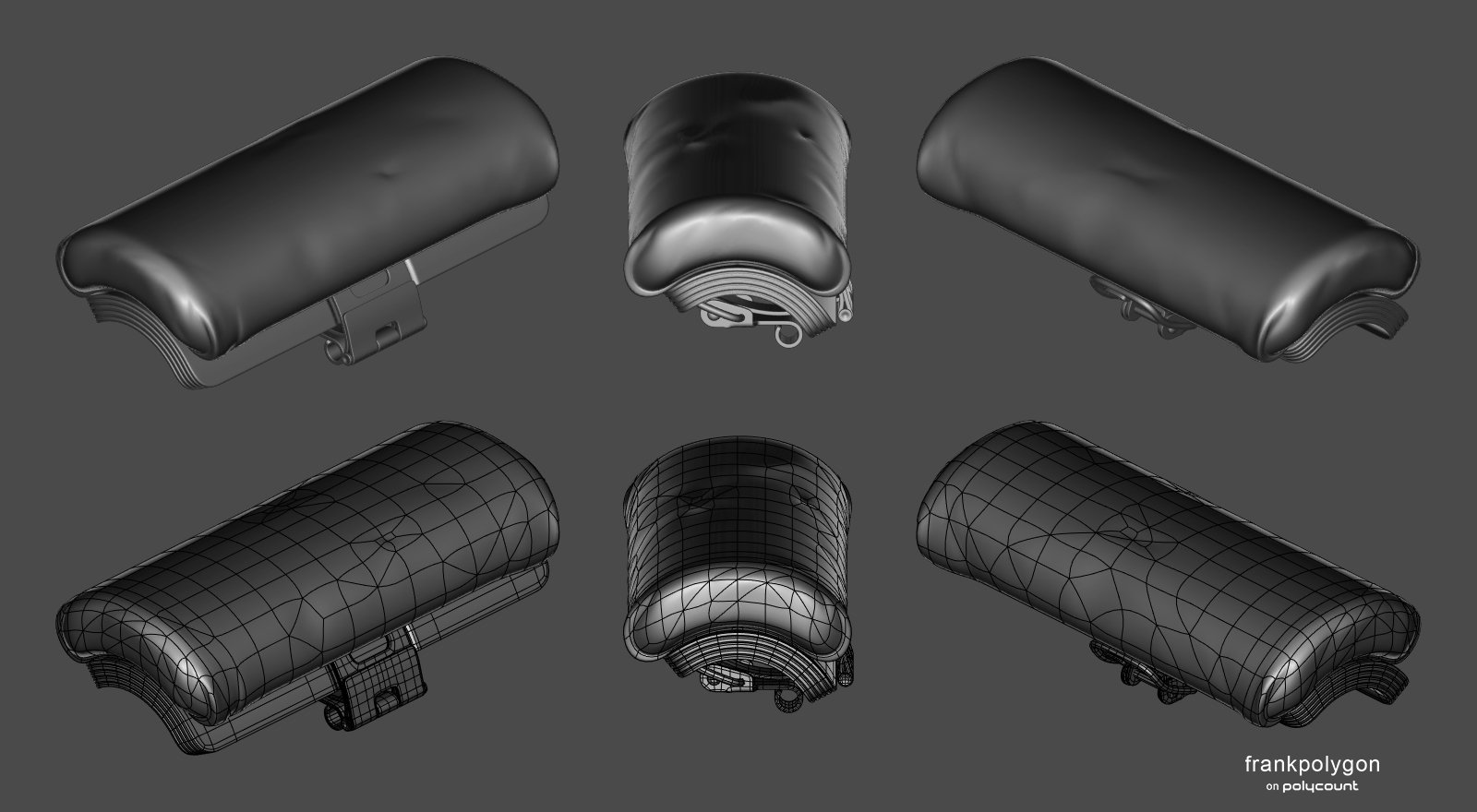 Subdivision sketch: soft hard surface. This write-up is a brief look at using basic modeling operations to create a base mesh for stiffer types of soft goods. Complex folds and detailed wrinkles can be added to the base mesh using textile specific sculpting and simulation tools but the tradeoff is these processes tend to…
 -
Re: Sketchbook: Frank Polygon
 Subdivision sketch: studying shapes and simplifying subdivision. This write-up is a brief overview of a simple, shape based approach to subdivision modeling. This approach, with the primary focus being to create accurate shapes that define the loop flow paths, can help streamline the modeling process for most hard surface…
 -
Re: Sketchbook: Frank Polygon
 To anyone just starting out in game art. Learning a game asset creation pipeline requires commitment and repetition. It can be tempting to rush through projects but it's important to remember that it's often less about how fast the work is done and more about what is learned along the way. Actively participating in the…
 -
Re: Sketchbook: Frank Polygon
 Subdivision modeling: block outs and incremental progression. Drawing is a creative process that most people encounter quite early on so it's often appealing to try and draw parallels between the initial rough sketch used to develop a finished drawing and the block out mesh used to develop a finished model. Taking this…
 -
Re: Sketchbook: Frank Polygon
 Lighting breakdowns This write-up looks at how some of the fundamentals of photographic composition can be applied to render setups for presenting real-time assets. Since each render engine is slightly different this is less of a deep dive into the technical nuances of how things work and more of a broad overview of how to…
9 results