Search
-
Re: Rounded corners filter in Substance Painter
 I though this was done with UV shell mask too, and requires an SVG or bitmap. Anyone know if there is a way to access the UV coordinates via code magic and auto generate a UV shell mask? I guess that may be flawed the way Designer works, you'd need to feed it a 3D model in a node.... guess baking it out makes sense in the…
 -
Re: Rounded corners filter in Substance Painter

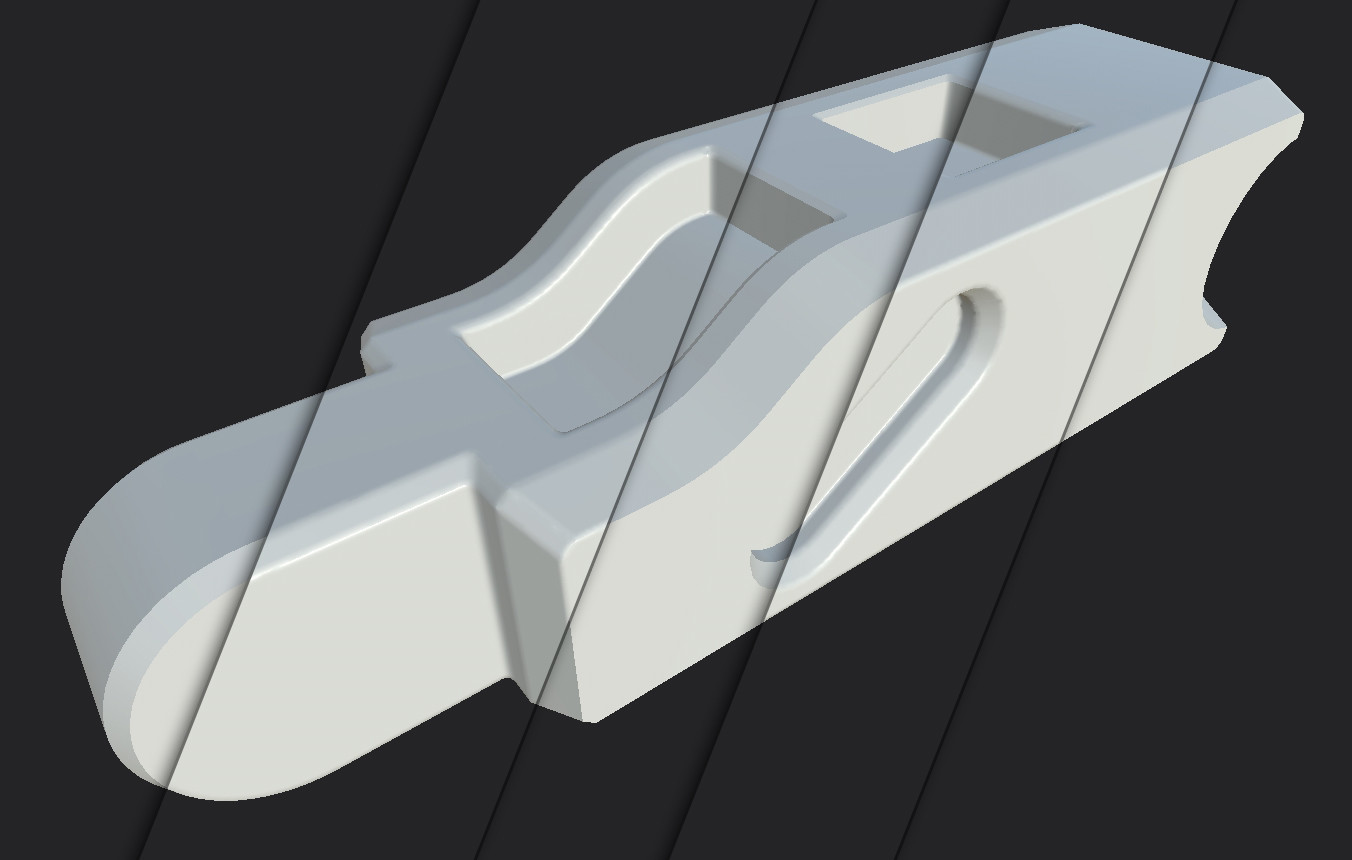 Damn I didn't expect to find a live thread about that feature! Back in Photoshop times we had Maya to photoshop chamfer creator based on masks and color blending. It were usible solution but with unstable results. And from that time I was playing with that kind of filter and I was so frustrated because its so obvious that…
 -
Re: Rounded corners filter in Substance Painter
 @pior This is what I wondered about in Blender, can it bake fully averaged(it's using MikkT) from a bevel node? From your last image it appears that's what you're doing. So your low is a single smoothing group(fully smooth shaded) and your 'high' is just the low with hard edges and a bevel node assigned.
 -
Re: Rounded corners filter in Substance Painter
 Hi there Simon ! Shift-A in the node editor, search for Bevel, plug that in the normal input. That's it :)
 -
Re: Rounded corners filter in Substance Painter

 Sorry digging up this old thread but I tried to recreate your model to test out the bevel node and the edges have some very visible seams. Could you post your UV layout @musashidan
 -
Re: Rounded corners filter in Substance Painter
TexTools have explode feature. And you can combine bevel node with creased hard edge + subdivision and bake that mesh to low poly. It will produce chamfers and smooth shading. Some times it's the best solution. -
Re: Rounded corners filter in Substance Painter

 Hey. I just tried the chamfer 2 node and its giving me a lot of errors. Also, back to the curvature method topic, the use average normals checkbox does nothing so I used a manually smoothed version for testing, and that one bakes curvature fine.
 -
Re: Rounded corners filter in Substance Painter
@pior Yes, I was pleasantly surprised myself at how well the bevels baked. I didn't think that the larger, more 'chunky' bevels would hold up. I'll definitely look into the vertex data setup as I've just been thinking of using multiple bevel nodes for varying bevel sizes. I have no doubt that once 2.80 is finally released… -
Re: Rounded corners filter in Substance Painter
Hey there @musashidan - that does look great ! Smooth and perfectly rounded, just the way it should be :) Note that it is also possible to control and modulate the rounding diameter within an object by multiplying the bevel value with vertex color data - therefore allowing for bevels of varying width along an edge, or even… -
Re: Rounded corners filter in Substance Painter
 While this approach is undoubtedly interesting and may have some cool applications, it also seems fairly limited as it seems to depend on *both* UVs and hard edges - meaning that the optimisation of the final asset itself will be hindered by the requirements of the effect. Now I certainly don't want to sound like an…
12 results