Search
-
Re: Anime Process + Shader Techniques
 So now that I've looked into shader forge extensively enough to (kind of) know what I'm looking at, i guess what I'm hung up on now is semantics between code and node. I know I must seem really dense here, but I can't seem to put the right node connections to achieve a basic diffuse/toon shade (i.e. telling SF what parts…
 -
Re: Anime Process + Shader Techniques
 Did you check out Unity Chan toon shader 2.0? it's a pretty great shader implementation for Anime style, and you can see the full source code. (it was created using shader forge, with a bit of manual coding)
 -
Re: Anime Process + Shader Techniques
Yes, but I *was* actually coding my shader manually when I posted that, but I've since switched to learning shaderforge (because why not?). Even so, I was looking into a potential new way to make outlines than the standard 'upscaled-reversed-normals' approach used by most (including shaderforge) as I've got an idea… -
Re: Anime Process + Shader Techniques

 Your questions are hard to answer because you are not clearly stating what your current skillset is (or isn't). You mention being "still very new to shader design". Does that mean that you know already know how to write/develop rudimentary shader code for your target environment, and you are simply looking for help as to…
 -
Anime Process + Shader Techniques
 Been doing lots of studying lately on making shaders and have decided to go the route of making an anime shader for Unity in the style of both 2D anime (in order to achieve a particular look) and also a shader in the style of Zelda Botw (in order to learn how to do fancy lighting stuff with ramp shaders.) Here's 2…
 -
Re: Anime Process + Shader Techniques
 Sorry, I didn't realize -- yes, exactly that -- I know enough that I can make rudimentary shader code, I'm just looking for operations/math/advice/direction/etc that might help me to achieve something like the above images/examples, especially with the constraints I've mentioned (performant enough for many onscreen chars…
 -
Re: Anime Process + Shader Techniques

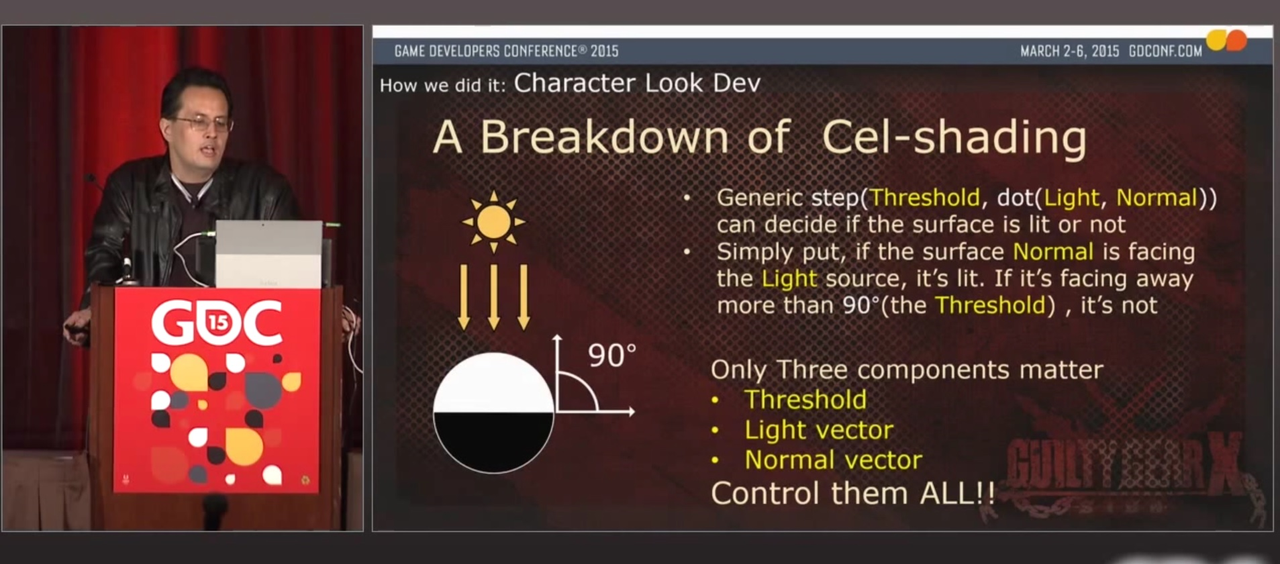 It doesn't look like you're using the step function in your shader, and it's absolutely necessary to make the sharp shadowing. They mention it in the GDC presentation on this slide: So you take the dot product (also called "scalar" product) between the vertex-to-light vector (going from the vertex to the light position)…
 -
Re: Anime Process + Shader Techniques
 For reference, the Guilty Gear Xrd GDC presentation is this: https://www.youtube.com/watch?v=yhGjCzxJV3E They mention a few things in there, maybe this helps: - They preferred to use vertex attributes (colours and normals) instead of textures to store information because it was easier to edit (instant feedback) and these…
8 results