Search
-
Re: Judgement on my tiling textures ?
 Hi NAIMA, The non-detail shot of the grass looks pretty good to me, better than any grass I've ever made (I'm not a grass expert either). The only problem I see right now is the repeating dots. I think the saturation of grass (or any texture) is really a property of light in the natural world, so if your scene is lit like…
 -
Re: Edge smothness
 It is using face weighted vertex normals. Also smoothing groups are simply Max's way of splitting vertex normals, that concept doesn't really exist in other software.
 -
Re: UE4 - Wonky results from multiplying world displacement
 You need to multiply by the "vertex normal world space" so it will go based on your vertex normals. Then you can put your "amount" multiplier after that.
 -
Re: Weird Maya smoothing angle issue
 By the way, smoothing angle doesn't affect vertex normals (and therefore shading), it just a way of setting which vertex normals are split or shared between faces.
 -
Re: UV scramble
 In Modo, it's very easy - hit Rotate UVs from the UV tools. It sets the UV coordinates for each vertex to be the UV coordinate of the next vertex of the polygon.
 -
Re: Material Blending painting issue
Nop. Byebye \( ˇ_ˇ) Thats a totally wrong vertex paint setup though. He is multiplying vertex alpha on all of his textures. That makes it "black". -
Re: Adding details what method is better?
Hi, this question has got me too. which engines use vertex lighting? also, what is vertex lighting, and does the marmoset engine use it? -
UE 3 - Shader
 Got bored, started to play with shaders in UE3 and this thing just kept on growing. Doesn't do anything that special..yet other than blending two set of textures together by using vertex color and a height map. And giving you a lot of options with just one shader. It's a scalable shader, so as you turn the switches on and…
 -
Re: How to model Low Poly Birch tree

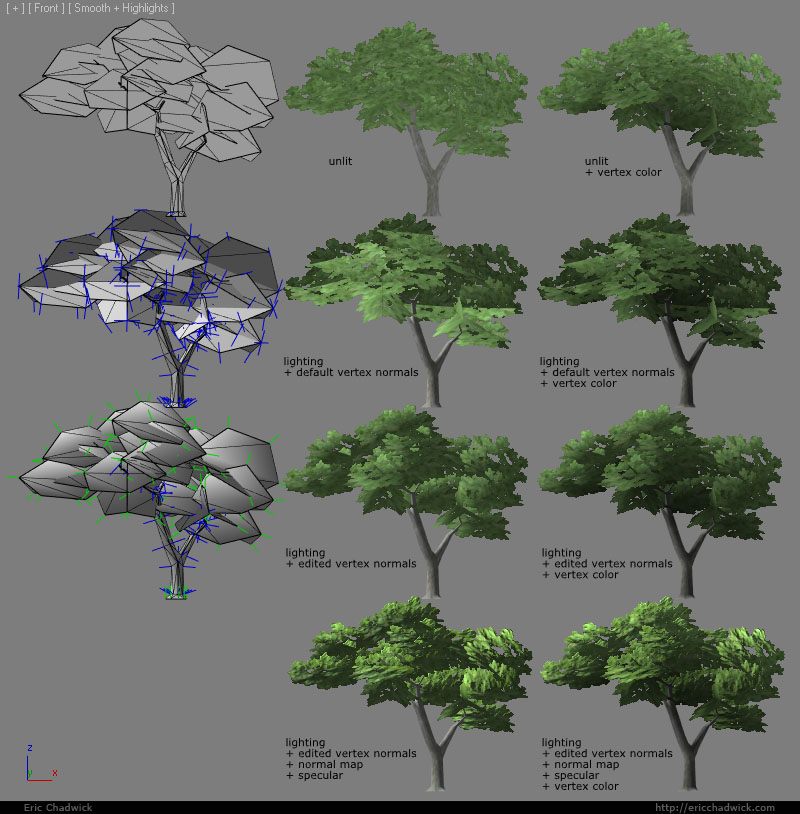 I'd recommend bent vertex normals, and some vertex color ambient occlusion. http://wiki.polycount.com/wiki/Foliage#Vertex_Normals An old example (could use better textures):
 -
Re: Compare two meshes and highlight the differences?
 how would that diff of vertex positions with tolerance work? how would know which vertex to compare to another? does this mean the 2 meshes need to have identical vertorders?
>9917 results