Search
-
Re: Quick Question on Tiling Textures and Enviro
 Cheers for the examples; I understand the second example doesn't really make sense, I was literally just pointing out how I've been told that UVs can be OUTSIDE the 1-0 space. Cheers for all the examples, but I'm guessing you can as i was told use OUTSIDE of the 0-1 space for repeating walls etc? Sorry to sound simple but…
 -
Re: Why you should NOT trust 3ds Max's viewport normal-map display!
 I can't post that example its under NDA :) The texture has changed from the OS map generated by max, but doesn't match the tangent map from maya, it's still very object-y looking. I'm not going to plough any more time into fiddling with this at the moment, I want to press on with the production work instead, confident that…
 -
Re: Feedback: Hair

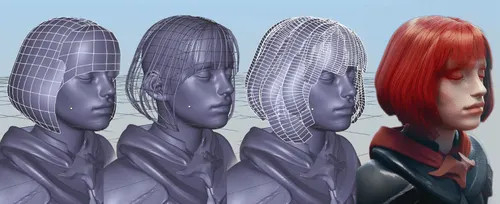 Blender Hairtool by Bartosz Styperek This is a hair plane example. Straight away you can see the difference between volume and vibrance with the example you posted above. So it depends on what you are looking for. I reckon you should look into material and lighting, but also styling.
 -
Re: Free Music / SFX Resource for Your Games - Over 1900 Tracks
Hi Everyone, Please don't forget to check out my Game Music Mega Pack...it has over 1400 tracks (looping and standard) and is growing all the time. Users receive weekly updates as I add new tracks and expand the library. Here's the link: https://soundimage.org/ogg-game-music-mega-pack/ That said, this week's brand new… -
Re: Efficient Use of Texture Sheets
Right. So the reference isn't for any one specific item. I understand the principles of efficient UV use, but the reference is more for providing a visual example to other people. Good packing is easy to find, but getting examples of reuse is what is tripping me up. People are happy to reuse textures in modular environment… -
Re: Gina (critique welcome)

 A detour or not, depending on how you look at it. I was trying to understand eye refraction. After finding some examples, attempted to recreate the effect... and it sort of looked correct. There was just that one issue I spent a good deal of forever chasing down. The whole thing distorts depending on whether you look along…
 -
Re: single or multiple objects into one uv map?
 It’s good you mentioned this specific example. Objects can be setup to share UV space specifically so they can reuse the same material. This optimizes the rendering speed, by reducing draw calls. However, anything using transparency is usually separated from things without, and uses a dedicated material. This is because…
 -
[PAID] We're looking for a really fast rigger to consult with us on our rigging pipeline [FILLED]
Hi all, I’m an Art Department Director at a game studio, and we’re specifically looking for a very fast character rigger to help us evaluate and improve our rigging pipeline. Speed is the primary focus here. We’re looking for someone who can turn around solid, game-ready rigs quickly and consistently. Phase 1 (Paid Test… -
Re: The Bi-Monthly Environment Art Challenge | March - April (101)
Nice blockout! I would suggest choosing your rendering system first, then set up the ground shader to work within it. For example, in Unity I would use a layered shader, and paint a mask where the water would be on the concrete. And add some clumps of dirt as geometry. -
Re: Material Studies?

 you can try learning by rough and smooth surfaces (glossy). This is base for classify a lot of materials, but of course, there are few exceptions like rubber materials, that can be smoothness but not necessarily have to emit or reflect the light like some glossy materials, cuz rubber materials absorve too much the light.…
>27398 results