Ground and buildings pipeline/workflow/approaches

I was surprised not to find a separate section dedicated to game development, so I'm asking here. While I learned a lot about making game assets recently, there are two topics that absolute mystery to me.
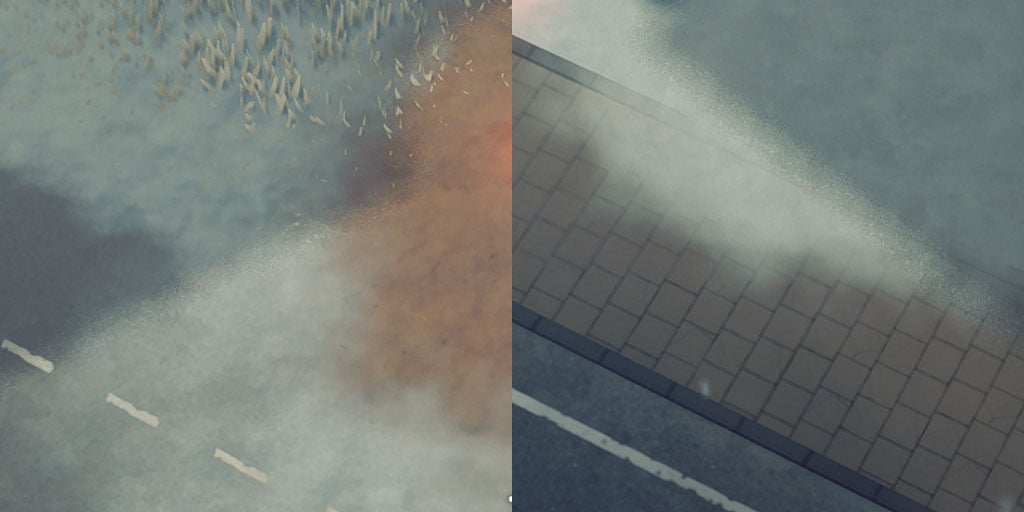
The first one is how to make a ground for a game. Imagine having a road, a sidewalk, a gravel/dirt whatever. E.g. here is from Escape from Duckov:
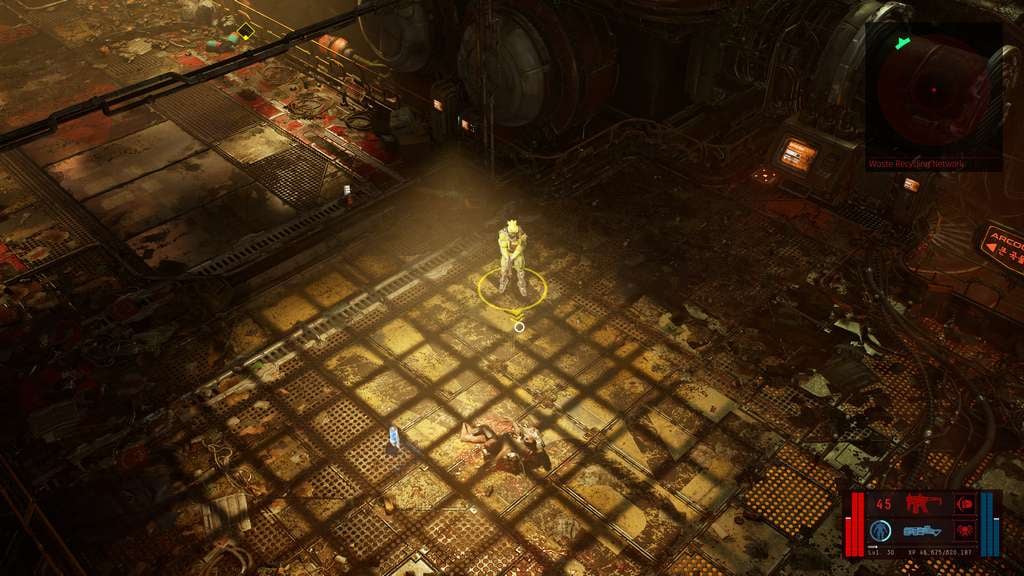
Or The Ascent:
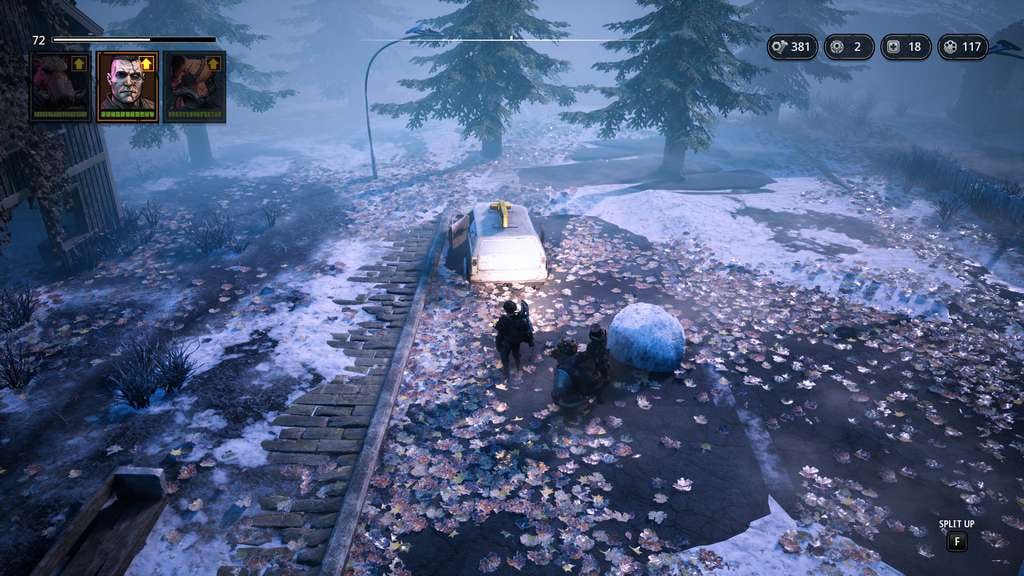
Or Mutant Year Zero:
Should I use tile approach and create fixed size tiles for every surface as well as transitioning types, create a large non-square areas filled with tileable texture, or something else?
And the second question about architecture. I want to make buildings with navigable interior for the game. I can do the following:
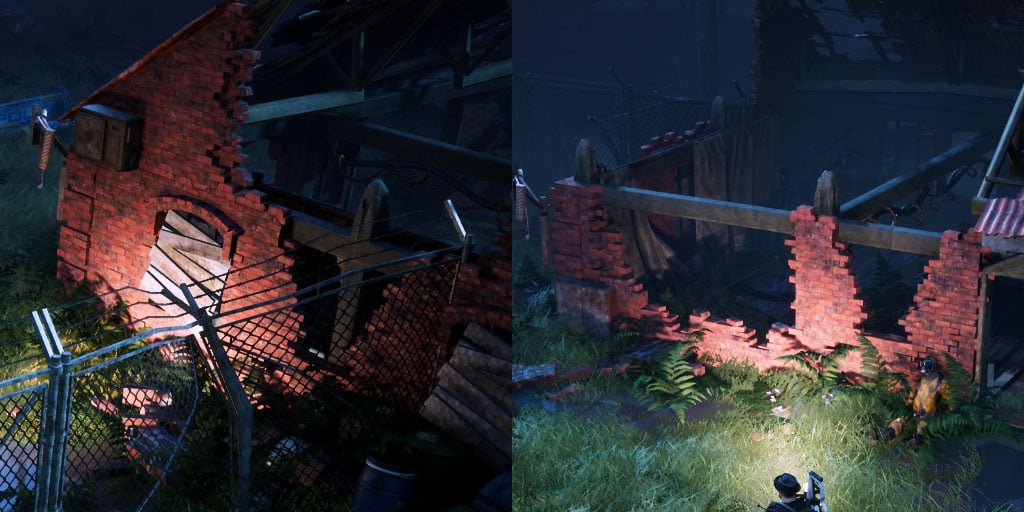
This example less relevant to my case since I'm planning to have intact buildings (the world is just abandoned), thus this approach might be less efficient. In the other hand, I could use these bricks as debris as well as building blocks. And not paint another building which has the same material.
Any ideas?
The first one is how to make a ground for a game. Imagine having a road, a sidewalk, a gravel/dirt whatever. E.g. here is from Escape from Duckov:
Or The Ascent:
Or Mutant Year Zero:
Should I use tile approach and create fixed size tiles for every surface as well as transitioning types, create a large non-square areas filled with tileable texture, or something else?
And the second question about architecture. I want to make buildings with navigable interior for the game. I can do the following:
- Either create a unique mesh completely in Blender and paint it in the Substance and then make an asset in Unity
- Or create smaller blocks (like bricks or wall tiles) and build a prefab inside the Unity
- Or there is another approach? (As usual, a combination of the both)
This example less relevant to my case since I'm planning to have intact buildings (the world is just abandoned), thus this approach might be less efficient. In the other hand, I could use these bricks as debris as well as building blocks. And not paint another building which has the same material.
Any ideas?
Replies
The problem with these sort of questions is that the answer depends on what you're making and what your engine and toolchain can cope with.
and
on top of that - the answer will often be "all of the above"
Your best bet on the terrain / road stuff is to explain what you're trying to achieve (ideally with some concept art or reference photos) and which engine you want to do it. People will have many ideas and you'll learn terms to search for.
Your suggested approach could be the best solution in some situations while also being the worst possible solution in others - we need more context.
as far as the building goes..
One way to think about this is to consider your range of view distances.
2m - 200m - you're probably best off using modular pieces cos you get more flexibility and you don't need to worry about what happens at a distance
2m - 5000m - you're probably best off making buildings as one model so you can lod them properly and get less entities overall.
I'd prefer the approach that saves me a lot of time (since I'm making it alone) yet providing a good optimisation on resource loading since I don't see that polycount/VRAM is an issue.
Eg. If you need paving to follow the shape of your street it's a different problem to not needing that.
I need all the stuff: usual crossroads with pavements and crosswalks, T-junctions with gravel road, parking lots, and even ramps and elevated roadways, and also a railways with railway crossings. And, of course, with road markings, cracks and potholes. Just like in real life.
Or imagine a poor man's (i mean VERY poor) Cyberpunk 2077 (also a ref to some extent) with top-down fixed camera. :-)
My first thought was to create a modular roads but it solves only half of the problems, my primary concern is a smooth transition between different surfaces and surface details like mud, puddles and fallen leaves. The idea is to generate procedurally as much as possible to get the unique look for every player/new game (and may be for every raid). I.e. how do I connect modular road to the surrounding grass so it could look natural? Or how do I make areas that don't obviously rectangle shaped (see Escape from Duckov)?
You can vertex paint, use heightmaps, normals, or even have a dedicated world mask texture that you paint in engine.
I've seen a version of the latter, where they baked onto such a mask texture using the geometry of the world as input.
I can't find the video, but they basically in engine baked AO from trees onto ground and used that as a mask to blend in a "fallen leaves" texture.
These are just ideas. Googling the software you use and the problem you're trying to solve always grants quick insight.
If blender:
https://www.youtube.com/shorts/noInRltAsXo
https://www.youtube.com/shorts/M-NJLtwAINg
World aligned textures (Show texture if normal is pointing in Direction_a = TRUE):
Any method you choose can be filtered or altered by any other methods, and the one you end up with will generally be unique to solve a single type of problem, like:
Where should grass grow?
Do a big thinkywink about where you'd logically want grass to end up: (not in the ocean, not on walls, not indoors, not on mountain sides so steep that there's no soil, not on top of mount everest, not on the moon)
Separate them and importance weigh them, and roughly plan out how you might wanna achieve that.
I'm trying to be vague here because there's almost an infinite amount of unique ways to decide where do grass ends up.
The best answer is: Go look. Youtube is a great resource for learning.
Not entirely related, but not entirely unrelated, when texturing, we use all kinds of texture types as input data to decide where different textures go.
Way before there was anything like Substance Painter, I was doing that kinda noise in Photoshop, semi-manually.
My first attempt looked like this:
My (bad) scrapes were supposed to end up where convexity was max. Where concavity was max, I wanted rust or dirt.
If you pay attention to where my scrapes ended up, you'll be able to find a couple where I mixed up convexity with concavity
You start by asking an AI how, so you can avoid interacting with other people.
Then you ask an AI to choose which applications and engine you should use. The less you know about software alternatives, the better.
Then you ask an AI which buttons you should press so you don't have to learn the software.
Fuck these buttons, am i rite? Do not waste time reading the fucking manual. Instead ask an AI to write scripts and/or macros to do that for you. NO, DO NOT RECORD A MACRO YOURSELF WHAT THE HELL ARE YOU DOI
There's probably an AI that can generate all the models for you. IDK what AI that would be, but you could ask ChatGPT.
For engine implementation, have an AI vibe code it, so you can avoid learning that part as well.
Auuh ooggghhh, the result is shit, huh? You have no idea what to do...
Ooooh, ask an AI which AI can solve this for you.
Nothing? shit. Uhhh, ask someone on a forum which AI they use that's better than your AI at finding out why your other AI model sucks.
Maybe have an AI write a bot or a new AI that can fix all of the problems?
I'm out of ideas, and god willing, your result will be perfect.
Post your result on a forum, bragging how easy it was.