Interior Environment with Hero Assets WIP Log: 1960s Apartment Crime Scene

polycounter lvl 5
For my first full environment portfolio project, I am working on a homicide crime scene in a rundown apartment in 1960s New York, aiming to push realism inside a playable, but believable space that could (hypothetically) be in a game with an investigation element.
My hero assets are a period-appropriate CSI camera, murder weapon (large pipe wrench,) and the victim (covered by a cloth.) At the moment, I am finalizing my establishing shot, the pacing within my greybox/blockout, and the base lighting.
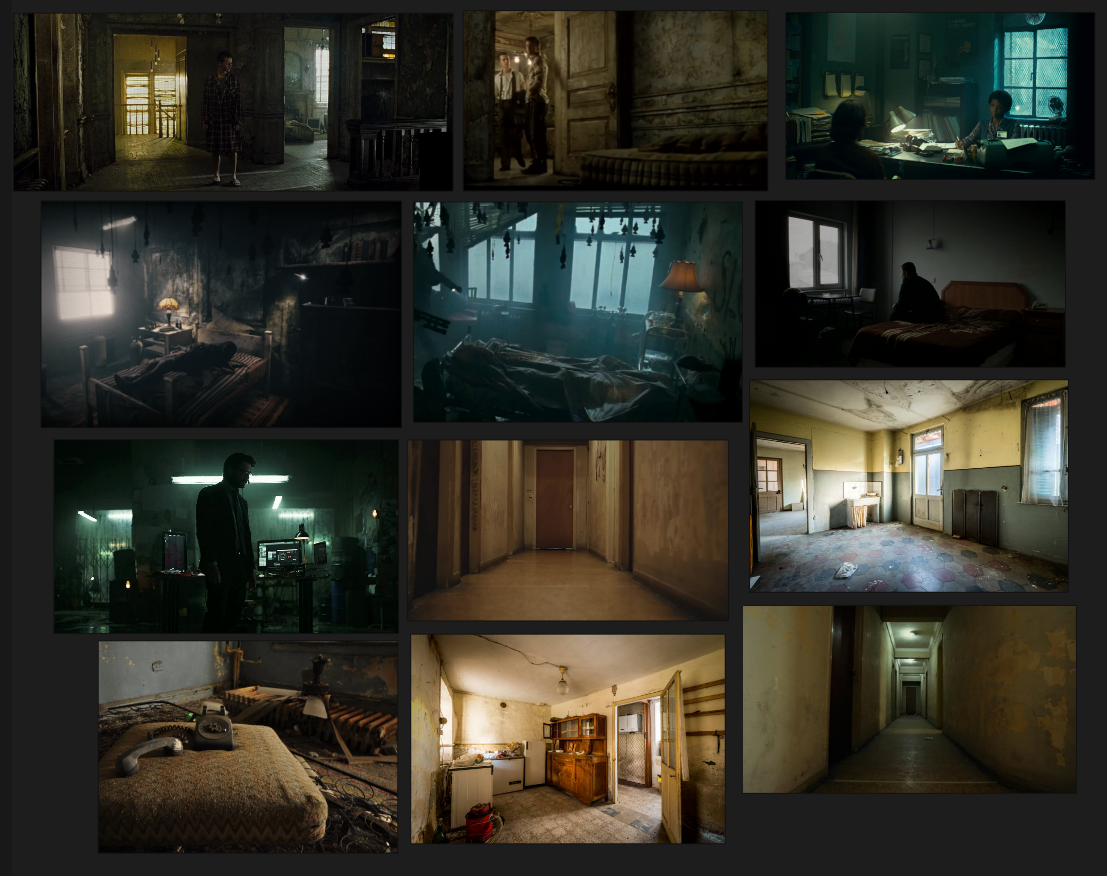
Below are some examples of inspirations of the space from my larger mood-board (which consists of shots from neo noir films and photo references of abandoned/derelict spaces of the era.)
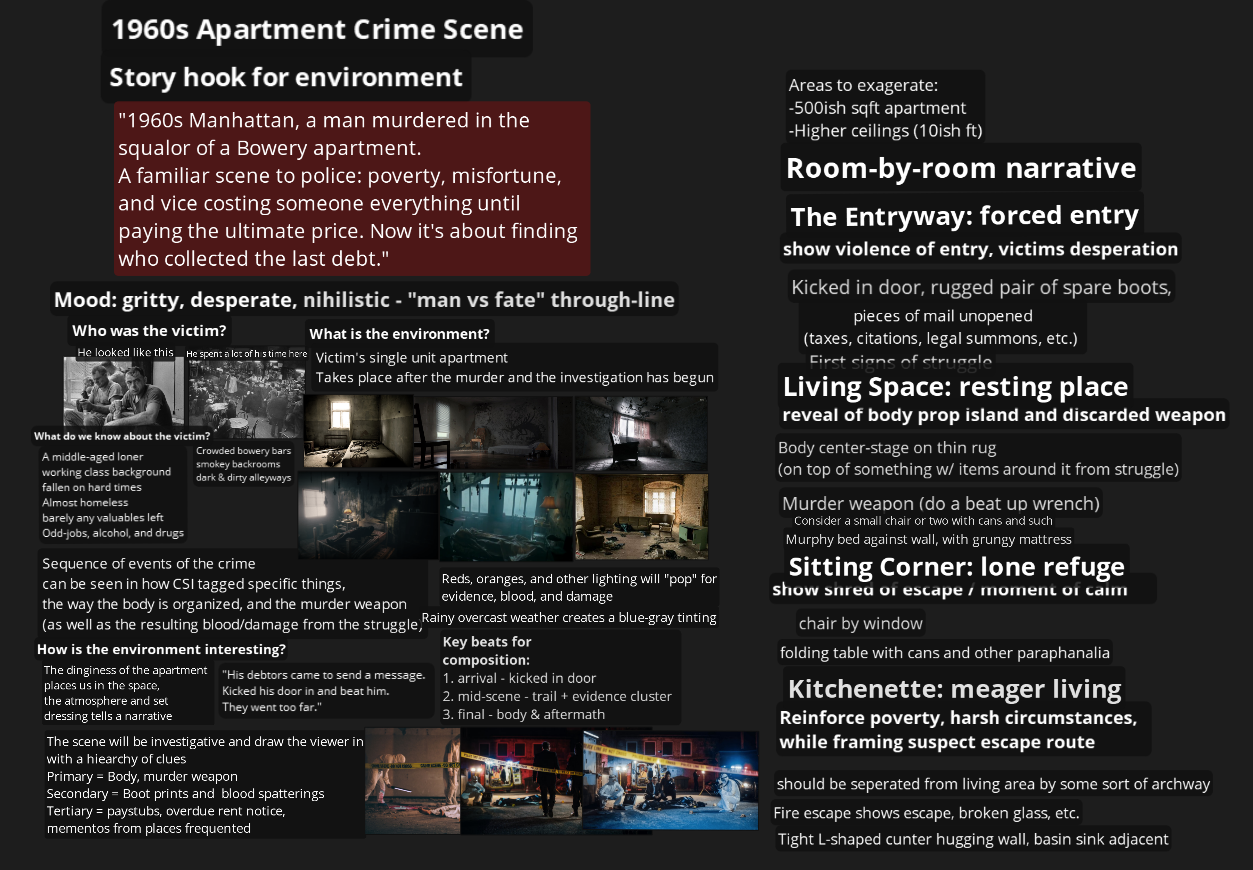
From the inspiration, I fleshed out a Narrative Guidance that I can refer to as the environment develops:
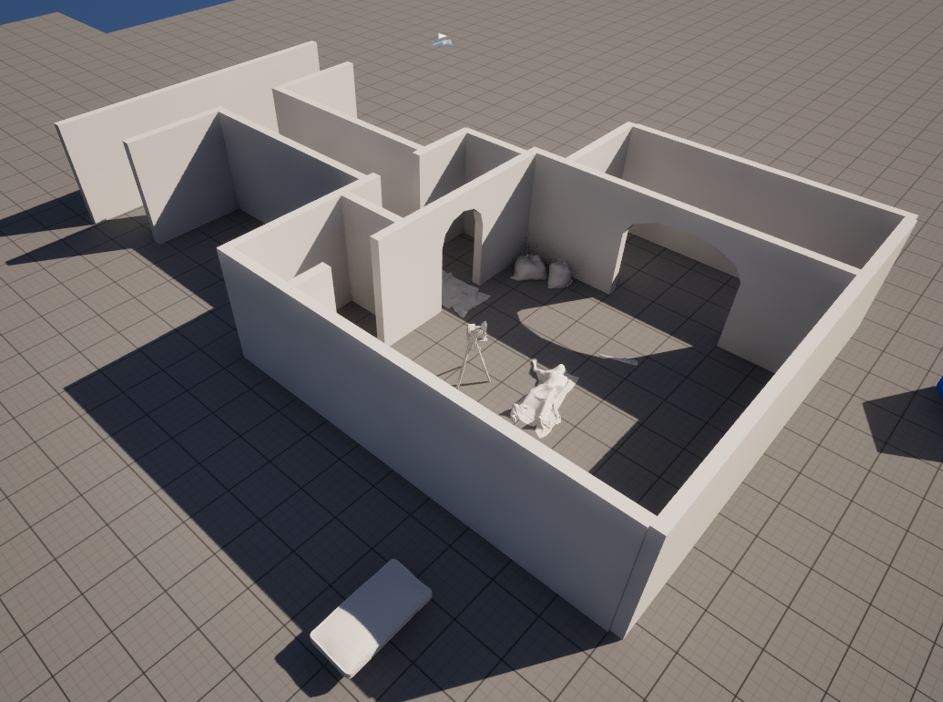
This was my initial blockout (using simple shapes and model placeholders) that I started with in UE to feel out the space/dimensions:
Then I moved to setting up the bases of an architecture kit in Blender (one for the unit, one for the halls) - along with more placeholder props (I attempted this project a couple years ago and have some meshes from then that work perfectly as placeholders.) I also put in some very basic lights.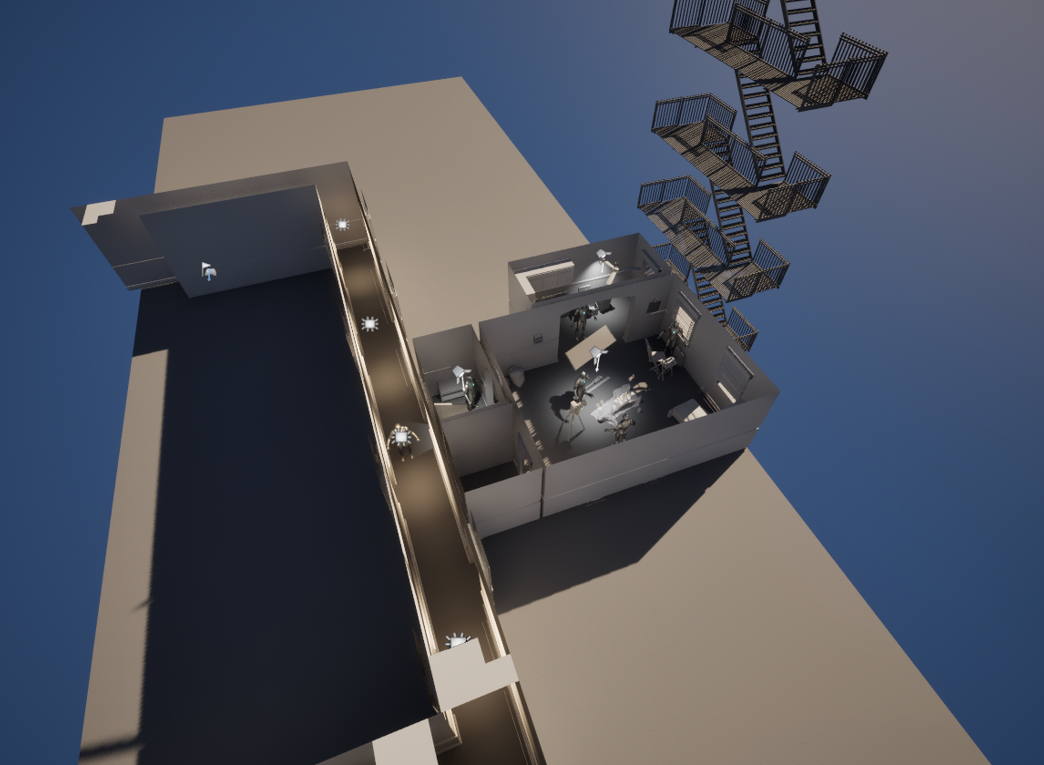
Over the past month, I've done more detailed kitting (vents, pipes, cabinets, fixtures, etc.) base lighting, and further defining of the architecture kit along with starting in on the environment settings (fog volume, indirect lighting from the sky, etc.) to further flesh out the greybox / feel of the space.
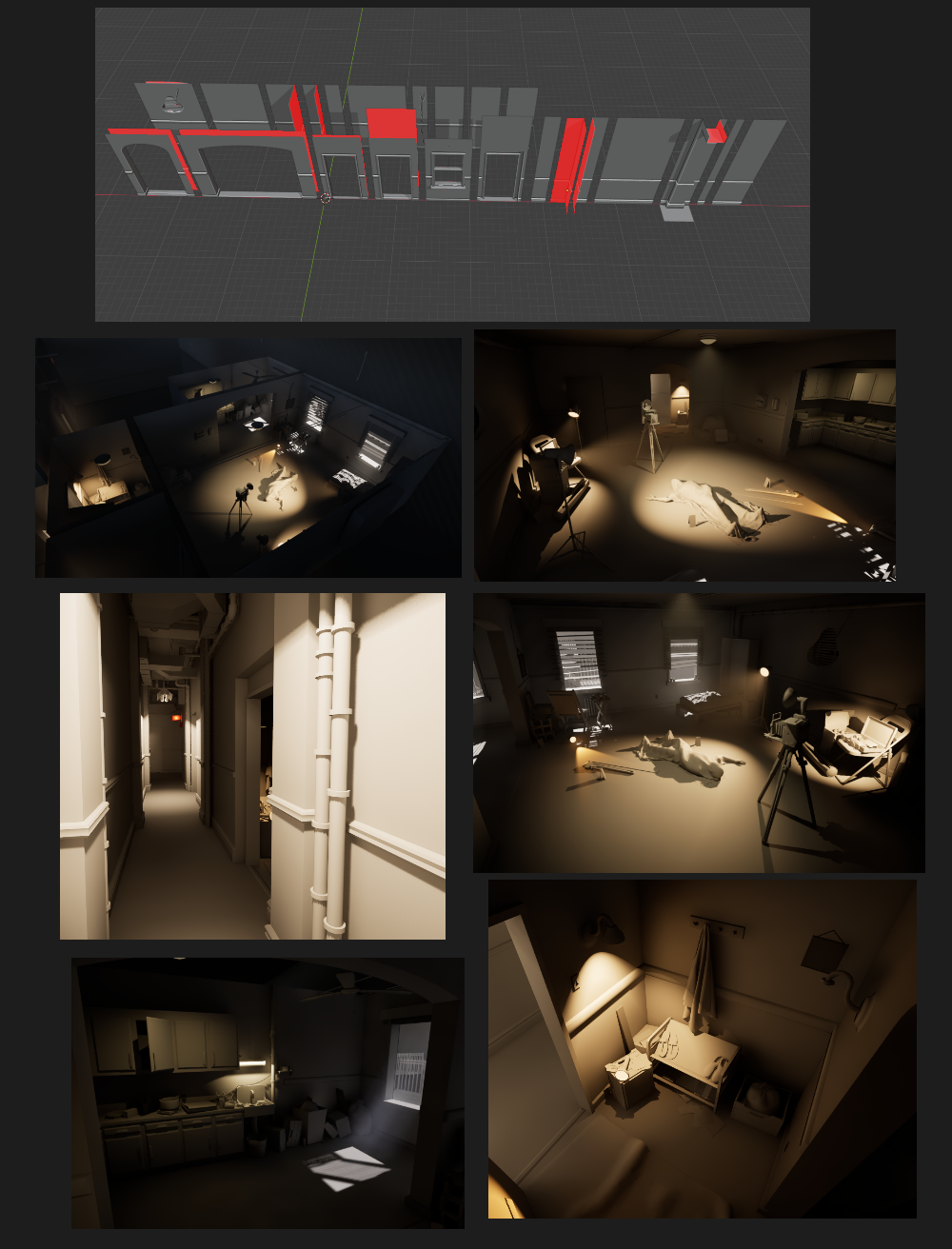
This past week, I focused on exploring the establishing and supporting renders along with general tweaks to the greybox/lighting etc.
Establishing shot:
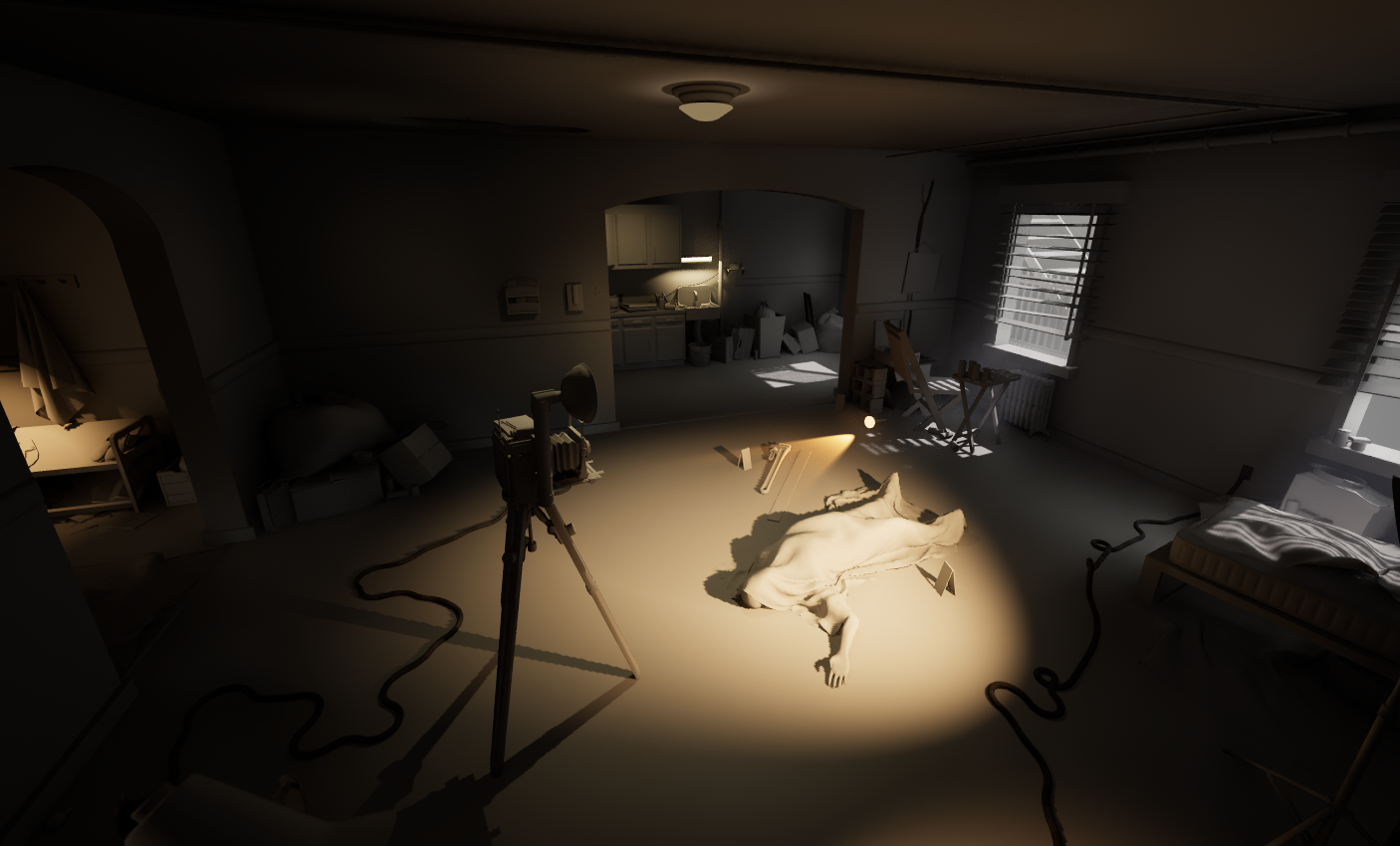
Supporting "Investigative" shot:
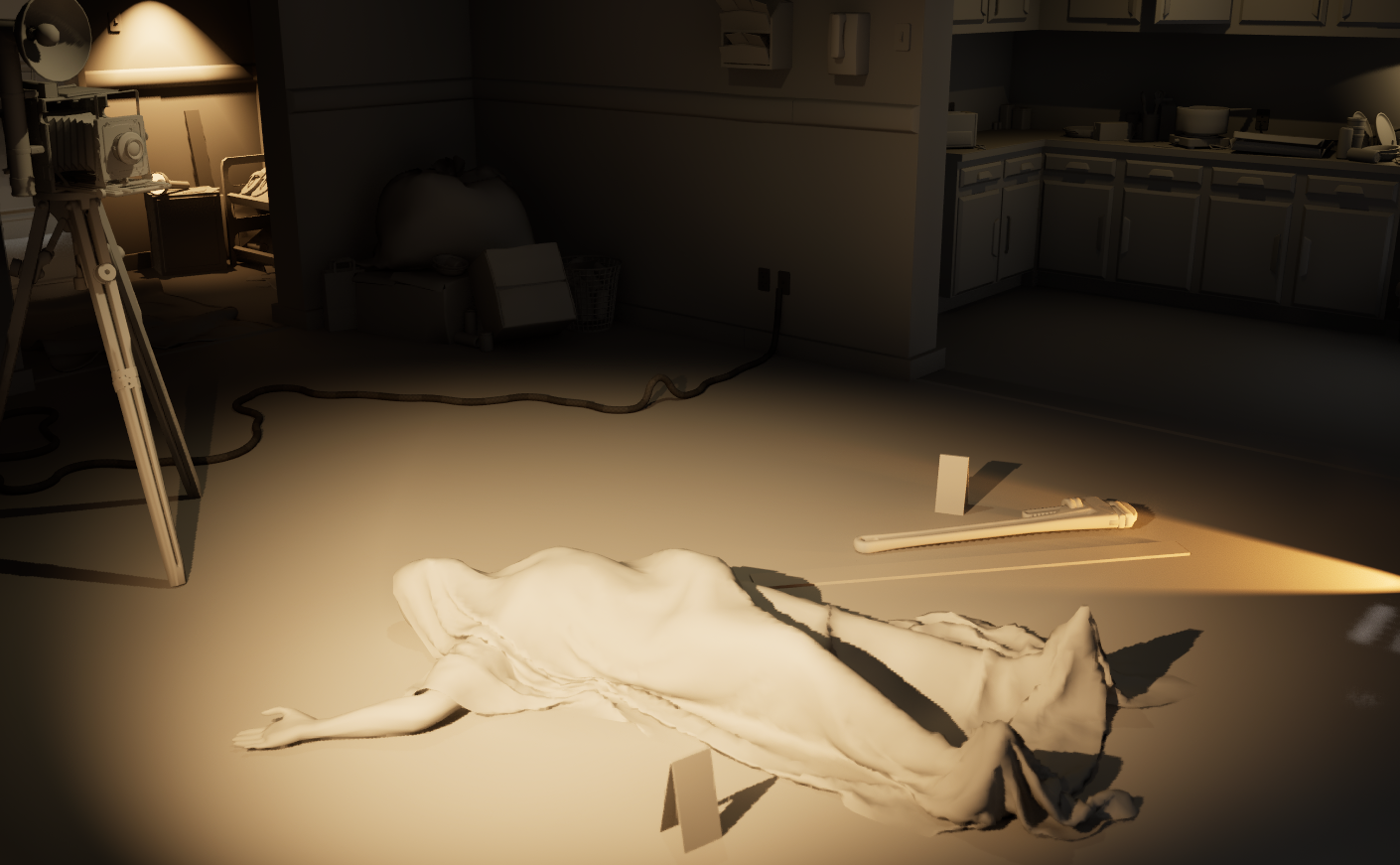
Does this approach to lighting and the shots I am trying to lock in evoke that contrast of desperation/grunge alongside a crime scene investigation effectively?
Next week will be starting the modeling of the heroes (starting with the murder weapon) while also fitting in some more lighting tweaks / trial and error with finding the right shots I want to stick with throughout the project.
My hero assets are a period-appropriate CSI camera, murder weapon (large pipe wrench,) and the victim (covered by a cloth.) At the moment, I am finalizing my establishing shot, the pacing within my greybox/blockout, and the base lighting.
Below are some examples of inspirations of the space from my larger mood-board (which consists of shots from neo noir films and photo references of abandoned/derelict spaces of the era.)
From the inspiration, I fleshed out a Narrative Guidance that I can refer to as the environment develops:
This was my initial blockout (using simple shapes and model placeholders) that I started with in UE to feel out the space/dimensions:
Then I moved to setting up the bases of an architecture kit in Blender (one for the unit, one for the halls) - along with more placeholder props (I attempted this project a couple years ago and have some meshes from then that work perfectly as placeholders.) I also put in some very basic lights.
Over the past month, I've done more detailed kitting (vents, pipes, cabinets, fixtures, etc.) base lighting, and further defining of the architecture kit along with starting in on the environment settings (fog volume, indirect lighting from the sky, etc.) to further flesh out the greybox / feel of the space.
This past week, I focused on exploring the establishing and supporting renders along with general tweaks to the greybox/lighting etc.
Establishing shot:
Supporting "Investigative" shot:
Does this approach to lighting and the shots I am trying to lock in evoke that contrast of desperation/grunge alongside a crime scene investigation effectively?
Next week will be starting the modeling of the heroes (starting with the murder weapon) while also fitting in some more lighting tweaks / trial and error with finding the right shots I want to stick with throughout the project.
Replies
You're spot on regarding the camera hero; my original research for this project led me to the Graflex Speed Camera (with many of my references below being from 1960s models/videos of fixing up ones from that time period.) Your note on long exposure, angle, and it being favored by law enforcement echoes to a t what I found and why I went with it for this project.
The model right now is my low poly from my original attempt - I will actually be running it back through using Plasticity as a way to show off the efficiency gains (a sort of "with purely blender poly/sub-d modeling, it took x hours, but redoing in Plasticity took y.)
Absolutely no need to apologize, I love diving into this stuff!
Establishing Shot
Supporting Shot "Investigation"
Supporting Shot "Kneeling Down"
Supporting Shot "Escape Route"
I also started the modeling of the murder weapon hero in Plasticity, running a few test bakes through:
Any feedback on finding the right establishing shot & base lighting for an environment like this would be very appreciated!
Edit: added newest renders with slight changes
I didn't think of that; so with keeping the same camera position (kitchen/escape route in background, windows with rays to the right)
Very nice this has a solid and clear story beat, and the scene has a
great foundation. As you continue refining it, consider pushing the secondary
storytelling details further. Adding personal items—such as photos, handwritten
notes, or scattered everyday tools—could hint at who lived here and deepen the
narrative. These subtle touches will help anchor the scene in a lived-in
reality.
this has a solid and clear story beat, and the scene has a
great foundation. As you continue refining it, consider pushing the secondary
storytelling details further. Adding personal items—such as photos, handwritten
notes, or scattered everyday tools—could hint at who lived here and deepen the
narrative. These subtle touches will help anchor the scene in a lived-in
reality.
When you move into texturing, think about introducing signs of struggle if it fits your narrative direction. A knocked-over chair, a spilled mug, disturbed papers, or dragged objects can suggest past action without being explicit. Environmental clues like bloody footprints, cryptic markings, or damaged surfaces can support a mystery or puzzle-based gameplay loop.
Lighting-wise, the scene is already atmospheric, but there’s room to heighten the drama. Adding subtle bounce light and rim light around the body can help separate it from the floor and guide the player’s eye. You might also try pushing the kitchen area deeper into darkness, increasing contrast and focusing attention on the foreground.
Compositionally, keep refining object placement. The wrench is a good prop, but since it aligns closely with the lower frame, rotating or offsetting it could avoid tangents. Introducing a few more mid-height objects (shelves, small furniture, hanging items) would also help balance the composition vertically, since most elements currently sit either very low or very high.
Overall, you’ve built a compelling starting point—strong mood, solid staging, and clear narrative potential. Excited to see where you take it next!
P.S. One of your fellow Alumni @scotthomer did a simular project, I thought you might want a look, might give you some ideas on texturing and materials. You used to be able to download this Robo Recal project, not sure if its still avaliable. Maybe Scott might come back on here and give you some tips, he did a cool little boat house for this project
https://www.artstation.com/artwork/3Q1QA
Taking it piecemeal, some of your feedback hits right on areas I had planned out + gives me a lot of stellar ideas and I wanted to call them out & show where my mind is at:
- "lived-in" details: I have a sitting area where the victim spent most his time in the corner (with a foldable table with papers/bills, medications, etc. to his right, and a record player/makeshift table and records to his left) by the window and a bed with effects littered around it / on a makeshift side table + the entryway has piles of unopened mail in and around the shoerack
- Suggesting action / struggle: I think I have that planned out in the story-beats I've been trying to adhere to (hallway -> entryway -> living room where victim is -> sitting area -> kitchen/escape route) which in turn lines up with the incident that transpired before the player/viewer saw this... I plan on showing a kicked in entry door with the boot print, damage to the entryway wall + scuff marks as well as some initial blood spatter alongside personal items the victim was holding strewn (ex. spilled coffee mug, dropped letter or shattered eyeglasses) with this coreographing all the way to the victim where the blood spatter + pooling would be heaviest (with the csi cloth dampened by the body underneath)
- A puzzle/investigation loop: still trying to find the right placement of the wrench / body, a bloody boot print or two (especially showcasing their movement to the kitchen for escape) as well as damage to the surrounding walls or "push in" / "knocked over" props where shoving happened
- Lighting to lean into the drama/narrative further: I definitely have further light passes in mind and your call outs of adding bounce/rim lighting around the body is an amazing idea (was thinking this with the wrench, but I think now something like bounce/rim lighting and then a feint subsurface scattering effect on the victim per the tarp...)
- Lighting in the kitchen should be deeper darker: yes, 100% love this, and then the green/off kilter light over the sink + light from the window/escape route will act as a way to lead the eyes/player)
- Composition/Layout: absolutely going to play with rotation/movement of the heros and critical dressing props (i.e. flood lights, csi kit, etc.)
I think this top down shot might help visualize the flow of the environment (I've done one of these every time I make a major change to the planning/grey box, to be sure the narrative beats & flow makes sense)To that point, here is the establishing shot I've felt the best about "empty."
I spoke to Belisarius Cawl the Adeptus Mechanicus Tech-priest today and he said!
"By the Omnissiah’s sacred gears and the holy rites of the Machine Spirit, I consecrate this message to @jbeck3d. May your cogitators hum with flawless precision, your circuits burn with righteous efficiency, and your data remain inviolate against the ceaseless tides of corruption. Step forth into the digital void with unyielding resolve, and let no error or lag halt your purpose. Godspeed, jbeck3d, for the Machine God watches over your every computation, and victory shall be forged in the purity of your code!"